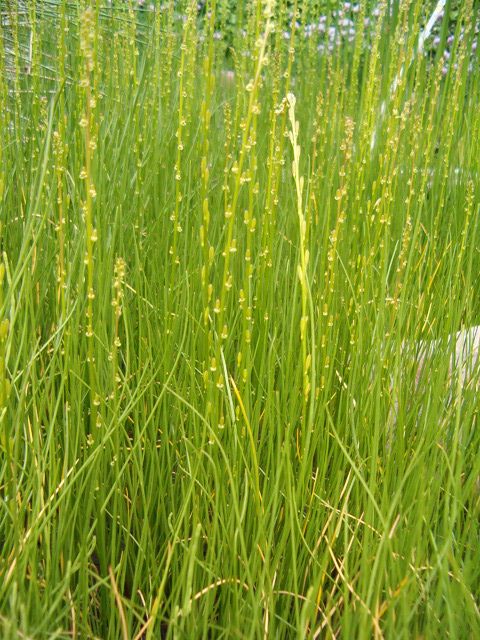
Triglochin, commonly known as arrowgrass, is a genus of about 25 species of marsh herbs in the family Juncaginaceae (order Alismatales), first described by Carl Linnaeus in 1753. Despite the common name, arrowgrasses are not true grasses — they are monocotyledonous aquatic and wetland plants with a distinctive growth form and floral architecture that set them apart from the grass family Poaceae.
Plants in this genus produce flat or cylindrical leaves and bear their small flowers in elongated spikes or racemes. Each flower carries two bracts and three to six herbaceous, deciduous perianth segments; three to six stamens are attached at the base of these segments and shed together with them. The gynoecium consists of three to six carpels, each with a single-chambered ovary containing one ovule; styles are short, sometimes fused at the base, and the stigmas are often sessile and plumose. Fruits are small curved follicles or achenes — dry, one-seeded structures with a loose coat — that detach from a persistent three-winged central axis at maturity.
The genus has a nearly cosmopolitan range, occurring on every continent except Antarctica. North America hosts four accepted species, two of which — Triglochin palustris (marsh arrowgrass) and Triglochin maritima (sea arrowgrass) — also occur in Europe. Australia is a centre of diversity with many more species. Triglochin palustris is perhaps the best-known member, a characteristic plant of fens, marshes, and wet grasslands across the Northern Hemisphere.
Arrowgrasses serve as food plants for the larvae of certain Lepidoptera, including the grey chi moth. The genus has historically been broader: a number of species once placed in Triglochin have since been transferred to related genera including Cycnogeton, Tetroncium, and Bulbine as molecular studies have clarified relationships within Juncaginaceae.
Etymology
The name Triglochin is derived from Greek — tri- ("three") and glōchis ("point" or "barb") — a reference to the three-pointed or three-winged persistent axis of the fruit. The widely used English common name "arrowgrass" reflects the arrow-like appearance of the plant, though the genus is not related to true grasses.
Distribution
Triglochin is nearly cosmopolitan, absent only from Antarctica. North America supports four accepted species, two of which — T. palustris and T. maritima — also range into Europe. Australia has the greatest species richness within the genus. Species typically grow in wetland and coastal habitats including fens, marshes, salt marshes, and wet grasslands.
Ecology
Arrowgrasses occupy wetland and waterlogged habitats ranging from freshwater fens and marshes to salt marshes and coastal mudflats. They serve as larval food plants for certain Lepidoptera, including the grey chi moth (Antitype chi), linking them to broader invertebrate food webs in wetland ecosystems.
Taxonomy Notes
Several species historically assigned to Triglochin have been transferred to closely related genera as phylogenetic understanding of Juncaginaceae has improved. Former members now placed in Cycnogeton include the Australian T. procera (now Cycnogeton procerum, commonly called water ribbons) and several other Australasian taxa. Triglochin magellanica and T. reflexa are now placed in Tetroncium, and Triglochin racemosa has been moved to Bulbine. Maundia triglochinoides (formerly T. maundii) now stands in its own genus.

