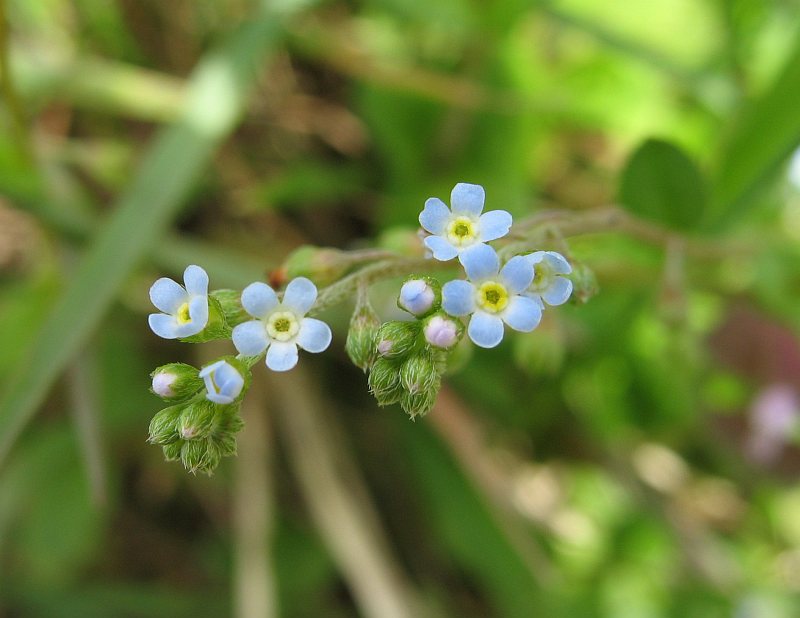
Trigonotis is a genus of flowering plants in the family Boraginaceae (order Boraginales), comprising approximately 58–70 accepted species. The genus ranges from southern European Russia across Asia to New Guinea, with its greatest diversity in China, where about 39 species occur, of which 34 are endemic.
Plants in this genus are herbs, typically perennial or biennial, and rarely annual. Stems may be solitary or form tufted clumps (cespitose), growing erect to diffuse, and are usually hispid or pilose, though occasionally glabrous. The inflorescences are cymes, either solitary or dichotomously branched, and may be ebracteate or have bracteate lower pedicels. The calyx is 5-lobed or 5-parted and is usually not enlarged in fruit. The corolla is most often blue, or sometimes white, with a tube that is generally shorter than the calyx; the throat bears 4 characteristic lunate or trapeziform appendages, and the 5 lobes are spreading and overlapping. Stamens are included within the corolla tube; the ovary is 4-parted and the gynobase is flat.
The nutlets — 4 per flower — are a key diagnostic feature: they are either semiglobose-tetrahedral or subulate trigonous-tetrahedral in shape, typically shiny and glabrous or pubescent, and it is these distinctively angled nutlets that give the genus its name, derived from the Greek roots tri- (three) and gonia (angle).
Trigonotis was formally described by Christian von Steven in 1851 and is closely related to the forget-me-nots (Myosotis), which it resembles in flower form. The genus shares the characteristic small blue flowers with five petals and throat appendages that typify many members of the borage family.
Etymology
The genus name Trigonotis derives from the Greek tri- (three) and gonia (angle or corner), referring to the distinctively three-angled (trigonous-tetrahedral) nutlets that are a key diagnostic character of the genus. The Chinese common name 附地菜属 (fu di cai shu) translates roughly as "ground-adhering vegetable genus," reflecting the low, spreading growth habit of many species.
Distribution
Trigonotis is distributed from southern European Russia across temperate and subtropical Asia to New Guinea, with its center of diversity in China. According to the Flora of China, approximately 39 of the roughly 58 accepted species occur in China, and 34 of those are endemic. The genus also extends into Japan, the Indian subcontinent, Southeast Asia, and reaches as far as New Guinea and Australia.

