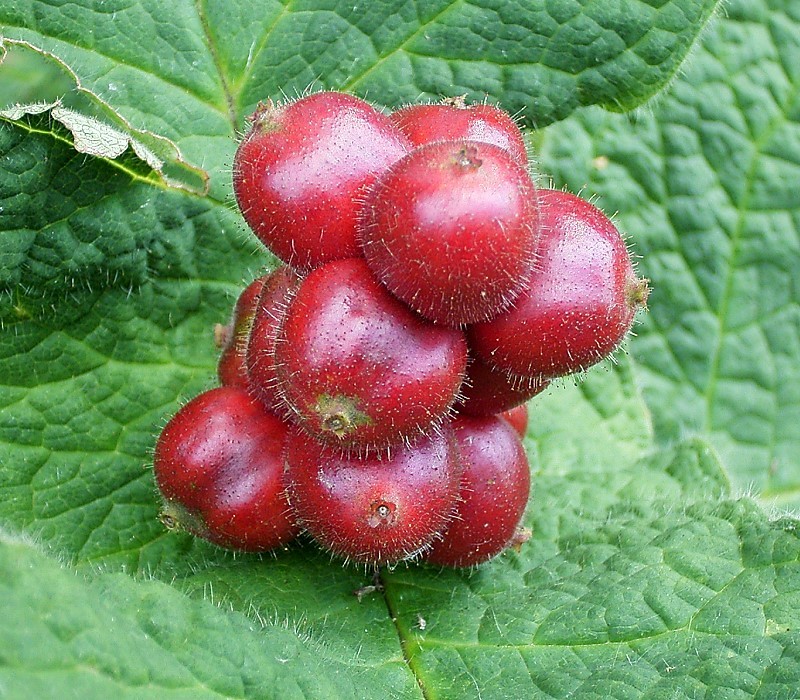
Triosteum is a small genus of six species of perennial herbaceous plants in the family Caprifoliaceae (order Dipsacales), closely related to the honeysuckles (Lonicera). Commonly known in North America as horse-gentian or feverwort, the genus has a disjunct distribution spanning eastern North America and eastern Asia.
Plants are typically found in rich, shaded woodlands. Each plant produces at least one erect, round, hairy, hollow stem reaching 1 to 4 feet (0.3–1.2 m) in height. The leaves are opposite and ovate-lanceolate. Flowers are small, whitish to purplish, and are borne either in axillary whorls or terminal racemes — generally less showy than those of related honeysuckles. The fruit is a drupe that may be white, yellow, orange, or red depending on the species, and is the most ornamentally notable feature.
The genus contains three species native to eastern North America — T. angustifolium (yellowfruit horse-gentian), T. aurantiacum (orangefruit horse-gentian), and T. perfoliatum (feverwort) — and three native to eastern Asia: T. himalayanum from China, Bhutan, Nepal, and India; T. pinnatifidum from China and Japan; and T. sinuatum from east Asia.
Etymology
The common English names horse-gentian and feverwort refer to North American species; the genus was also known historically by the folk name "Tinker's root" after a Dr. Tinker who promoted its medicinal use. In Standard Chinese the genus is called 莛子藨属 (ting zi biao shu).
Distribution
Triosteum has a disjunct distribution between eastern North America and eastern Asia. Three species — T. angustifolium, T. aurantiacum, and T. perfoliatum — are native to the eastern United States. The remaining three species occur in east Asia: T. himalayanum in China, Bhutan, Nepal, and India; T. pinnatifidum in China and Japan; and T. sinuatum across east Asia.
Ecology
Species of Triosteum are perennial herbs of rich woodland habitats, typically growing in shaded, fertile soils. The drupe fruits, varying in color from white and yellow to orange and red, are likely dispersed by birds and small mammals.
Cultivation
Certain species are occasionally cultivated for their colorful drupes, though they have been characterized as "somewhat weedy perennials." Their flowers are smaller and less showy than those of the related honeysuckle genus Lonicera, so the plants are generally grown more as botanical curiosities than as ornamentals.
Cultural Uses
American species have had several folk uses: the dried and roasted fruits were occasionally used as a coffee substitute, and the roots were valued medicinally as an emetic and mild cathartic — a use known under the folk-medicine name "Tinker's root." In the Himalayas, the ripe fruits of T. himalayanum were used for "blood purification," a concept associated in folk and alternative medicine with cholagogue, laxative, and/or diuretic effects, though not recognized by modern medicine as such.










