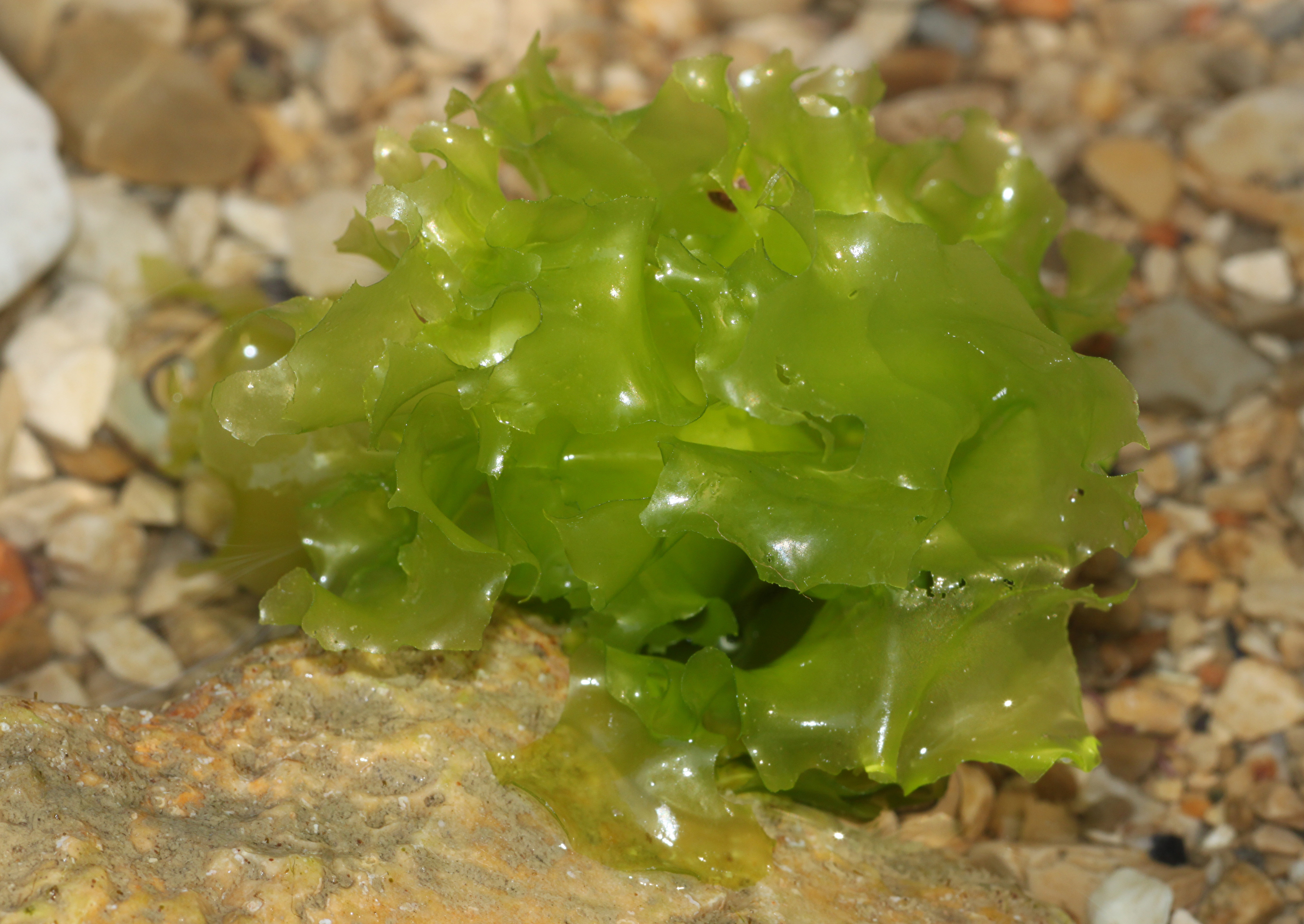
Ulva, commonly known as sea lettuces, is a genus of green algae (division Chlorophyta) in the family Ulvaceae, order Ulvales. The genus is widely distributed along ocean coastlines around the world, making sea lettuces among the most familiar macroalgae on rocky and sandy shores.
Individual blades are light to dark green and can grow to more than 400 mm (16 in) in sheltered conditions. The thallus is leaflike and flattened, anchored to substrate by a disc-shaped holdfast. The genus also encompasses species formerly placed in the genus Enteromorpha, including tubular forms now collectively grouped within Ulva and popularly called green nori.
The type species is Ulva lactuca, whose species epithet "lactuca" is Latin for "lettuce," the source of the common name. Other well-known members include Ulva intestinalis (gut weed) and Ulva compressa. Sea lettuces are eaten by manatees and sea hares, and serve as an important link in coastal food webs. Several species are edible for humans and are consumed raw in salads and cooked in soups in countries including Japan (where the alga is called aosa), China, Ireland, Great Britain, and Scandinavia. The tissue is notably high in protein, soluble dietary fiber, iron, and other vitamins and minerals.
Ecologically, Ulva species are sensitive indicators of coastal water quality. Excess nutrients from agricultural runoff can trigger dense blooms; decomposing masses release hydrogen sulfide, a toxic gas that has caused documented fatalities in Brittany, France (2009).
Etymology
The genus name Ulva is associated with its type species Ulva lactuca, where "lactuca" is Latin for "lettuce" — a reference to the flat, leaflike appearance of the thallus that gives rise to the common name "sea lettuce." Species formerly classified under the genus Enteromorpha are now included in Ulva and are known as green nori.
Distribution
Sea lettuces are widely distributed along the coasts of the world's oceans, growing on rocky shores, sandy flats, and in estuaries across temperate and tropical regions. They are among the most cosmopolitan of macroalgae.
Ecology
Ulva species play an important role in coastal ecosystems as primary producers and food sources for animals including manatees and sea slugs (sea hares). Their growth is strongly promoted by nitrogenous nutrients, and excess runoff from agricultural land can trigger large blooms; as these blooms decompose, they produce hydrogen sulfide gas, posing risks to coastal wildlife and humans.
Cultural Uses
Several Ulva species are eaten by humans across multiple cultures. In Japan the alga is called aosa and is used in soups and side dishes. It is also consumed in China, South Korea, Ireland, Great Britain, and Scandinavia, where it is eaten raw in salads or cooked in soups. Sea lettuce is high in protein, soluble dietary fiber, iron, and vitamins. Caution is warranted when harvesting from polluted sites, as the thallus can accumulate heavy metals.










