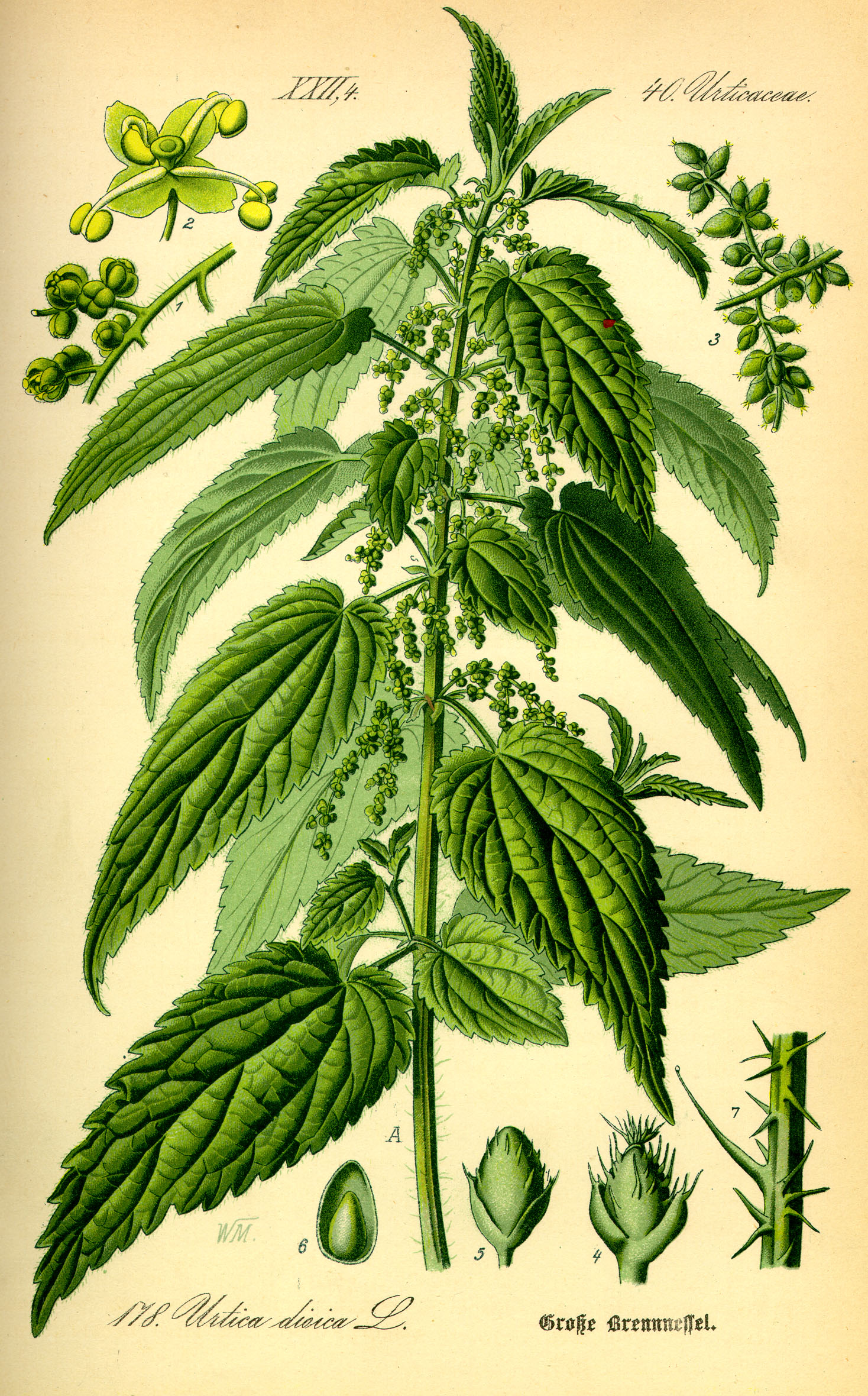
Urtica, commonly known as nettles, is a genus of annual and perennial flowering plants in the family Urticaceae, order Rosales. Established by Linnaeus in his landmark 1753 Species Plantarum, the genus encompasses roughly 45 to 70 widely accepted species distributed across temperate regions of both hemispheres, with the full GBIF descriptor listing approximately 270 taxonomic entries when synonyms and infraspecific taxa are included.
Plants are herbs, reaching anywhere from 10 cm to 300 cm in height depending on species and growing conditions. Stems are typically quadrangular and bear both stinging and non-stinging hairs on the same plant. Leaves are opposite, with serrate margins and three to five prominent veins. Flowers are unisexual — plants may be monoecious or dioecious — with staminate flowers bearing four stamens and pistillate flowers producing a tufted stigma. Fruits are small, sessile, laterally compressed achenes.
The genus is best known for its stinging trichomes — hollow, silica-tipped hairs that inject a cocktail of irritants (including formic acid and histamine) on contact with skin. Despite this, nettles are among the most ecologically and culturally significant wild plants in the temperate world. They provide critical habitat and food for a wide range of insects: caterpillars of numerous Lepidoptera — including the peacock butterfly, small tortoiseshell, and red admiral — depend on Urtica as a larval host plant, while aphids, moths, and other invertebrates shelter among the leaves.
Urtica dioica (stinging nettle) is the most widespread and well-studied member of the genus, found across Europe, temperate Asia, North Africa, and widely introduced elsewhere. The genus has its evolutionary origins in Eurasia, with Miocene-age fossils recorded from Germany and Russia, and has since dispersed globally — including to New Zealand (Urtica ferox) and Hawaii (the related Hesperocnide sandwicensis, now considered within Urtica by some genetic analyses).
Etymology
The genus name Urtica is Latin for "sting" and is rooted in the verb urere, meaning "to burn." The name is a direct reference to the plant's most distinctive feature: hollow, silica-tipped stinging hairs (trichomes) that inject irritants on contact and produce an immediate burning sensation. The same root gives English "urticaria" (hives) and the botanical family name Urticaceae.
Distribution
Urtica originated in Eurasia, where Miocene-age fossils have been recovered from sites in Germany and Russia. From this centre of origin, species have dispersed across temperate regions of both hemispheres through a combination of natural and human-mediated pathways.
The genus is well represented across Europe (with U. dioica and U. urens as the principal European species), temperate Asia, North Africa, and the Americas. In Switzerland, the genus is represented by exactly two species (U. dioica and U. urens). In the American Southwest (Arizona, New Mexico), several species occur, including U. chamaedryoides, U. gracilenta, and U. gracilis. Urtica ferox (ongaonga) is native to New Zealand, where it is the country's most potent stinging plant.
Human activity — agriculture, trade, and colonisation — has further extended the range of several species, especially U. dioica, well beyond their native distributions.
Ecology
Urtica species are characteristic plants of disturbed, nutrient-rich habitats: stream margins, woodland edges, roadsides, agricultural field margins, and waste ground. They are especially associated with nitrogen-enriched soils, often marking the sites of former human habitation or animal enclosures.
The stinging trichomes are an effective defence against large herbivores, allowing dense colonies to persist in grazed landscapes. Paradoxically, the plants are also among the most important larval host plants for temperate Lepidoptera: caterpillars of the peacock butterfly (Aglais io), small tortoiseshell (Aglais urticae), red admiral (Vanessa atalanta), and comma (Polygonia c-album), as well as the tortrix moth Syricoris lacunana, all depend on nettles. Aphids and other invertebrates shelter among the leaves, supporting insect-eating birds in turn.
Urtica inhabits rich, moist deciduous forests, seepage areas, and stream margins from sea level to approximately 2,000 m elevation, tolerating both semi-shade and full sun.
Cultivation
Urtica species grow readily in light, medium, or heavy soils provided moisture is adequate. They tolerate both semi-shade and full sun, and thrive in nitrogen-rich conditions. In cultivation, U. dioica is the species most commonly grown — both for edible foliage and as a wildlife plant to support Lepidoptera. Plants can be kept manageable by cutting back hard, which also promotes a flush of tender young growth suitable for harvest. Gloves are essential when handling; cooking, blanching, or drying completely neutralises the sting.
Propagation
Urtica species can be propagated by seed or vegetative division. Seeds are best sown in spring in cold frames; seedlings transplant readily once established. Established clumps can be divided in spring, taking sections of rhizome. Plants spread naturally via rhizomes and stolons and can become invasive in garden settings if not managed. They prefer moist, nutrient-rich soils and establish readily in disturbed ground.
Cultural uses
Nettles have been used by humans across cultures for millennia, providing food, fibre, and medicine.
Food and drink: Young nettle leaves and shoots, when cooked or blanched, are entirely safe to eat — heat neutralises the stinging trichomes. They are nutritious and have been used in soups, omelettes, the Bulgarian pastry banitsa, and purée. Nettle tea and traditional nettle ale are documented beverages. In cheesemaking, nettle leaves are used to wrap and preserve cheeses, most notably Cornish Yarg from England.
Fibre: Nettle bast fibre (from the stem) was an important textile material before the adoption of cotton and synthetic fibres. Nettle fabric has been found in Bronze Age Danish burial sites, and the fibre was historically used for sailcloth, fishing nets, and paper production through a retting process similar to that used for flax and hemp. Nettle cordage is reportedly far stronger than cotton.
Medicine: Traditional medicinal uses include diuretic preparations from the root, decoctions for fevers, and infusions historically used to assist childbirth.
History
Nettles appear in the folklore and recorded history of many cultures. In Tibetan Buddhist tradition, the saint Milarepa is said to have subsisted for decades on nothing but nettles during his meditation retreats, and his skin is depicted greenish in iconography as a result. In European folklore, the phrase "grasp the nettle" — meaning to tackle a difficult situation boldly — derives from the folk belief that gripping a nettle firmly reduces the sting. Nettles feature in Hans Christian Andersen's fairy tale The Wild Swans (where shirts woven from nettles free enchanted brothers) and in Brothers Grimm tales.
The botanist Charles Naudin recorded in 1874 that strong winds sustained for 24 hours rendered nettle stinging hairs harmless for an entire week — an early observation of environmental modification of the plant's defensive structures.
Taxonomy notes
Urtica L. was formally established by Carl Linnaeus in Species Plantarum (1753, p. 983), where it is placed in family Urticaceae, tribe Urticeae, order Rosales. The authorship is abbreviated L. in standard nomenclature. GBIF (usage key 2984391) accepts the genus with taxonomic status ACCEPTED, assigned to kingdom Plantae, phylum Tracheophyta, class Magnoliopsida.
Species counts vary by authority: SEINET cites approximately 45 species indigenous to temperate regions of both hemispheres, while GBIF records around 270 total entries (including synonyms and infraspecific taxa). The chromosome base number for the genus is x = 12 or 13.
Historical taxonomy has been complex: many names that were once treated as distinct species are now regarded as synonyms of Urtica dioica. More recently, molecular phylogenetic evidence has suggested that the two species of the genus Hesperocnide fall within Urtica, which would expand the genus's circumscription further.










