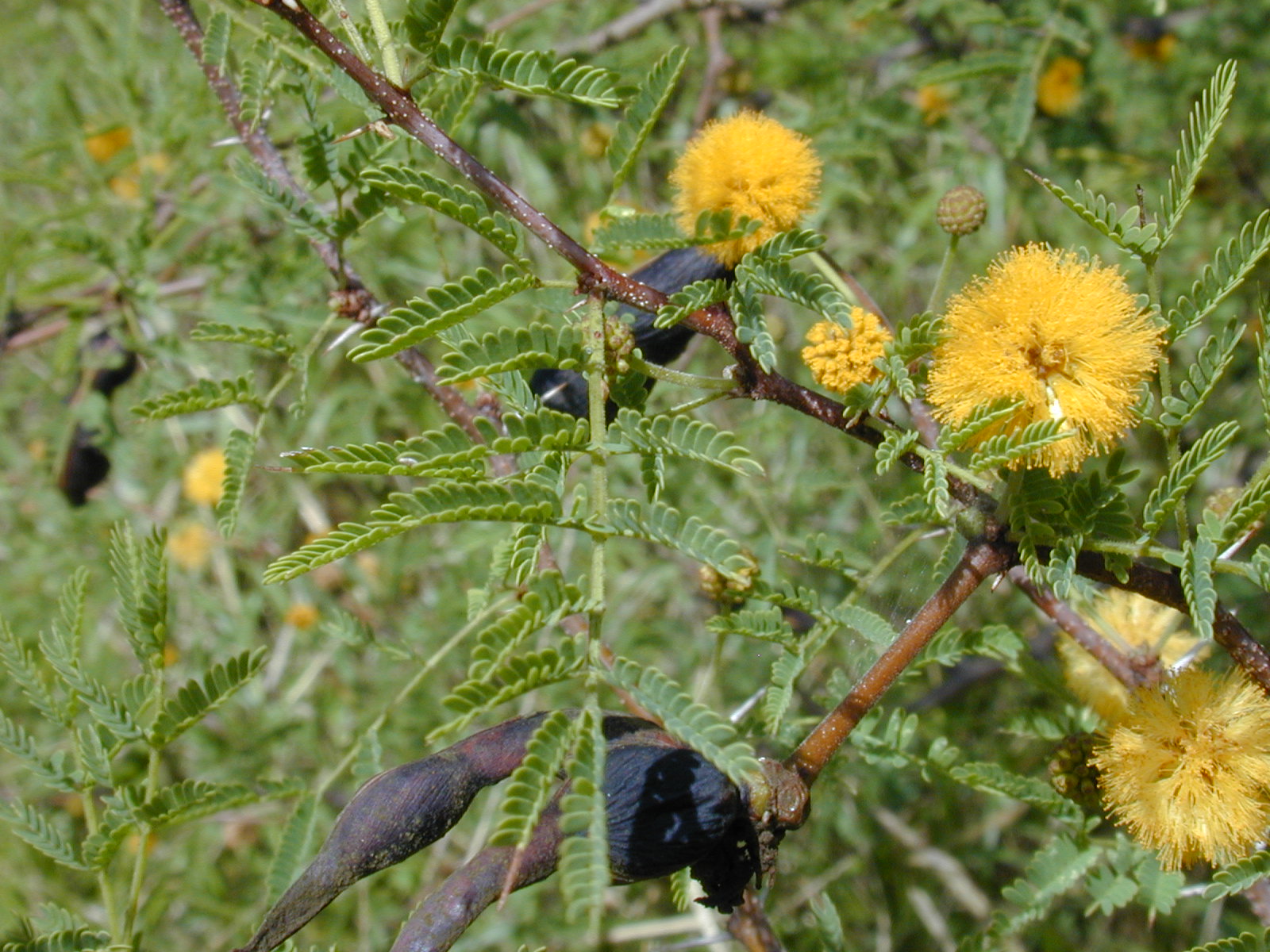
Vachellia is a genus of approximately 157 accepted species of trees and shrubs in the legume family Fabaceae, placed within the Mimosoid clade of the subfamily Caesalpinioideae. First formally described by Robert Wight and George Arnott Walker-Arnott in their 1834 Prodromus Florae Indiae Orientalis, the genus spans tropical and subtropical regions worldwide — from the Americas and Africa to Asia, Australia, and the Pacific Islands. In Africa alone more than 80 species occur, with the genus frequently dominant in open savanna landscapes.
All members of Vachellia are armed: their paired stipular spines are a defining feature, and some species additionally bear recurved prickles. Leaves are alternate and bipinnately compound with opposite pinnae. The small flowers — yellow or creamy white — are massed into tight, spherical (capitate) heads that distinguish the genus from related genera in the Mimosoid clade. Fruits are pods of variable form, either splitting at maturity (dehiscent) or remaining closed (indehiscent).
In African savannas the genus demonstrates a striking evolutionary response to herbivory: spine length and architecture vary with the size of the browsers the plants face, graduating from defenses against gazelles at the base of plants up to those against giraffes at their canopy. Several species form myrmecophytic relationships with ants, housing colonies inside swollen hollow thorns that in turn protect the plant — Vachellia cornigera (bullhorn wattle) and V. drepanolobium (whistling thorn) are the best-known examples, the latter producing an audible whistling sound as wind passes through ant-inhabited gall chambers.
The genus includes some of the most economically and ecologically significant trees of the African and Asian tropics. Vachellia nilotica, the gum Arabic tree, has been used medicinally and as a source of gum arabic for millennia. Vachellia farnesiana, the type species, is cultivated worldwide and its flowers are the source of "cassie" perfume, while V. tortilis — the iconic umbrella thorn — defines the silhouette of the African savanna. Fourteen other generic names (including Farnesia, Poponax, and Myrmecodendron) are now recognized as synonyms of Vachellia.
Etymology
The genus name Vachellia honors George Harvey Vachell (1789–1839), a British chaplain stationed in Macau who collected plants in China and sent specimens to William Hooker — a connection that earned him the dedicatory name from Wight and Arnott in 1834. The type species epithet farnesiana commemorates Odoardo Farnese (1573–1626) of the Italian Farnese family, who maintained celebrated botanical gardens in Rome where the plant was first grown and described by Europeans.
Distribution
Vachellia is native to the tropics and subtropics worldwide. POWO characterizes the native range as spanning from Afghanistan to Zimbabwe. Africa is the principal center of diversity, with more than 80 species occurring across the continent, Madagascar, and the Mascarene Islands; the Americas host about 52 species; Asia around 32; and Australia with Pacific Islands a further 9. Several species — notably V. farnesiana — have become pantropical through human introduction, now occurring across southern Europe, the Middle East, and Australia in addition to their probable American origin.
Ecology
Vachellia species occupy open, tropical to subtropical habitats, where they frequently achieve local dominance — particularly in African and American savannas, thornbush, and semi-arid shrublands. The genus shows a well-documented graduated anti-herbivore spine strategy in African savannas: spine length and density increase with the size of the browsers that graze each zone of the plant, from small gazelles near the ground to gerenuk at mid-height and giraffes at the canopy.
Several species are conspicuous myrmecophytes (ant-plants). Vachellia cornigera (bullhorn wattle) houses ant colonies inside enlarged, hollow stipular thorns; the ants defend the tree against herbivores and competing vegetation. Vachellia drepanolobium (whistling thorn) produces gall-like swellings inhabited by ant colonies, and wind passing through entrance holes in these structures creates an audible whistle. Vachellia farnesiana supports vertebrate wildlife as a food source (deer and peccaries consume the fruit) and provides nesting habitat for birds, though it is classified as invasive in Australia where it spreads along waterways and interferes with pastoral operations.
Cultural Uses
Vachellia species have been used by humans across Africa, Asia, and the Americas for millennia. Vachellia nilotica (gum Arabic tree) is the source of gum arabic, a natural exudate harvested from the bark and traded internationally as a food stabilizer, pharmaceutical excipient, and industrial adhesive; the tree also has a long history of medicinal use. Vachellia farnesiana flowers are steam-distilled to produce "cassie" absolute, an ingredient in French perfumery; its bark yields tannins used in leather processing, its foliage provides livestock fodder (approximately 18% crude protein), and its young leaves, flowers, and pods are consumed as food in several cultures. Traditional medicine applications for V. farnesiana are documented in Brazil, Colombia, the Philippines, and Malaysia. Across sub-Saharan Africa, various Vachellia species furnish timber, charcoal, fodder, and material for live fences and windbreaks. Common local names — "babul" (South Asia), "pilang" and "klampis" (Southeast Asia) — reflect the genus's deep integration into regional cultures.
Taxonomy Notes
Vachellia was erected by Robert Wight and George Arnott Walker-Arnott in 1834 in Prodromus Florae Indiae Orientalis (vol. 1, p. 272). For most of the 19th and 20th centuries its species were treated as part of the much larger genus Acacia sensu lato. The split became official following a contentious 2005 International Botanical Congress decision in Vienna to conserve the name Acacia for the predominantly Australian clade, using Acacia penninervis as the conserved type, rather than the original African type Acacia nilotica (now Vachellia nilotica). The decision passed over significant opposition (54.9% of attending representatives voted against), and was upheld at the 2011 congress by a vote of 373-172.
Vachellia is placed in subfamily Caesalpinioideae within the Mimosoid clade of Fabaceae. The type species is Vachellia farnesiana. Fourteen genera are now treated as heterotypic synonyms, among them Farnesia, Poponax, Myrmecodendron, Acaciopsis, and Bahamia. Eight species currently remain incertae sedis, awaiting formal transfer from Acacia. POWO recognizes 157 accepted species; GBIF lists 256 descendant taxa (including infraspecific ranks and synonyms).










