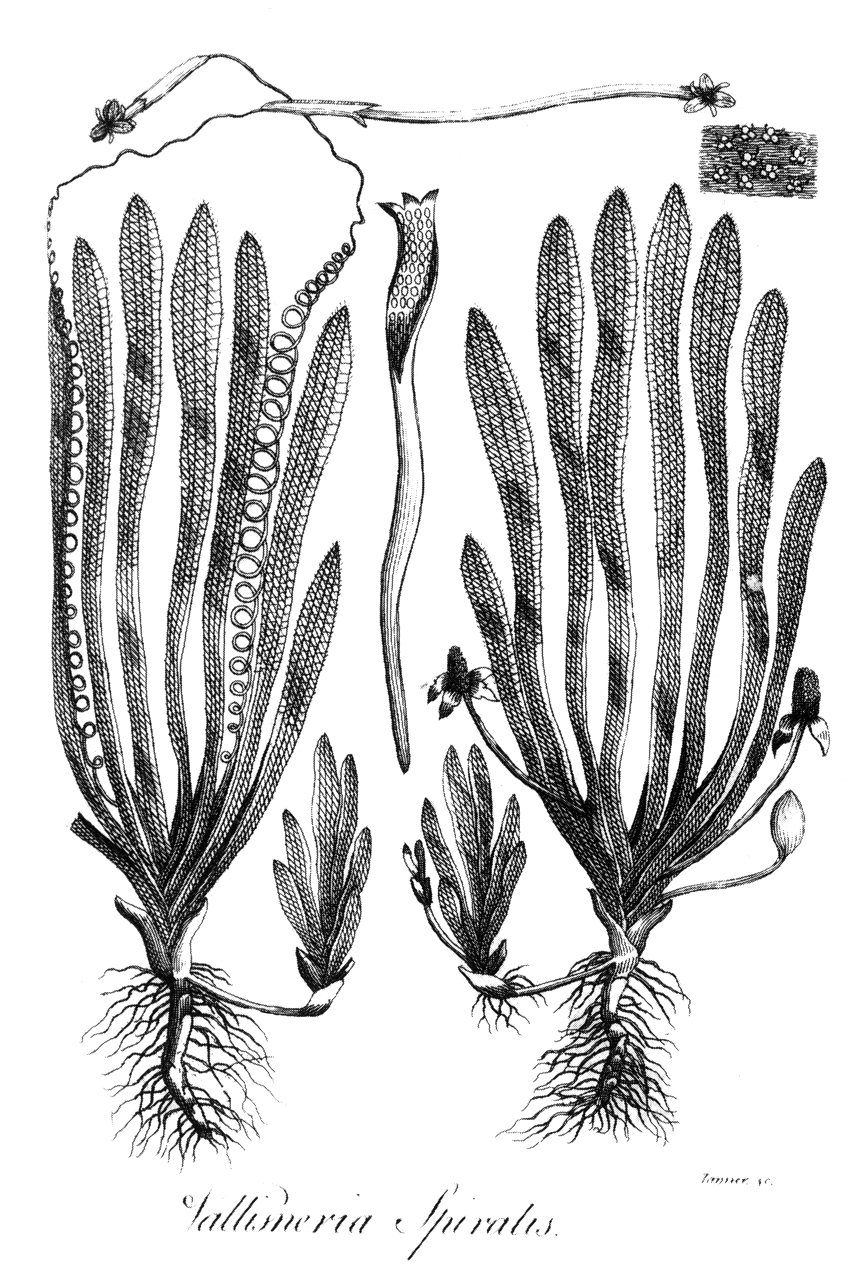
Vallisneria is a genus of submerged freshwater aquatic plants in the family Hydrocharitaceae, order Alismatales. Commonly known as eelgrass, tape grass, or vallis, the genus comprises a small number of species widely distributed across tropical and subtropical regions of Asia, Africa, Australia, Europe, and North America.
Plants are fully submerged and spread vegetatively by horizontal runners, often forming dense underwater meadows in slow-moving rivers, lakes, and streams. Leaves grow in clusters from the roots, are strap-shaped with rounded tips, and bear distinct raised parallel veins. The genus is dioecious, meaning male and female flowers occur on separate plants. Female flowers are borne singly on long, spiralling stalks that extend to the water surface. Male flowers develop on short stalks, detach at maturity, and float freely to the surface, where they contact female flowers and effect pollination — an unusual hydrophilous pollination strategy. After fertilisation, the female flower stalk coils back and the fruit, a banana-shaped capsule containing numerous tiny seeds, matures underwater.
Well-known species include Vallisneria spiralis, the type species long used in botanical studies, Vallisneria americana, widespread across North America, Vallisneria natans from Asia, and Vallisneria australis from Australia. The genus should not be confused with Zostera (marine seagrasses, also called eelgrass) or with Sagittaria, which can appear similar when submerged.
Etymology
The genus name Vallisneria honours Antonio Vallisneri (1661–1730), an Italian naturalist and physician who was one of the first to describe the plant's unusual floating-flower pollination mechanism.
Distribution
Vallisneria has a broad tropical and subtropical distribution, occurring naturally in freshwater habitats across Asia, Africa, Australia, Europe, and North America. Species favour slow-moving or still water bodies such as rivers, lakes, ponds, and ditches.
Ecology
Vallisneria is notable for its hydrophilous pollination: male flowers detach and float on the water surface, drifting to contact female flowers held at the surface by elongated coiling stalks. This surface-water pollination strategy is rare among angiosperms. Dense underwater stands provide important habitat and shelter for fish and invertebrates.
Cultivation
Vallisneria species, particularly V. spiralis and V. americana, are widely cultivated in freshwater aquaria worldwide. They tolerate a broad range of water conditions, spread readily by runners, and provide oxygenation and cover for fish. They are among the most commonly available aquarium plants and are considered easy to grow for beginners.

