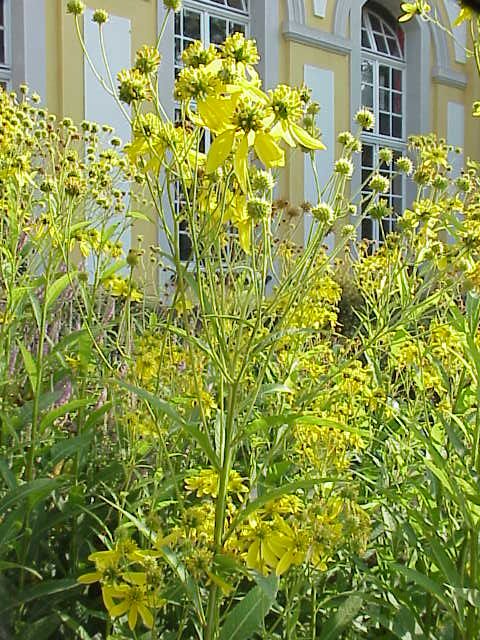
Verbesina is a large New World genus of flowering plants in the daisy family (Asteraceae), tribe Heliantheae, subtribe Verbesininae. Plants of the World Online recognises 351 accepted species, while Flora of North America reports "200 or more" globally and Wikipedia gives an approximate figure of 350; GBIF, which counts synonyms and infraspecific names, records 474 descendants. Members of the genus are commonly known as crownbeards.
Most Verbesina are annual or perennial herbs, though the genus also includes subshrubs, shrubs, and occasionally small trees that can reach two metres or more in tropical habitats. Stems are typically erect and branched, with internodes that are sometimes conspicuously winged — a feature that gives several species their colloquial name "wingstem." Leaves are basal and/or cauline, arranged either opposite (sometimes whorled) or alternate; blades range from rhombic, deltate, and ovate through elliptic to lance-linear, and may be entire, toothed, or pinnately to palmately lobed.
Flower heads can be radiate or discoid and are borne singly or in corymbiform, dichasiiform, or paniculiform arrays. Involucres are hemispheric, turbinate, or campanulate, 5-20+ mm in diameter, with 9-30 or more phyllaries arranged in one to four series. The ray florets, when present, number five to thirty and bear yellow, orange, or ochroleucous corollas resembling small sunflowers; the disc, with 8-150 or more bisexual fertile florets, is usually concolorous with the rays. Achenes (cypselae) are flattened and very often broadly winged, with a persistent pappus of typically two subulate scales or awns (sometimes absent). The reported base chromosome number is x = 17, with x = 18 noted as uncertain.
Verbesina is native throughout the New World, from Canada and the United States south through Central America and the Caribbean to Argentina and Chile. Several species have been widely naturalised in Africa, Europe, temperate and tropical Asia, Hawaii, and Australasia.
Etymology
The genus was published by Carl Linnaeus in Species Plantarum in 1753. Linnaeus left no etymological note in the protologue, and Flora of North America suggests the name was probably coined from the unrelated genus name Verbena plus the Latin suffix -ina, expressing a perceived resemblance — most likely in foliage. The English vernacular "crownbeard," applied to many species, refers to the persistent pappus of two subulate scales or awns that crowns each achene.
Distribution
Verbesina is endemic to the New World as a native range, spanning North America (from Canada through the United States), Central America, the Caribbean, and South America as far south as Argentina and Chile. The genus is centred in subtropical, tropical, and warm-temperate latitudes — Flora of North America notes that the 16 species occurring in its area are concentrated in the warmer south. Beyond its native range Verbesina has been widely introduced and is now established in parts of Africa (Algeria, Egypt, Ethiopia, Morocco, Namibia, Zimbabwe), Europe (Belgium, France, Germany, Spain, the United Kingdom), Asia (India, Japan, Korea, Pakistan), the Pacific (Hawaii, Line Islands), and Oceania (Australia, New Guinea). Treatments differ on species totals: POWO accepts 351 species, Flora of North America gives "200 or more," and the older Gleason & Cronquist manual cited by SEINet reports 60 (reflecting the temperate North American subset, not the full New-World genus).
Ecology
Verbesina species function as host plants for several specialist Lepidoptera: the noctuid moths Schinia bina and Schinia siren both feed on the genus, and S. siren is recorded exclusively from V. encelioides. Within the Flora of North America area the genus is concentrated in subtropical, tropical, and warm-temperate habitats.
Taxonomy
Verbesina L. is placed in Asteraceae, tribe Heliantheae, subtribe Verbesininae. The name is a conserved generic name (nom. cons.) and was first published in Linnaeus, Species Plantarum 2: 901 (1753), with a further citation in Genera Plantarum, ed. 5: 384 (1754). The Flora of North America treatment, by John L. Strother, cites mid-twentieth-century revisionary work by J. R. Coleman on sections Ximenesia and Sonoricola and a treatment by J. S. Olsen of the V. virginica complex as principal references for the genus.
Conservation
At the genus level Verbesina is not flagged in the IUCN Global Invasive Species Database, which records no Verbesina entries. However, POWO documents that several species have naturalised well outside the New World — across Africa, Europe, Asia, the Pacific, and Australasia — so behaviour and management vary by species.

