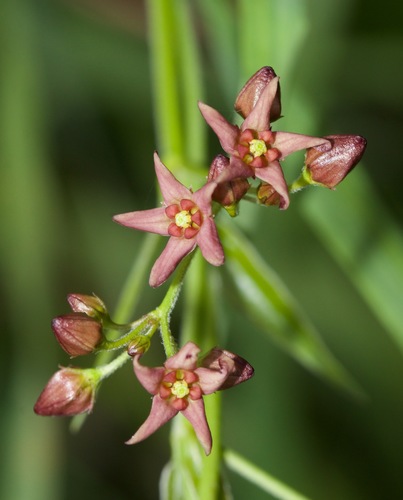
Vincetoxicum is a genus of flowering plants in the family Apocynaceae (order Gentianales), commonly known as swallowworts. It is closely allied to Tylophora, which molecular and chemical studies now place within Vincetoxicum itself. For much of the twentieth century many of its species were circumscribed under the broader genus Cynanchum, but phylogenetic evidence supports Vincetoxicum as a distinct lineage within the milkweed subfamily Asclepiadoideae.
The genus takes its name from the Botanical Latin vincetoxicum, meaning "poison-beater," a reference to the longstanding folk belief that preparations from these plants could neutralise snakebite venom. Members are herbaceous to twining perennial vines with opposite leaves and small, star-shaped flowers produced in cymose clusters, typical of the tribe Vincetoxiceae within Apocynaceae.
Vincetoxicum has a broad Old World distribution spanning Europe, Asia, and parts of Africa, with individual species endemic to specific mountain ranges or regional floras. The genus includes the invasive pale swallowwort (V. rossicum) and black swallowwort (V. nigrum), both native to Eurasia and now naturalised and considered weedy in parts of North America.
Etymology
The generic name Vincetoxicum derives from Botanical Latin meaning "poison-beater" (vincere, to conquer; toxicum, poison), coined in reference to the belief that species of this genus could serve as antidotes against snakebite poisoning.
Distribution
Vincetoxicum has an Old World distribution, with species native to Europe, the Mediterranean basin, temperate Asia, the Himalayan region, and East Asia (including China and Taiwan). Two species—V. rossicum (pale swallowwort) and V. nigrum (black swallowwort)—have become naturalised and invasive in northeastern North America.
Taxonomy Notes
Vincetoxicum has had an unstable circumscription: most of its species were long lumped into the large pantropical genus Cynanchum, but chemical and molecular phylogenetic evidence demonstrates that Vincetoxicum (along with Tylophora, now subsumed within it) forms a distinct clade within Apocynaceae subfamily Asclepiadoideae. Many former members have since been redistributed to genera such as Alexitoxicon, Antitoxicum, Cynanchum, Matelea, and Polystemma. GBIF and Plants of the World Online (as of 2025) treat Vincetoxicum as an accepted genus in family Apocynaceae, order Gentianales.

