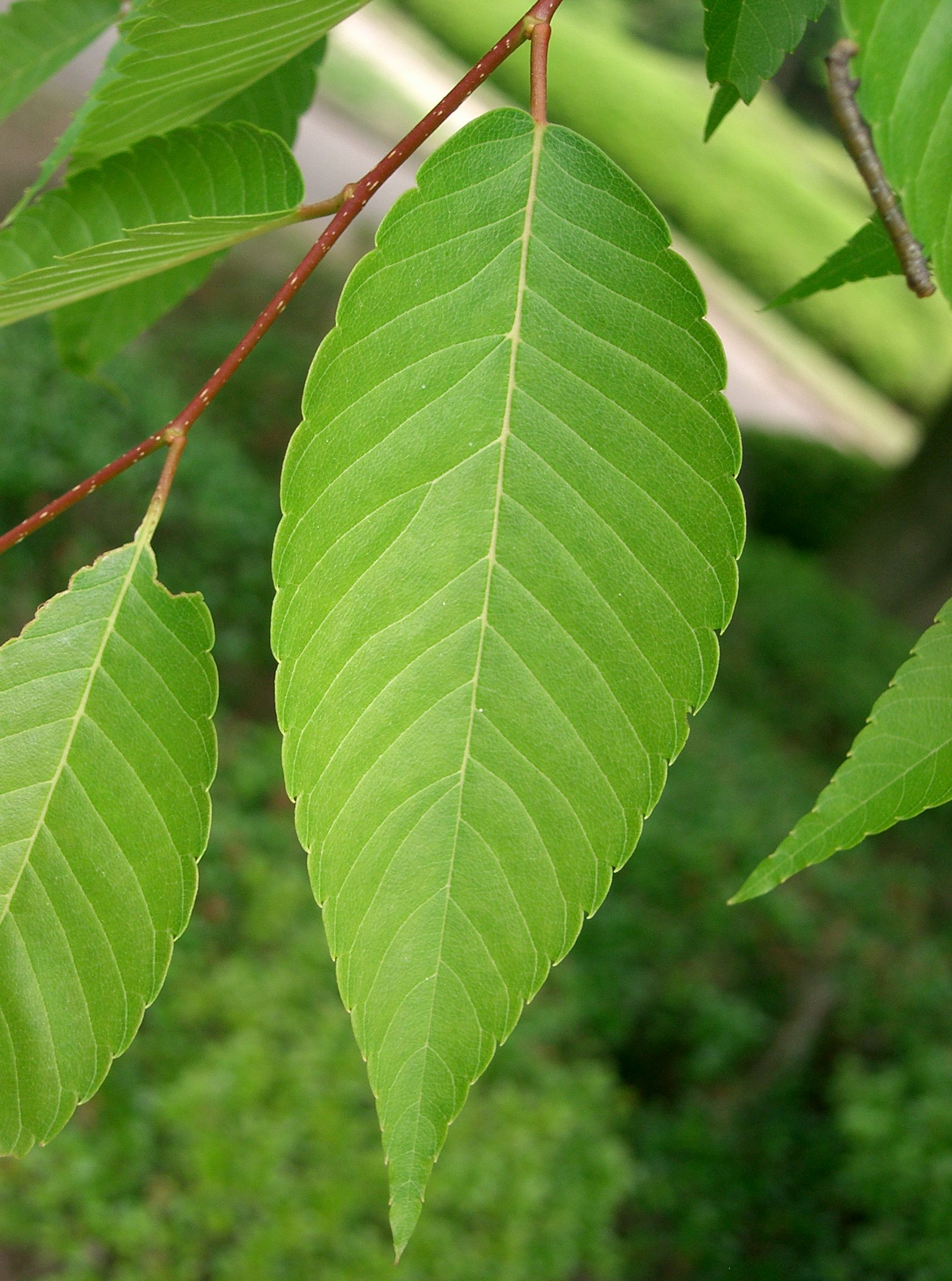
Zelkova is a genus of six species of deciduous trees and shrubs in the elm family Ulmaceae (order Rosales), native to southern Europe and across temperate Asia. The genus spans a strikingly disjunct range: two species persist as island endemics in the Mediterranean (Crete and Sicily), one occupies the Caucasus and adjacent southwest Asia, and three are distributed across China, Korea, Japan, and Taiwan.
Trees range from low shrubs to large specimens reaching 35 metres tall. The bark is smooth and dark brown. Leaves are alternate with serrated margins and, unlike the related elms, a symmetrical base to the leaf blade; they are arranged in two distinct rows with pinnate venation, each vein terminating in a marginal tooth. The flowers are polygamous: staminate flowers cluster in lower leaf axils, while pistillate and hermaphrodite flowers appear singly or in small clusters in upper axils. The fruit is a dry, nut-like drupe borne singly in the leaf axils.
Once widespread across the Northern Hemisphere during the Cenozoic, the genus was abundant in northern Europe and North America as recently as the Pliocene. Extensive Pleistocene glaciation drove it to its present fragmented refugia. Fossil evidence dates the genus back to the early Eocene, approximately 55 million years ago, in western North America where it is now extinct.
The most widely cultivated species is Zelkova serrata (Japanese zelkova or keyaki), prized as an ornamental street and garden tree for its graceful vase-shaped form and vivid autumn colour. Its dense, hard wood is traditionally used in Japan for furniture and for crafting wadaiko drums. Zelkova carpinifolia (Caucasian zelkova) is also grown ornamentally. Two Mediterranean island species — Z. abelicea and Z. sicula — are critically threatened in the wild, the latter known from only two small populations near Syracuse, Sicily, and discovered as recently as 1991.
Etymology
The genus name Zelkova derives from the Georgian word dzelkva, the native name for Z. carpinifolia in the Caucasus. It combines dzeli (bar or pillar) and kva (rock or stone), reflecting the traditional use of the tree's exceptionally hard and durable wood for building bars, pillars, and furniture.
Distribution
Zelkova has a disjunct distribution across three main regions: two species (Z. abelicea and Z. sicula) survive as island endemics in the Mediterranean (Crete and Sicily), one (Z. carpinifolia) ranges through the Caucasus into Turkey and Iran, and three (Z. serrata, Z. schneideriana, Z. sinica) are distributed across China, Japan, Korea, and Taiwan. This fragmented range is a relic of a formerly continuous distribution across northern Europe and North America, which was severed by Pleistocene glaciation.
Ecology
Zelkova was a dominant genus of Northern Hemisphere forests during much of the Cenozoic. Quaternary glaciation eliminated it from Europe and North America, leaving isolated refugial populations. The Cretan endemic Z. abelicea grows at 900–1800 m elevation on north-facing slopes and rocky ravines that remain moist through dry summers; it is threatened by habitat fragmentation, overgrazing, fire, and water stress. Zelkova sicula in Sicily comprises a small number of low shrubs confined to two sites near Syracuse, suffering from severe overgrazing. Phylogeographic studies using chloroplast and mitochondrial markers have documented both Quaternary refugial dynamics and more ancient Miocene-era patterns in the genus.
Cultivation
Zelkova serrata and Z. carpinifolia are widely grown as ornamental trees in parks and streetscapes, valued for their form, autumn colour, and tolerance of urban conditions. The hard, fine-grained wood of Z. serrata (keyaki) is a prized timber in Japan, traditionally used for furniture, lacquerware bases, and wadaiko drums — ideally hollowed from a single trunk, though stave construction is also common. All known Zelkova taxa are maintained in cultivation at botanic gardens and arboreta, which also serve as ex situ conservation reservoirs for the threatened island species.
Conservation
Zelkova abelicea (Cretan zelkova) is classified as Critically Endangered, threatened by habitat fragmentation, overgrazing, fire, and drought in its mountain refugia on Crete. Zelkova sicula (Sicilian zelkova), discovered only in 1991, is listed as Endangered; its two known populations near Syracuse consist of a small number of heavily grazed shrubs. Botanic garden collections across the world hold all known Zelkova taxa, providing an ex situ safety net, though few accessions are sourced from documented wild-origin material.

