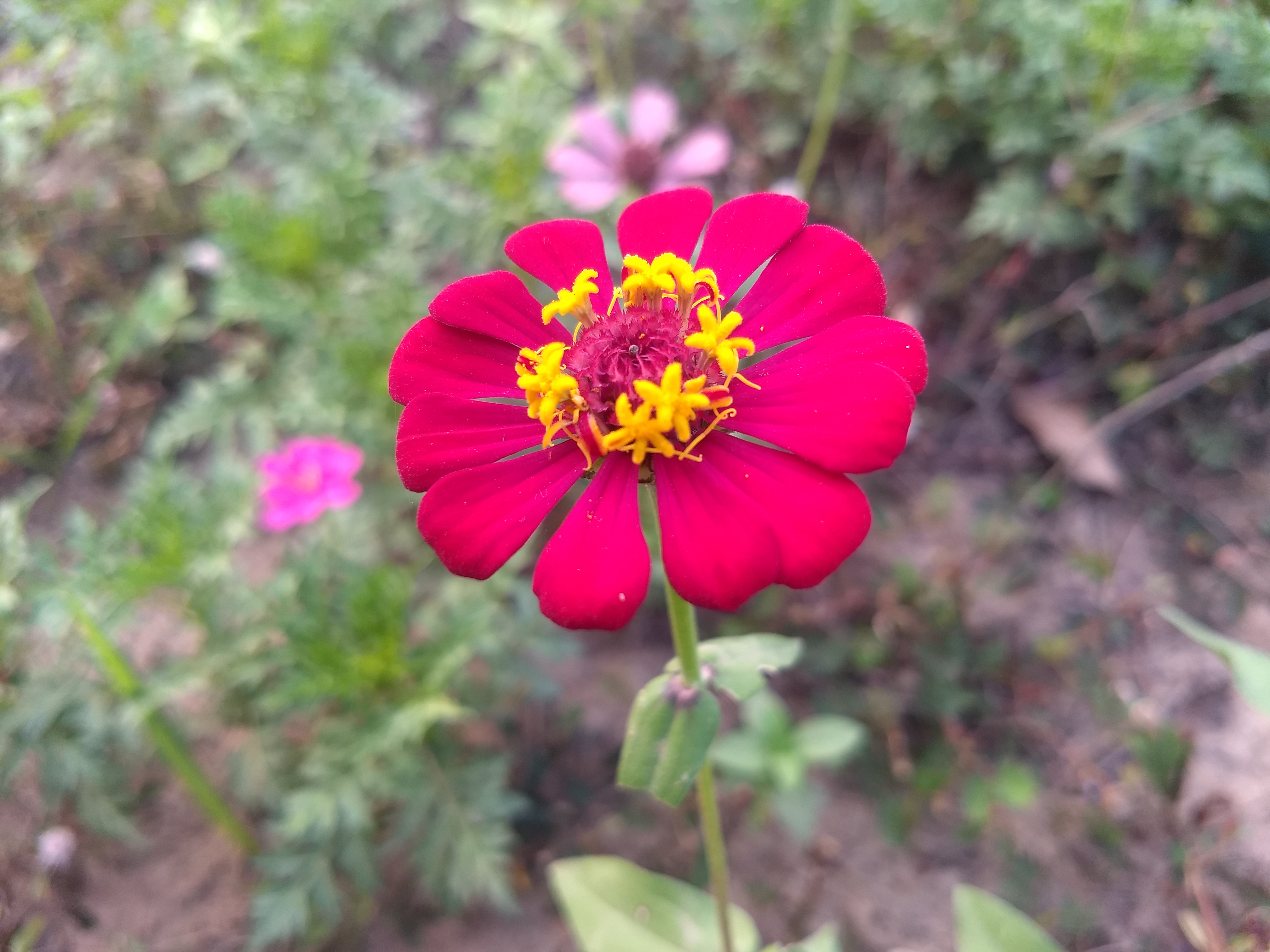
Zinnia is a genus of annuals, shrubs, and sub-shrubs in the family Asteraceae (the daisy family), comprising approximately 20 accepted species native to scrub and dry grassland from the southwestern United States through Mexico to South America. The greatest diversity of species occurs in Mexico, where the genus has its evolutionary centre. Plants typically grow 10–100 cm tall, though some cultivars reach up to 200 cm, with upright or spreading stems bearing opposite, stalkless leaves that range from linear to ovate in shape.
The flower heads are composite, with an outer ring of ray florets in a wide spectrum of colours — white, yellow, orange, red, maroon, purple, or lilac — surrounding a central cluster of disk florets that produce pollen and nectar. Petal arrangement varies from a single flat layer to a dense dome, and modern cultivars come in single, semi-double, and fully double forms. The involucre (the cup of bracts beneath the flower head) is persistent, a characteristic feature of the genus.
In gardens, zinnias are among the most popular warm-season annuals worldwide. They are grown from seed, prefer full sun, and tolerate a range of soil types from clay to sand across a wide pH range. They are deer and rabbit resistant and are well-known for attracting butterflies, hummingbirds, and other pollinators including long-tongued bees and hoverflies. Over 100 cultivars have been developed through selective breeding since the 19th century, and the genus achieved a notable milestone when Zinnia plants became the first flowers cultivated in microgravity aboard the International Space Station.
Etymology
The genus name Zinnia honours Johann Gottfried Zinn (1727–1759), an 18th-century German botanist and anatomist who collected seeds of what became known as Zinnia elegans during travels in Mexico. Linnaeus established the genus in his honour, making Zinnia one of the relatively few plant genera named after a German scientist of that era.
Distribution
Zinnia is native to a belt of scrub and dry grassland stretching from the southwestern United States — with documented occurrences in Arizona, New Mexico, Utah, and Texas — southward through Mexico and into South America, including Bolivia and Argentina. Mexico serves as the genus's centre of diversity and is home to the majority of species. Zinnia peruviana has the broadest natural range, extending into Peru and other Andean regions.
Outside its native range, Zinnia has been introduced widely as an ornamental. Introduced populations are recorded across large parts of Africa, Europe, and Asia, based on World Checklist of Vascular Plants data, though these represent garden escapes or cultivation rather than naturalized wild populations in most cases.
Ecology
Zinnias grow as annuals or subshrubs in scrub, dry grassland, and disturbed open habitats, typically in warm, frost-free climates. They are notable pollinator plants: the disk florets produce abundant pollen and nectar that attracts long-tongued bees, butterflies, and hoverflies, while the large colourful flower heads also attract hummingbirds. Songbirds feed on seed heads as they ripen.
Plants tolerate a range of soil conditions from clay to sandy loam across acid to alkaline pH, and mature specimens show moderate drought tolerance. They are sensitive to frost and function as true annuals in temperate climates (USDA zones 3a–10b when grown seasonally). Disease susceptibility includes powdery mildew, southern bacterial wilt, and southern blight.
Cultivation
Zinnias are among the easiest warm-season annuals to grow. They require a position in full sun — at least six hours of direct sunlight daily — and perform best in well-drained soil of average to good fertility. They tolerate clay, loam, and sandy soils across a wide pH range. Seeds should be sown in place once frost risk has passed, as zinnias have a fragile root system and dislike transplanting. Keep the soil evenly moist until plants are established; mature plants can withstand occasional dry spells.
Regular deadheading prolongs blooming. The genus offers tremendous variety: cultivars range from compact 8-inch edging plants to tall 4-foot cut-flower types, in every colour except blue. They are effective as mass plantings, border plants, container specimens, and cutting-garden subjects. Plants are deer and rabbit resistant, making them reliable in gardens with browsing pressure.
Propagation
The standard propagation method for Zinnia is by seed. Because the roots are fragile and resent disturbance, direct sowing into the final growing position is strongly preferred over starting seeds in pots and transplanting. Sow after the last frost date when soil has warmed. Germination is rapid under warm conditions.
History
Zinnia peruviana was the first species introduced to European horticulture, arriving in the early 18th century. Zinnia elegans, now the dominant garden species, reached Europe around 1790 from Mexico. Scarlet-flowered varieties were being cultivated by 1829, and double-flowering forms appeared from the 1860s onward. Intensive 19th- and 20th-century breeding produced more than 100 named cultivars spanning a wide colour range, size range, and flower form. In the 21st century, Zinnia plants gained wider recognition when they became the first flowering plants successfully cultivated aboard the International Space Station, using NASA's Veggie plant growth system.
Taxonomy
The genus Zinnia L. was established by Carl Linnaeus and is placed in tribe Heliantheae, family Asteraceae, order Asterales. The type species is Zinnia peruviana. GBIF records 59 descendant taxa; regional treatments recognise around 20 accepted species. Several genera are now treated as synonyms of Zinnia, including Crassina Scepin, Diplothrix DC., Lejica Hill ex DC., Lepia Hill, Mendezia DC., Sanvitaliopsis Sch.Bip. ex Greenm., and Tragoceros Kunth.

