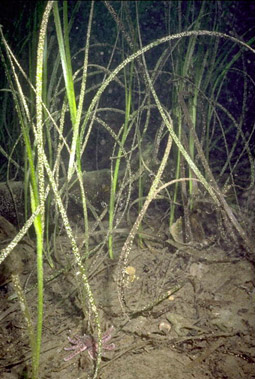
Zostera is a small genus of marine flowering plants commonly known as eelgrass or seagrass, belonging to the family Zosteraceae within the monocot order Alismatales. The genus contains approximately 15 accepted species and is one of the few groups of flowering plants adapted to fully subaquatic, marine conditions.
Plants are characterised by long, ribbon-like leaves roughly 1 centimetre wide, bright green in colour, arising from short stems on extensive white branching rhizomes. Flowers are enclosed within the sheaths of the leaf bases, and the bladdery fruits are capable of floating, aiding dispersal. Most species are perennial. Zostera is able to regulate its internal turgor pressure in response to tidal changes in environmental salinity, losing solutes as the tide recedes and gaining them as it rises.
Zostera beds are ecologically significant habitats. They stabilise sediments, provide substrate for epiphytic algae and micro-invertebrates, and serve as nursery grounds for commercially important fish and shellfish species. Eelgrass is a key food source for brant geese and wigeons. The genus is also susceptible to wasting disease, caused by the slime mould Labyrinthula zosterae, which historically caused severe declines in Z. marina populations and the fauna dependent on them.
Notable species include Zostera marina, the most widely studied, found across North Pacific and North Atlantic shores; Z. noltii, which uniquely occurs along the landlocked Caspian Sea as well as the northeastern Atlantic and Mediterranean; Z. japonica, distributed across the Russian Far East, Japan, Korea, and China; and Z. capensis, found along the African coastline from Kenya to the Cape Province and Madagascar.
Distribution
Zostera is distributed across seashores throughout much of the Northern Hemisphere, including the North Atlantic, North Pacific, Mediterranean, Black Sea, and Caspian Sea, as well as Australia, New Zealand, Southeast Asia, and southern Africa. The discovery of Z. chilensis in 2005 extended the known range to an isolated population on the Pacific coast of South America (Chile). One species, Z. noltii, is notable for occurring along the landlocked Caspian Sea.
Ecology
Zostera grows on sandy substrates and in estuarine bay mud, typically submerged or partially floating. Its beds stabilise sediments, provide substrate for epiphytic algae and micro-invertebrates, and function as nursery grounds for fish and shellfish. Eelgrass is a primary food source for brant geese and wigeons. The genus is physiologically adapted to tidal salinity fluctuations, actively regulating internal solute concentrations to maintain constant turgor pressure. Populations are threatened by wasting disease caused by the slime mould Labyrinthula zosterae, which devastated Z. marina beds historically and continues to pose a conservation risk.
Conservation
Zostera populations have been severely affected by wasting disease caused by the slime mould Labyrinthula zosterae, which devastated Z. marina beds particularly during the 1930s and caused cascading declines in dependent fauna. Eelgrass meadows are recognised for their potential to sequester atmospheric carbon, giving them additional conservation relevance in the context of climate change mitigation.
Cultural Uses
The Seri people of Sonora, Mexico, traditionally harvested eelgrass as food — rhizomes and leaf-bases were eaten fresh or dried into cakes for winter provisions, and the plant was used in deer-meat smoking. The Seri calendar names April after the eelgrass seed maturation. In Europe, Zostera was used as packing material, mattress and cushion stuffing, and for thatching (notably on the Danish island of Læsø, where eelgrass roofs were valued for durability). In early 20th-century America, dried eelgrass was commercially sold as building insulation under the brand name "Cabot's Quilt." More recently, dried Zostera has been explored as eco-friendly house insulation and permaculture ground cover, and eelgrass meadows are under study for their potential to sequester atmospheric carbon.

