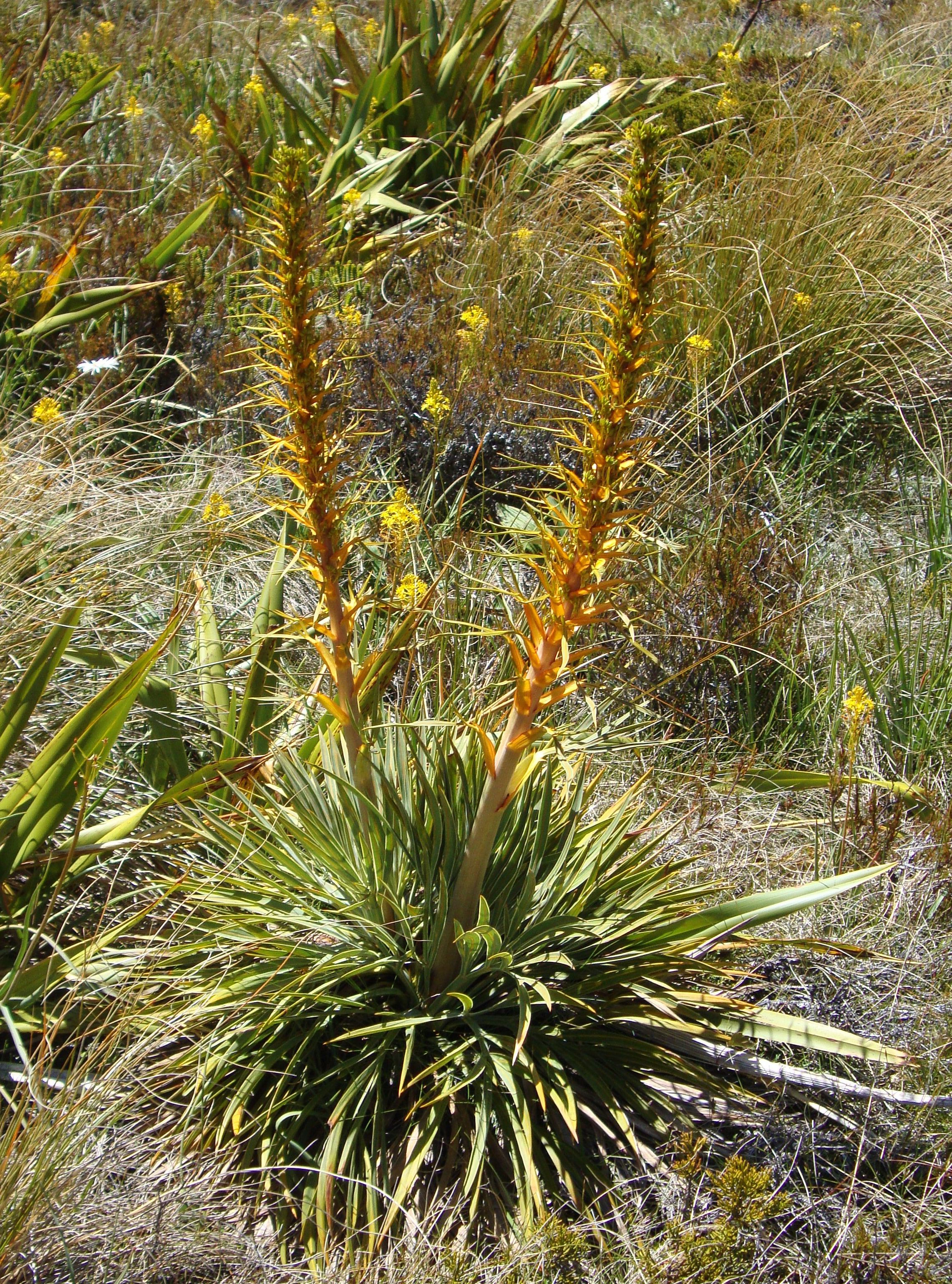
Aciphylla is a genus of roughly 40 species of herbaceous flowering plants in the family Apiaceae (order Apiales), almost entirely endemic to New Zealand. All but two species are confined to New Zealand; the remaining two are found only in Australia. The genus belongs to the large carrot family and shares its characteristic features: taproots, small flowers clustered into compound umbels, and winged, wind-dispersed seeds called schizocarps.
The plants are commonly known as speargrass or, for the larger species, Spaniard — though the latter term is increasingly avoided — and as taramea in Māori. They range dramatically in form, from tiny alpine cushion plants a few centimetres across to imposing mounds over 50 cm tall with rosettes of long, stiff, spine-tipped leaves radiating in every direction. The genus is dioecious, meaning male and female flowers occur on separate plants, and plants do not flower every year, making field identification often dependent on leaf characters and locality.
The rigid, spear-like leaves that give the genus its name — from the Greek aci (needle) and phylla (leaf) — are thought to be an evolutionary response to browsing pressure from the now-extinct giant moa. Supporting this hypothesis, the two species endemic to the Chatham Islands, which never had moa, have soft leaves without spines. Species in the A. aurea group are further distinguished by their milky sap, whereas most other species have clear sap.
Most species favour subalpine and alpine habitats, reaching greatest diversity in New Zealand's South Island, though the group spans environments from mountain zones down to the coast. Fragrant oil extracted from large taramea species has been valued by Māori as a perfume for centuries. Today, many Aciphylla species face conservation threats from introduced mammals — hares and rabbits eat the soft young leaves from the side to avoid the spiny tips, sheep graze the foliage, and feral pigs dig up the carrot-like taproot — as well as from widespread conversion of New Zealand high-country grasslands to improved pasture.
Etymology
The genus name Aciphylla derives from the Greek aci (needle) and phylla (leaf), a direct reference to the long, rigid, needle-sharp leaf tips characteristic of most species. The Māori name taramea applies specifically to the larger, fragrant species whose essential oils have long been used as a traditional perfume.
Distribution
Almost all Aciphylla species are endemic to New Zealand, with the greatest concentration of species in the South Island's alpine and subalpine zones. Two species are restricted to Australia. Within New Zealand the genus ranges from coastal to high-alpine environments, though montane and subalpine grasslands and herbfields are the core habitat.
Ecology
Aciphylla species are characteristic components of New Zealand's subalpine and alpine flora, growing in grasslands, herbfields, and rocky terrain from montane zones to above the treeline. The genus is dioecious and does not flower every year. Spine-tipped leaves are an inferred anti-herbivory adaptation, originally against browsing by moa; today the primary ecological pressures come from introduced lagomorphs (rabbits, hares) and ungulates (sheep, pigs). Studies in fenced exclosure plots found young A. aurea plants 15 times more abundant after 30 years of lagomorph exclusion, confirming ongoing browse pressure on the genus.
Conservation
Numerous Aciphylla species are threatened by introduced mammals. Hares and rabbits circumvent the spiny leaf-tips by grazing from the side; feral pigs excavate plants to eat the taproot. The decline of A. colensoi from rabbit browsing was documented as early as 1883. Conversion of New Zealand high country to improved pasture for sheep farming is an additional broad-scale threat. The genus has been proposed as a useful bioindicator for measuring lagomorph impacts on native vegetation.
Cultural Uses
Fragrant essential oil extracted from large taramea species (Aciphylla spp.) has been used by Māori as a perfume, and the practice continues today. The taproot of small speargrasses, known collectively as papaī in Māori, was also recognised as a food resource; the Māori name papaī technically refers to the taproot itself.










