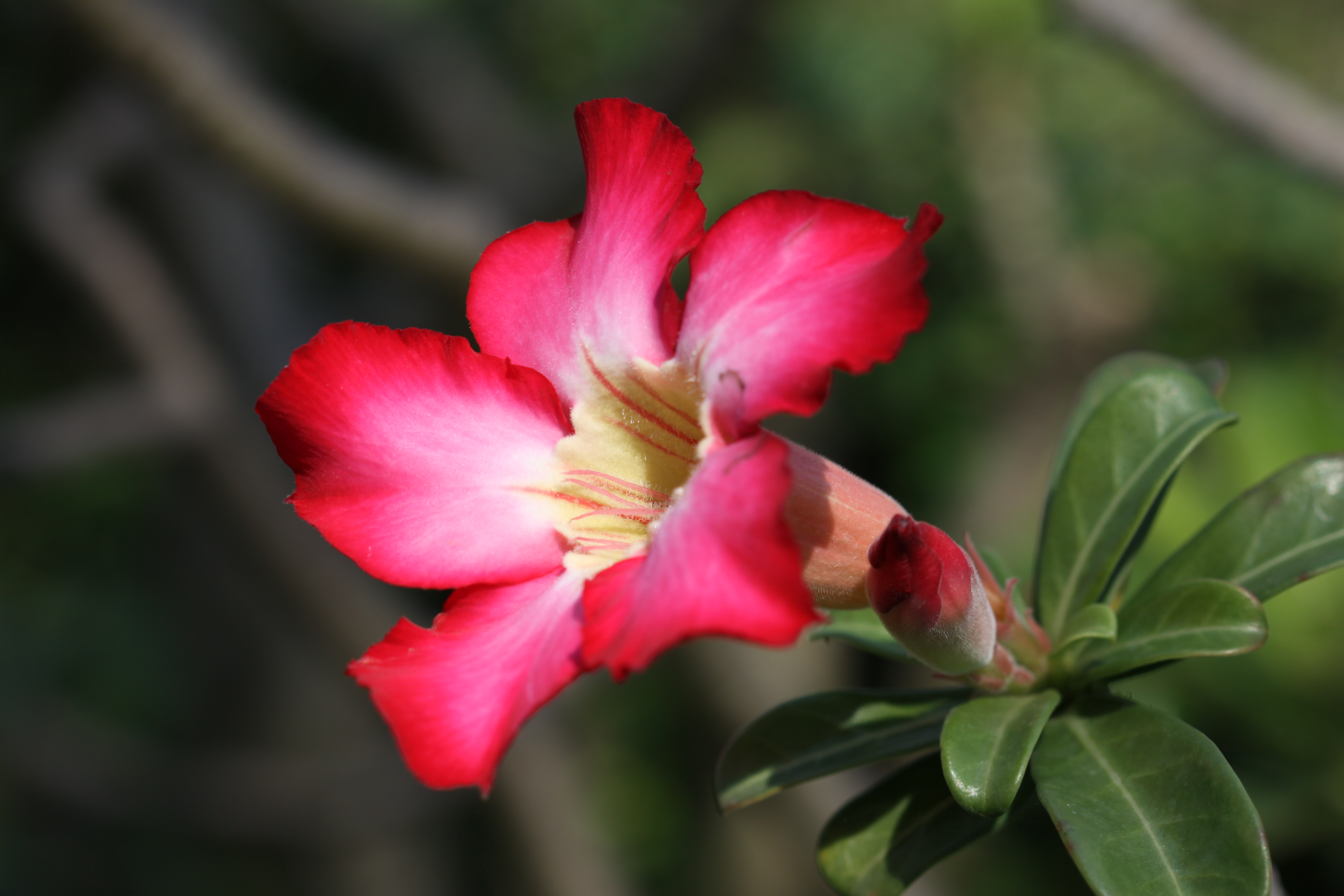
Adenium is a genus of succulent flowering plants in the family Apocynaceae (order Gentianales), first formally described in 1819 by Roemer & Schultes. The genus is native to Africa and the Arabian Peninsula, where species grow in seasonally dry habitats ranging from the Sahel and East African savanna to the semi-arid regions of southern Africa and the Arabian coast.
Plants in the genus are characterised by a dramatically swollen base — the caudex — which stores water and gives mature specimens a sculptural, pachycaul silhouette. Flowers are showy, trumpet-shaped, and typically bright pink, red, or white, borne at or near branch tips. The combination of striking flowers and an unusual stem form has made the genus highly prized in horticulture.
The number of species recognised varies by authority; some treatments accept as many as twelve species, while a widely cited classification by Plazier recognises five: A. boehmianum, A. multiflorum, A. obesum, A. oleifolium, and A. swazicum. The most familiar species is Adenium obesum, commonly known as the desert rose, which is grown worldwide as a houseplant and bonsai subject. All parts of several species contain toxic cardiac glycosides; the sap of A. boehmianum, A. multiflorum, and A. obesum has been used traditionally as arrow poison for hunting large game across sub-Saharan Africa.
Etymology
The genus name Adenium is derived from "Aden," the port city on the Arabian Peninsula (in present-day Yemen), reflecting one of the regions where the plants were first collected and described by European botanists.
Distribution
Adenium is native to Africa and the Arabian Peninsula. Adenium obesum has the widest range, occurring from Senegal east to Somalia and into the Arabian Peninsula. Other species have more restricted ranges: A. multiflorum in southern Africa from Zambia southward, A. boehmianum in Namibia and Angola, A. oleifolium in South Africa, Botswana, and Namibia, and A. swazicum in eastern South Africa.
Cultivation
Adenium obesum and its many hybrids are widely grown as ornamental houseplants in temperate and tropical regions, and are popular bonsai subjects because specimens can be maintained in pots for many years. Desirable named varieties are typically propagated by grafting onto seedling rootstocks, since seed-grown plants are not genetically identical to the mother. Cuttings can produce clonal plants but tend to develop a less pronounced caudex compared with seed-grown individuals.
Cultural Uses
The milky sap of several Adenium species — notably A. boehmianum, A. multiflorum, and A. obesum — contains toxic cardiac glycosides. Across sub-Saharan Africa these plants have been used as a source of arrow poison for hunting large game, a practice documented in multiple countries throughout the genus's range.
Taxonomy Notes
The genus has historically been treated as containing anywhere from five to twelve species, with disagreement over whether peripheral taxa should be recognised as full species or reduced to subspecies and varieties of A. obesum. A late-20th-century revision by Plazier accepts five species. GBIF (Roem. & Schult., 1819, Syst. 4: 35 & 411) lists synonyms Adenum G.Don and Idaneum Kuntze & Post for the genus. Pachypodium namaquanum, formerly placed in Adenium, is now treated in a separate genus.










