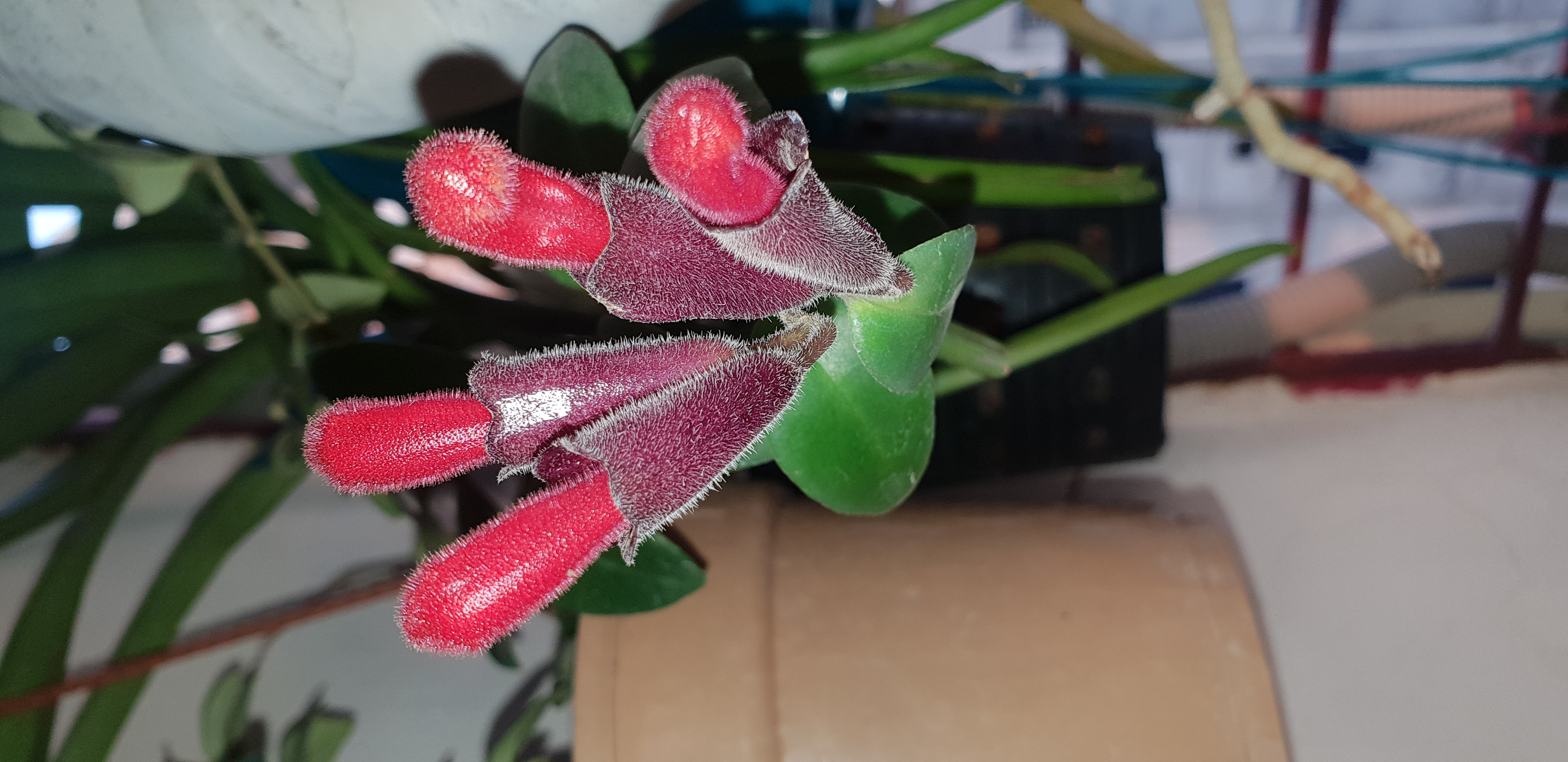
Aeschynanthus Jack is a genus of approximately 185 accepted species of evergreen epiphytic plants in the family Gesneriaceae (order Lamiales). The genus was established by William Jack in 1823, published in Transactions of the Linnean Society (vol. 14, p. 42). Plants are native to the subtropical and tropical regions of Asia, concentrated in Southeast Asia and the Pacific, where they grow in forest canopies clinging to the branches and trunks of trees.
Members of the genus are typically trailing in habit, producing brightly colored tubular flowers that emerge from cup-like calyces. This arrangement — red or orange buds pushing out of dark calyces — gives rise to the popular common name "lipstick plant." The genus is morphologically diverse: some species develop thick, waxy cuticles suited to drier epiphytic niches, while others bear softer, more succulent foliage. Size varies considerably, from large-flowered species such as A. speciosus to compact trailers like A. micranthus.
In the wild, sunbirds are the primary pollinators, attracted by the bright tubular flowers. In cultivation, the most widely grown species in temperate regions are A. longicaulis, A. pulcher, and A. radicans, all prized as trailing houseplants that perform well in hanging baskets. Plants generally thrive in warm, humid conditions with good indirect light, semi-moist and well-drained growing medium, and protection from temperatures that dip close to freezing.
Etymology
The genus name Aeschynanthus is a compound of two Greek roots: aischuno (αἰσχύνω, to be ashamed) and anthos (ἄνθος, flower). The allusion is to the appearance of the developing flower buds, which emerge as if shrinking from or hiding within the enclosing calyx — a visual parallel to blushing or shame. This interpretation is directly reflected in the German vernacular name Schamblumen ("shame flowers"). The popular English common name "lipstick plant" captures the same visual image from a different angle: the emerging red bud mimics lipstick being pushed up from its tube.
Distribution
Aeschynanthus is centered in the subtropical and tropical regions of Asia, with the greatest diversity in Southeast Asia and the Pacific. The genus extends across the Malesian floristic region (including the Malay Peninsula, Borneo, Sumatra, the Philippines, and New Guinea) and into the Himalayan foothills, southern China, and Indochina. A. pulcher is documented as native to Indo-China and western Malesia. The genus does not occur naturally outside Asia and the Pacific.
Taxonomy
Aeschynanthus Jack was formally described in 1823 in Transactions of the Linnean Society (14: 42). The genus belongs to the subfamily Didymocarpoideae within Gesneriaceae. Several names previously applied to segregate genera are now treated as synonyms: Trichosporum D.Don (1822, Edinburgh Philos. J. 7: 84) pre-dates Aeschynanthus in publication but was subsumed; Rheithrophyllum Hassk. (1842); Euthamnus Schltr. (1923); Oxychlamys Schltr. (1923); and Micraeschynanthus Ridl. (1925). GBIF records 217 descendant taxa under the accepted genus name (usageKey 6365037).
Ecology
Plants in this genus are predominantly epiphytes, anchoring to the bark of trees in tropical and subtropical forest canopies. This growth strategy allows access to strong light above the forest floor while minimizing competition for soil resources. The brightly colored, tubular flowers of most species are adapted for sunbird pollination — sunbirds being the primary documented pollinators. The calyx-enclosed bud structure (from which the common name derives) is characteristic of the genus and likely plays a role in the nectar-protection mechanism associated with bird-pollinated flowers.
Cultivation
In cultivation, Aeschynanthus species are grown primarily as trailing or hanging-basket plants. They perform best in warm, humid environments with bright indirect light; direct mid-day sun can scorch foliage. A semi-moist, well-drained growing medium — typically a peat- or coir-based mix with added perlite — is preferred, as the epiphytic roots are prone to rot in waterlogged conditions. Some species tolerate somewhat moister conditions than others. Plants are frost-tender and should be kept above temperatures that approach freezing. Trailing species such as A. radicans, A. pulcher, and A. longicaulis are the most commonly grown as houseplants in temperate climates.
Conservation
No Aeschynanthus species have documented IUCN Red List or CITES Appendix assessments in the BGCI PlantSearch database, which contains over 200 entries for the genus across living plant collections worldwide. The absence of formal threatened listings in this database suggests the genus as a whole does not currently face documented global extinction risk, though individual species from restricted forest habitats in Southeast Asia may be locally vulnerable to habitat loss. The genus is not listed as an invasive concern.










