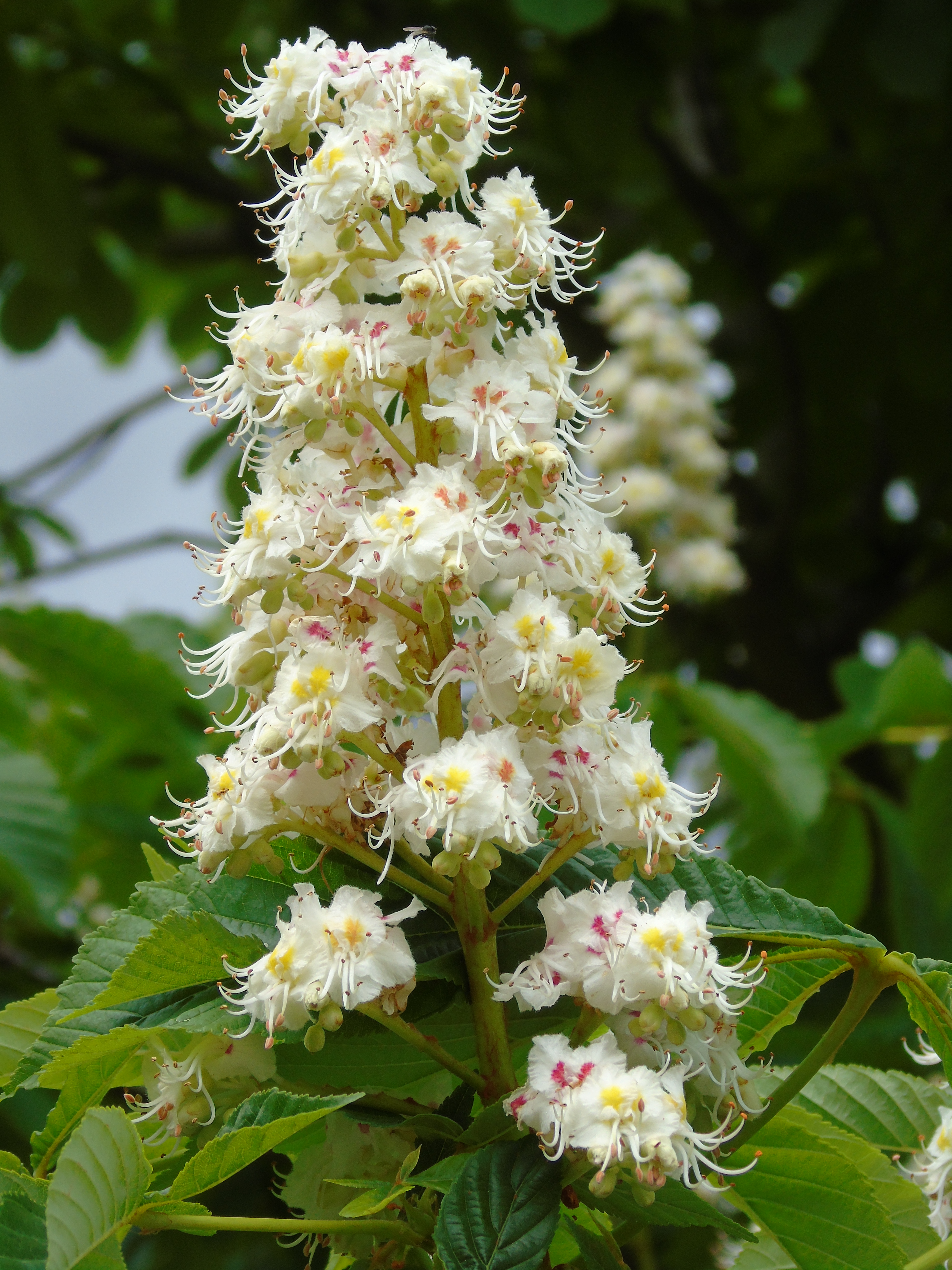
Aesculus L. — commonly known as horse-chestnuts (European and Asian species) and buckeyes (North American species) — is a genus of deciduous trees and shrubs in the family Sapindaceae, subfamily Hippocastanoideae. The genus comprises approximately 12–16 species, depending on the taxonomic authority, with POWO recognizing 12 accepted species and GBIF recording 67 descendant taxa.
Plants range from 4 to 35 metres tall and are immediately recognizable by their large, palmately compound leaves and stout shoots with resinous, often sticky buds. In spring and early summer, Aesculus produces upright panicles of showy flowers with four or five petals in shades of white, yellow, pink, or red. The fruits are distinctive leathery capsules 2–5 cm in diameter that split into three valves at maturity, releasing one to three large, glossy seeds.
The genus has a disjunct Arcto-Tertiary distribution, with seven species native to North America, four to Asia, and one — A. hippocastanum, the European horse-chestnut — originating in the Balkans. It is widely cultivated as an ornamental throughout temperate regions. All parts of the plant are moderately toxic to humans and livestock due to the presence of saponins and glucosides, though indigenous peoples across multiple continents developed methods to detoxify and consume the seeds.
Etymology
The genus name Aesculus was assigned by Carl Linnaeus in his Species Plantarum of 1753. Linnaeus derived the name from a classical Roman term for an edible acorn, applying it to these nut-bearing trees whose seeds superficially resemble large acorns. The common name "horse-chestnut" distinguishes the European species from the edible sweet chestnut (Castanea); the epithet "horse" traditionally indicated a coarser or inedible version of a familiar food plant. North American species are called "buckeyes" in reference to the shiny brown seed with its pale scar, which resembles the eye of a deer.
Distribution
Aesculus has a disjunct Arcto-Tertiary distribution across the Northern Hemisphere. Seven species are native to North America (the buckeyes), spanning from California and the Pacific coast east through the Midwest and Southeast; four species are native to Asia, ranging from Afghanistan and the Himalayas through China; and one species, A. hippocastanum, is native to the Balkan Peninsula in Europe. The genus has been widely introduced beyond its native range: A. hippocastanum in particular is naturalized or cultivated across much of Europe, the Baltic States, Austria, Belgium, Czechia, and parts of North America including British Columbia and the northeastern United States.
Taxonomy
Aesculus L. (Sapindaceae) was first published in Species Plantarum in 1753 by Linnaeus (GBIF usageKey 3189801). The genus is placed in order Sapindales, subfamily Hippocastanoideae. Authorities differ on species count: POWO accepts 12 species while other treatments recognize up to 16. Numerous historical segregate genera have been reduced to synonymy, including Hippocastanum Mill. (1754), Pavia Mill. (1754), Calothyrsus Spach (1834), Macrothyrsus Spach (1834), Nebropsis Raf. (1838), Ozotis Raf. (1838), Paviana Raf. (1817), Pawia Kuntze (1891), and Oesculus Neck. (1790).
Ecology
All parts of Aesculus plants — leaves, bark, seeds, and flowers — are moderately toxic due to saponin and glucoside compounds. Saponins are toxic to fish, a property exploited historically by some indigenous peoples who crushed seeds into streams to stun fish for harvest. The genus exhibits the classical Arcto-Tertiary disjunct pattern, a biogeographic signature of genera that were once continuous across the Holarctic region and became fragmented as climates changed during the Tertiary period. Seeds are among the largest produced by any temperate tree and have limited viability — they must not be allowed to dry out after ripening.
Cultivation
Aesculus hippocastanum is the most widely grown ornamental species, planted extensively in parks, avenues, and formal gardens across temperate Europe and North America. Aesculus × carnea, a hybrid with red flowers, is also popular in horticulture. Trees perform best in well-drained loamy soil with full sun exposure and cannot thrive in deep shade. They tolerate a range of soil textures from light to heavy. The genus is generally hardy where winter temperatures do not fall below -10°C (USDA zones 6–10). A. parviflora, the bottlebrush buckeye, is grown as a multi-stemmed ornamental shrub for its late-summer white flowers.
Propagation
The primary propagation method is by seed. Seeds should be sown immediately upon ripening — either directly outdoors or in a cold frame — as viability drops sharply if seeds dry out. Stored seeds require soaking in water for 24 hours before sowing to rehydrate the seed coat. Seeds are large and germinate readily when fresh. Vegetative propagation (grafting, budding) is used for named cultivars and hybrids such as A. × carnea, which do not come true from seed.
Cultural uses
Aesculus seeds have a long history of human use despite their toxicity when raw. Japanese Jomon-period communities consumed detoxified seeds over a span of four millennia, from prehistoric times until approximately 300 AD. Several North American indigenous peoples prepared buckeye seeds by slow-roasting, slicing, and rinsing in running water for two to five days to leach out saponins, then grinding the meal for use as gruel. The saponin content also made seeds useful as a soap substitute and as fish poison for subsistence fishing.
In Britain, the seeds of A. hippocastanum — known as "conkers" — are the object of a traditional children's game in which players attempt to crack each other's threaded seed. In the United States, the Ohio buckeye (A. glabra) became a political symbol during the 1840 presidential campaign of William Henry Harrison. The Aesculus leaf featured on the coat of arms of Kyiv from 1969 to 1995, reflecting the tree's cultural prominence in the city. In Geneva, the date on which the city's horse-chestnut tree first flowers has been officially recorded since 1818 as a seasonal marker of spring.
Medicinal uses include seeds used as an expectorant, the crushed fruit applied as a topical treatment for hemorrhoids, and bark decoctions used for toothache.
History
The genus was formally described by Linnaeus in Species Plantarum (1753), though horse-chestnuts had been cultivated in Europe for centuries before formal botanical description. Aesculus hippocastanum was introduced to western Europe from the Balkans in the late 16th century and rapidly became one of the most planted avenue and park trees on the continent. Geneva's practice of recording the first flowering date of a horse-chestnut tree since 1818 represents one of the oldest continuous phenological records in Europe, linking the genus to the early study of climate and seasonal change.










