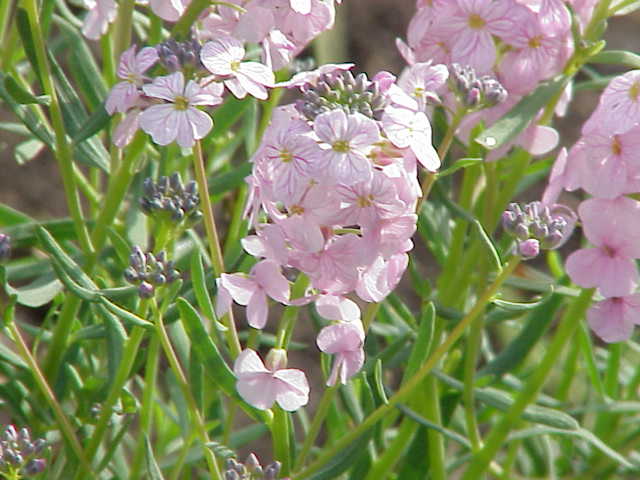
Aethionema, commonly known as stonecresses, is a genus of flowering plants in the family Brassicaceae, order Brassicales. It holds a unique position in the family as the sole genus in the subfamily Aethionemoideae, and molecular studies place it as sister to all remaining Brassicaceae lineages — a divergence that occurred sometime during the Eocene epoch.
The genus consists of typically perennial, sometimes annual, low-growing subshrubs and herbs. Leaves are simple, ovate to linear, and often somewhat fleshy. Plants produce dense racemes of small, four-petalled (cruciform) flowers characteristic of the mustard family, in shades of pink, red, or white, usually appearing in spring and early summer. The genus comprises roughly 50–60 species, centred on the mountainous regions of southwest Asia, particularly Turkey, with additional species extending across the Mediterranean and into central Europe.
Stonecresses are associated with open, sunny limestone habitats — rocky slopes, cliff crevices, and scree — conditions that are reflected in their preference for well-drained, alkaline soils in cultivation. Several species and cultivars are grown as ornamental rock-garden plants, the most widely known being the hybrid 'Warley Rose', a compact subshrub bearing bright pink flowers that has received the Royal Horticultural Society's Award of Garden Merit.
Etymology
The English common name “stonecress” reflects the genus’s creeping, mat-forming growth habit and its preference for stony or rocky habitats. The genus name Aethionema is of Greek derivation, though Wikipedia’s article does not specify its exact etymology beyond the common name explanation.
Distribution
Aethionema species are native to sunny limestone mountainsides of Europe and West Asia, with the greatest diversity centred on Turkey. The range extends across the eastern Mediterranean region and into parts of central Europe.
Taxonomy Notes
Aethionema is the sole genus in the subfamily Aethionemoideae and is phylogenetically sister to all other genera in Brassicaceae. Molecular clock analyses indicate the divergence between Aethionema and the remainder of the family occurred during the Eocene. This basal position makes the genus of considerable interest for understanding the early evolution of the mustard family.
Cultivation
Aethionema species are cultivated as ornamental plants, valued for their profuse racemes of cruciform flowers in shades of red, pink, or white produced in spring and early summer. A rock garden or wall crevice is the favoured planting site. Plants thrive in well-drained, alkaline soil and full sun, reflecting their native limestone habitat. They can be short-lived, especially in heavy or poorly drained soils. The hybrid cultivar ‘Warley Rose’ — a compact subshrub with bright pink flowers — is the most commonly grown selection and holds the Royal Horticultural Society’s Award of Garden Merit.










