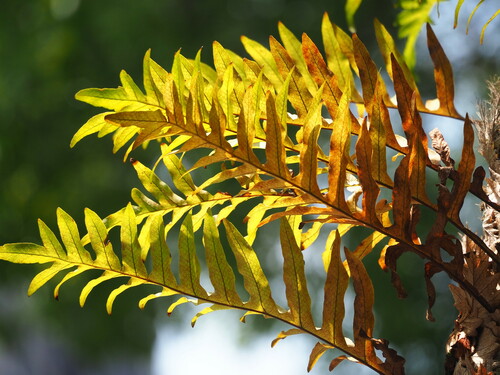
Aglaomorpha is a genus name that was proposed by Heinrich Wilhelm Schott and applied to a group of tropical ferns now more widely accepted under the older name Drynaria (Bory) J.Sm., in the subfamily Drynarioideae of the family Polypodiaceae (order Polypodiales). The Pteridophyte Phylogeny Group classification of 2016 (PPG I) used the name Aglaomorpha, but it was subsequently rejected in favour of Drynaria, which holds nomenclatural conserved status. The genus contains around 50 species, commonly known as basket ferns.
Basket ferns are immediately recognisable by their dimorphic fronds. Large, dark-green foliage fronds reach 60–120 cm in length; they are deeply lobed to pinnate, winged, and bear sori on their undersurfaces. A second type, the nest fronds, are smaller, rounded, and basal — they do not produce spores and remain persistent even after dying and turning brown. These dead nest fronds form a characteristic "basket" that catches falling litter and organic debris, which decomposes into humus directly beneath the plant, supplying nutrients that would otherwise be unavailable to a plant suspended off the ground. The creeping rhizomes, densely clad in brown scales, anchor the plant to a host tree or rock.
Plants are epiphytic (growing on trees) or epipetric (growing on rocks), and are occasionally found on brick walls or other man-made structures. They are native to wet tropical and subtropical environments — rainforests across tropical Africa, South and East Asia, Southeast Asia, Australia, and Oceania. Several species are economically significant as medicinal plants, particularly Drynaria roosii (frequently cited under its illegitimate synonym D. fortunei), whose rhizomes are a classic remedy for bone injuries in Chinese traditional medicine.
Etymology
The name Aglaomorpha was coined by Heinrich Wilhelm Schott; it derives from Greek aglaos (bright, splendid) and morphe (form or shape), referring to the striking appearance of these ferns. The commonly used synonym Drynaria (Bory) J.Sm. derives from Greek drys (oak), alluding to the oak-leaf-like shape of the nest fronds in some species.
Distribution
Basket ferns are native to wet tropical environments from equatorial Africa through South Asia, East Asia, Southeast Asia, to Australia and Oceania. They grow primarily in rainforests, typically epiphytically on trees or epipetrically on rock faces, and are occasionally recorded on man-made structures such as brick walls.
Ecology
Basket ferns possess specialised nectaries on the bases or undersides of their fronds that secrete sugar- and amino-acid-rich nectar, possibly attracting ants for protection or spore dispersal. The ant Iridomyrmex cordatus is frequently associated with Drynaria quercifolia. In Queensland, Australia, D. rigidula acts as important shelter for amethystine pythons (Morelia amethistina) and scrub pythons (Morelia kinghorni), which seek refuge in large frond masses particularly during colder months. The persistent nest fronds also serve as growing substrates for ribbon ferns (Ophioglossum pendulum) and are hosts to numerous water-borne fungi.
Cultural Uses
Rhizome extracts of Drynaria roosii (often cited under its illegitimate synonym D. fortunei) are used extensively in traditional Chinese medicine across China, Taiwan, Vietnam, Thailand, and Laos to treat bone fractures and injuries; the Chinese common name gu-sui-bu literally means "mender of shattered bones." The oak-leaf fern, D. quercifolia, is used similarly in South Asia and Maritime Southeast Asia. None of the medicinal species are currently cultivated commercially for the herbal medicine industry, raising concerns about wild over-harvesting.
Conservation
Several species used in traditional medicine — notably D. roosii and D. quercifolia — face pressure from over-harvesting, and none are currently cultivated as a commercial alternative. Drynaria species are considered endangered in parts of New South Wales, Australia, where habitat loss and small population sizes compound the threat.
Taxonomy Notes
The name Aglaomorpha Schott is a synonym of Drynaria (Bory) J.Sm. under GBIF and current pteridological consensus. PPG I (2016) adopted Aglaomorpha for this clade, but the name was subsequently rejected in favour of the conserved name Drynaria, published by J. Smith in 1841. The genus belongs to subfamily Drynarioideae, family Polypodiaceae, order Polypodiales. The Checklist of Ferns and Lycophytes of the World (as of July 2025) recognises 34 accepted species plus three named hybrids.










