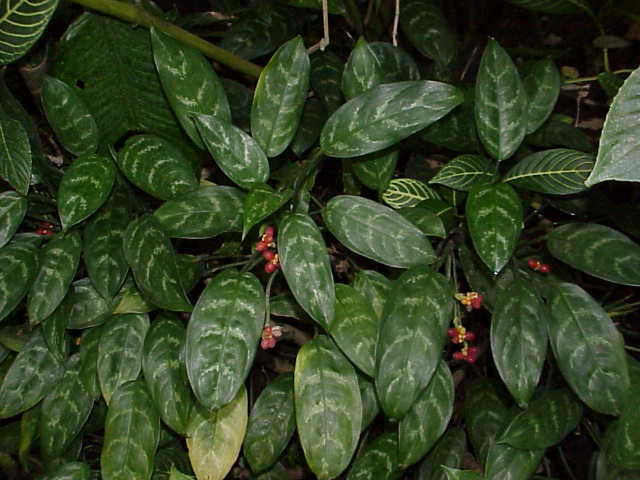
Aglaonema is a genus of evergreen, herbaceous flowering plants in the arum family (Araceae), known across English-speaking horticulture as Chinese evergreens. The genus was established by the Austrian botanist Heinrich Wilhelm Schott in 1829, and its name comes from Greek roots meaning "bright" and "thread," a reference to the conspicuous stamens of the small inflorescences. Species are native to the humid, shaded understory of tropical and subtropical forests across Southeast Asia and New Guinea, with a range that includes Assam, Bangladesh, Borneo, Cambodia, southern China, Myanmar, the Philippines, Thailand, and Vietnam.
Plants are typically low, erect, and bushy, reaching roughly half a meter in cultivation, with lance-shaped leaves that are frequently variegated in striking patterns of silver, cream, pink, or red on a green background. The genus is distinguished from the superficially similar Dieffenbachia by having five to eight main lateral leaf veins. Like other aroids, the inflorescence is a spadix subtended by a leafy spathe, and all parts of the plant contain calcium oxalate crystals that cause mucous-membrane irritation, oral burning, and contact dermatitis if chewed or handled roughly — a low-severity but well-documented toxicity.
The number of recognized species varies by source: Wikipedia lists around 24, the International Aroid Society recognises 26, and GBIF's backbone records 42 descendant names under the genus. Whichever count is followed, Aglaonema commutatum has become the genus's horticultural ambassador. It is native to the Philippines and northeastern Sulawesi and is the parent (with A. nitidum) of the cultivar 'Silver Queen', which holds the Royal Horticultural Society's Award of Garden Merit as a houseplant. Other commonly cited species include A. modestum, A. costatum, A. simplex, A. nitidum, A. pictum, and A. brevispathum, and modern breeding has produced more than fifty named cultivars in shades from deep crimson ('Siam Aurora', 'Lucky Red', 'Red Zircon') through classic silver-and-green.
Aglaonemas have been cultivated as auspicious, luck-bringing plants in parts of Asia for centuries and were introduced to Western horticulture in 1885. They are now among the most reliable foliage plants for low-light indoor spaces worldwide, prized for their tolerance of deep shade, average household humidity, and forgiving watering schedules.
Etymology
The genus name Aglaonema is built from the Greek roots aglaos, "bright" or "shining," and nema, "thread," a compound that refers to the conspicuous stamens of the small aroid flowers. The name was coined by Heinrich Wilhelm Schott when he established the genus in 1829.
Distribution
Aglaonema is native to the humid lowland and submontane forests of tropical and subtropical Asia and New Guinea. The natural range covers Assam and Bangladesh in the west, through Myanmar, southern China, Thailand, Cambodia, Vietnam, and the Malay Peninsula, into Borneo, the Philippines, and Sulawesi, with outliers reaching New Guinea. The horticulturally important Aglaonema commutatum is native to the Philippines and northeastern Sulawesi but has naturalised more widely in tropical regions including Cuba, Puerto Rico, Trinidad and Tobago, the Comoros, the Chagos Archipelago, India, Bangladesh, and the Cook Islands.
Ecology
Species grow as understory herbs in humid, shaded tropical forest, where they receive only filtered light and rarely experience cold temperatures. The genus as a whole is intolerant of chill: visible chilling injury begins at temperatures around 15 °C (59 °F), which constrains its natural range to the wet tropics and its cultivated range to indoor or sheltered growing conditions outside USDA zones 10b–11b.
Cultivation
Aglaonemas are among the most shade-tolerant common houseplants. They thrive in bright indirect light but accept deep shade — less than two hours of direct sun per day — making them well suited to north-facing rooms and offices. Daytime temperatures of about 70–80 °F are ideal; the plants resent cold drafts and chilling. They prefer high humidity but tolerate ordinary indoor air, and grow in a wide range of soils as long as drainage is good and the pH is slightly acidic (below 6.0). Keep the potting mix evenly moist from spring through autumn and ease back on water in winter. Outdoors they are hardy only in USDA zones 10b–11b. Cultivar choice drives most of the visual interest: 'Silver Queen' is the classic silver-on-green selection with an RHS Award of Garden Merit, while modern reds such as 'Siam Aurora', 'Lucky Red', and 'Red Zircon' have expanded the palette.
Propagation
Aglaonemas are propagated mainly by division of established clumps and by stem cuttings, both of which root readily in a warm, humid environment.
Conservation & Safety
The Global Invasive Species Database holds no entry for Aglaonema, and the genus is not flagged as an invasive concern in its archive. From a human-safety standpoint, all parts of these plants contain calcium oxalate crystals, classified as low-severity toxic: chewing leaves or stems can cause oral burning, swelling, swallowing difficulty, and vomiting, and skin contact with the sap may produce dermatitis. The plants themselves are robust in cultivation, with no serious disease or insect problems, though aphids, mealybugs, spider mites, and scale can occur indoors, and overwatering invites root rot.
Cultural Uses
In parts of Asia, Aglaonemas have been cultivated for centuries as auspicious, luck-bringing ornamentals, a cultural association that helped drive their popularity well before they reached Western greenhouses.
History
The genus was formally described by the Austrian botanist Heinrich Wilhelm Schott in the Wiener Zeitschrift für Kunst in 1829. Plants in cultivation in Asia for centuries before that were introduced to Western horticulture in 1885 and have since become a staple of indoor plant collections worldwide.
Taxonomy Notes
Aglaonema sits in the aroid family (Araceae), subfamily Aroideae, tribe Aglaonemateae, within the monocot order Alismatales. The number of accepted species is reported differently by different authorities: Wikipedia's diversity section lists about 24, the International Aroid Society recognises 26, and the GBIF backbone holds 42 descendant species names under the genus. The genus is morphologically close to Dieffenbachia but distinguishable by its 5–8 main lateral leaf veins.










