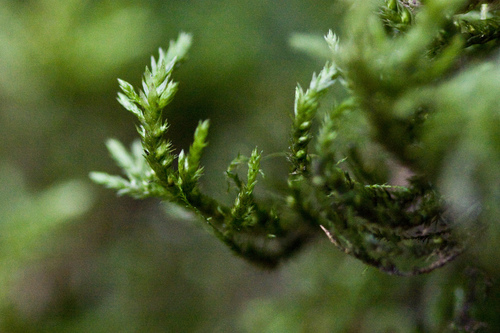
Alsia is a monotypic moss genus in the order Hypnales, containing the single species Alsia californica (Hook. & Arn.) Sull. Its family placement is disputed: the Flora of North America treats it under Neckeraceae, GBIF places it in Leptodontaceae, and iNaturalist and SEINet place it in Leucodontaceae.
The plants are large, forming thick, loose mats that are green, yellow-green, or stramineous, tail-forming, and wide-spreading. Primary stems are inconspicuous and stoloniform, tightly adnate to the substrate. Secondary stems are erect-ascending, reaching up to 8 cm tall, densely foliate, and irregularly subpinnate. They characteristically curl upward when dry and uncurl to an erect-ascending posture when moist. Lateral branches are of unequal length (5–15 mm), occasionally bearing gametangia or small branchlets.
Stem leaves are concave and about 2 mm long with obtuse bases. Branch leaves have weaker costae and may be ecostate. The perigonia (male reproductive structures) are conspicuous, about 1 mm, while perichaetia (female structures) are larger at about 5 mm. The seta (capsule stalk) is brown to red-yellow, straight, and mostly sheathed by the perichaetial leaves. Capsules are yellowish, 1.5–2 mm long, and smooth. Capsules mature in spring.
Alsia californica is an important component of the moss flora of maritime western North America. It was originally described as Neckera californica by Hooker and Arnott and later transferred to the genus Alsia by William Starling Sullivant in 1855.
Etymology
The genus name Alsia was published by American bryologist William Starling Sullivant in 1855. The etymology of the name is not recorded in accessible sources. The species epithet "californica" refers to California, where the type was collected.
Distribution
Alsia californica is restricted to the Pacific coast of North America, ranging from southwestern British Columbia (including Vancouver Island and the Fraser River Valley) south through Washington, Oregon, and California (from Del Norte County to Los Angeles County), and into Baja California, Mexico. It is primarily coastal and maritime in distribution, quickly diminishing with distance from the ocean; inland occurrences are limited to canyon riparian microhabitats. It occurs at low to moderate elevations (0–700 m).
Ecology
Alsia californica grows as an epiphyte on the bark of trunks and branches of many tree species including maple (Acer), alder (Alnus), chinquapin (Chrysolepis), tanoak (Lithocarpus), oak (Quercus), spruce (Picea), poplar (Populus), elderberry (Sambucus), redwood (Sequoia), and California bay (Umbellularia). It also colonizes rock surfaces, usually siliceous ones. In California, Oregon, and Washington it is strongly tied to maritime habitats. In British Columbia it extends further inland along the Fraser River Valley. Ecovariant forms occur on guano-enriched rock islands immediately offshore, and flagelliform variants with caducous leaves appear in poplar stands and in the sun-drenched upper canopies of coastal redwoods.
Taxonomy Notes
Family placement of Alsia is disputed among three families:
- Neckeraceae — Flora of North America (Volume 28), where it is treated under Neckera californica as the basionym.- Leptodontaceae — GBIF (both genus and species records).- Leucodontaceae — iNaturalist and SEINet.
The genus was erected by William Starling Sullivant in 1855, transferring Neckera californica Hook. & Arn. into it. A variety, Alsia californica var. flagellifera (Renauld & Cardot) Sull., has been described for flagelliform forms found in poplar stands of the Fraser Valley and occasionally in redwood canopies.










