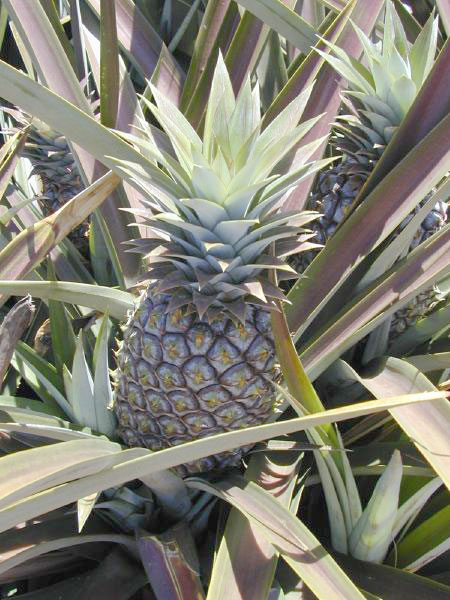
Ananas is a small genus of tropical plants in the family Bromeliaceae (order Poales), native to South America. The genus is dominated by a single species of global economic importance: Ananas comosus, the pineapple, widely considered the most economically significant plant in the entire bromeliad family.
Plants in the genus are herbaceous perennials, typically growing 1 to 1.5 metres tall. They produce a short, stocky central stem bearing 30 or more narrow, tough, waxy leaves 30–100 cm in length with sharp spines along the margins. After 12 to 20 months of vegetative growth, the stem develops a spike-like inflorescence bearing over 100 spirally arranged flowers. Each flower produces a berry, and these berries fuse together into the familiar compact multiple fruit, whose scales are typically arranged in two interlocking Fibonacci spirals. Ananas employs CAM (Crassulacean Acid Metabolism) photosynthesis, fixing carbon dioxide at night to reduce water loss — an adaptation to the warm, seasonally dry habitats of tropical South America.
The wild ancestor of the cultivated pineapple originated in the Paraná–Paraguay River drainages between southern Brazil and Paraguay, and was being cultivated by Indigenous peoples of South America, Central America, and the Caribbean long before European contact. Archaeological evidence places its cultivation in Peru as early as 1200–800 BC. Christopher Columbus encountered the fruit in Guadeloupe in 1493 and brought it back to Spain, after which the Portuguese introduced it to India by 1550, and it spread rapidly around the tropical world. By the 17th century the pineapple had become a potent symbol of luxury and hospitality in Europe.
The genus name Ananas comes from the Tupi-Guarani and Carib word nanas, the name Indigenous peoples of South America used for the fruit as a staple food. This was recorded by European explorers and adopted into many European languages, becoming the basis for the plant's binomial nomenclature.
Etymology
The genus name Ananas derives from nanas, the word used by the Tupi-Guarani and Carib peoples of South America for the fruit, which was a staple food. The Tupi word was recorded by André Thevet in 1568 and adopted into many European languages. The species epithet comosus is Latin for 'tufted', referring to the leafy stem (crown) at the top of the fruit.
Distribution
The genus is native to tropical South America, with the wild progenitor of the cultivated pineapple originating in the Paraná–Paraguay River drainages between southern Brazil and Paraguay. Cultivation spread throughout the Americas, the Caribbean, and later to Africa, India, Southeast Asia, and Australia following European contact. Today pineapple is commercially produced across the tropics, with Costa Rica, the Philippines, and Indonesia each producing approximately 3 million tonnes annually as of 2024.
History
The pineapple was cultivated by the Mayas and Aztecs by at least 200 BC–700 AD, and by the late 1400s was widely distributed as a staple food of Indigenous Americans. Christopher Columbus encountered it in Guadeloupe on 4 November 1493 — the first European contact — and brought it to Spain. The Portuguese introduced it to India by 1550, and the Spanish introduced the 'Red Spanish' cultivar to the Philippines, where its leaf fibers (piña) became central to a traditional textile industry. Introduced to Europe in the 17th century, the pineapple became a major cultural icon of luxury and hospitality. Commercial industrial cultivation in greenhouses began in the 1820s.
Cultivation
Pineapples are propagated vegetatively from the crown (the leafy top of the fruit), from side suckers that emerge at the leaf axils of the main stem, or from slips produced near the base of the fruit. Under commercial cultivation, flowering can be induced artificially, and early harvest of the main fruit encourages a second crop of smaller fruits. Because seed development diminishes fruit quality, cultivated pineapples are hand-pollinated and seeds are retained only for breeding programs.
Cultural Uses
The pineapple (Ananas comosus) is one of the world's most widely consumed tropical fruits, valued for its sweet, acidic flesh and juice, which are used in cuisines, desserts, and beverages globally. The leaves of certain cultivars — particularly 'Red Spanish' — yield piña fiber, which has been woven into fine textiles in the Philippines since at least the 17th century. The fruit's visual distinctiveness led to its adoption as a symbol of hospitality and luxury in European and colonial cultures from the 17th century onward. Some Ananas species are also cultivated as ornamental plants for their colorful foliage and unusually shaped fruits.










