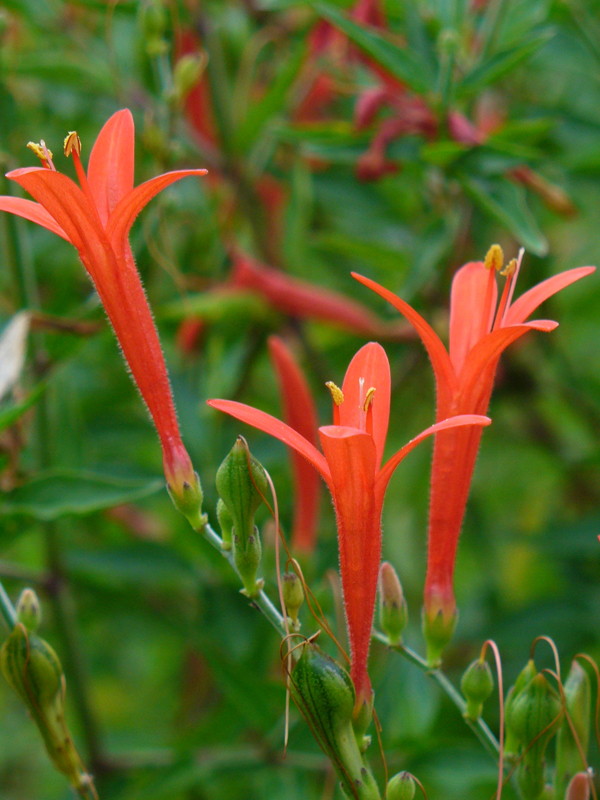
Anisacanthus is a genus of flowering plants in the family Acanthaceae (the bear's breeches family), placed within the order Lamiales. The genus comprises approximately eleven accepted species of shrubs and subshrubs native to tropical and subtropical regions of the Americas, ranging from the southwestern United States and Mexico through Central America to South America.
Members of the genus are commonly known as desert honeysuckles, a name shared with the closely related genus Ancistranthus. The common name is something of a misnomer: true honeysuckles belong to the genus Lonicera in the unrelated family Caprifoliaceae, whereas Anisacanthus belongs to the Acanthaceae. Plants in this genus are typically drought-tolerant shrubs that produce tubular, often brightly colored flowers attractive to hummingbirds. Notable species include Anisacanthus quadrifidus (flame anisacanthus or Wright's desert honeysuckle), Anisacanthus thurberi (Thurber's desert honeysuckle), and Anisacanthus linearis (narrowleaf desert honeysuckle). Several species are cultivated as ornamental plants, particularly in xeriscape gardens in arid regions of the American Southwest.
Etymology
The name Anisacanthus derives from the Greek words ἄνισος (anisos, meaning "unequal") and ἄκανθος (akanthos, meaning "spine" or "thorn"), referring to the unequal spiny character of the plants. The common name "desert honeysuckle" is shared with the related genus Ancistranthus and is considered a misnomer, as true honeysuckles (genus Lonicera) belong to the family Caprifoliaceae.
Distribution
Anisacanthus species are native to tropical and subtropical regions of the Americas, with the center of diversity in Mexico and the southwestern United States, and additional species extending into Central America and South America.
Cultivation
Species of Anisacanthus are sometimes cultivated as ornamental shrubs, particularly in xeriscape gardens suited to arid and semi-arid climates. Their drought tolerance and tubular flowers, which attract hummingbirds, make them popular choices for water-wise landscaping in the American Southwest.

