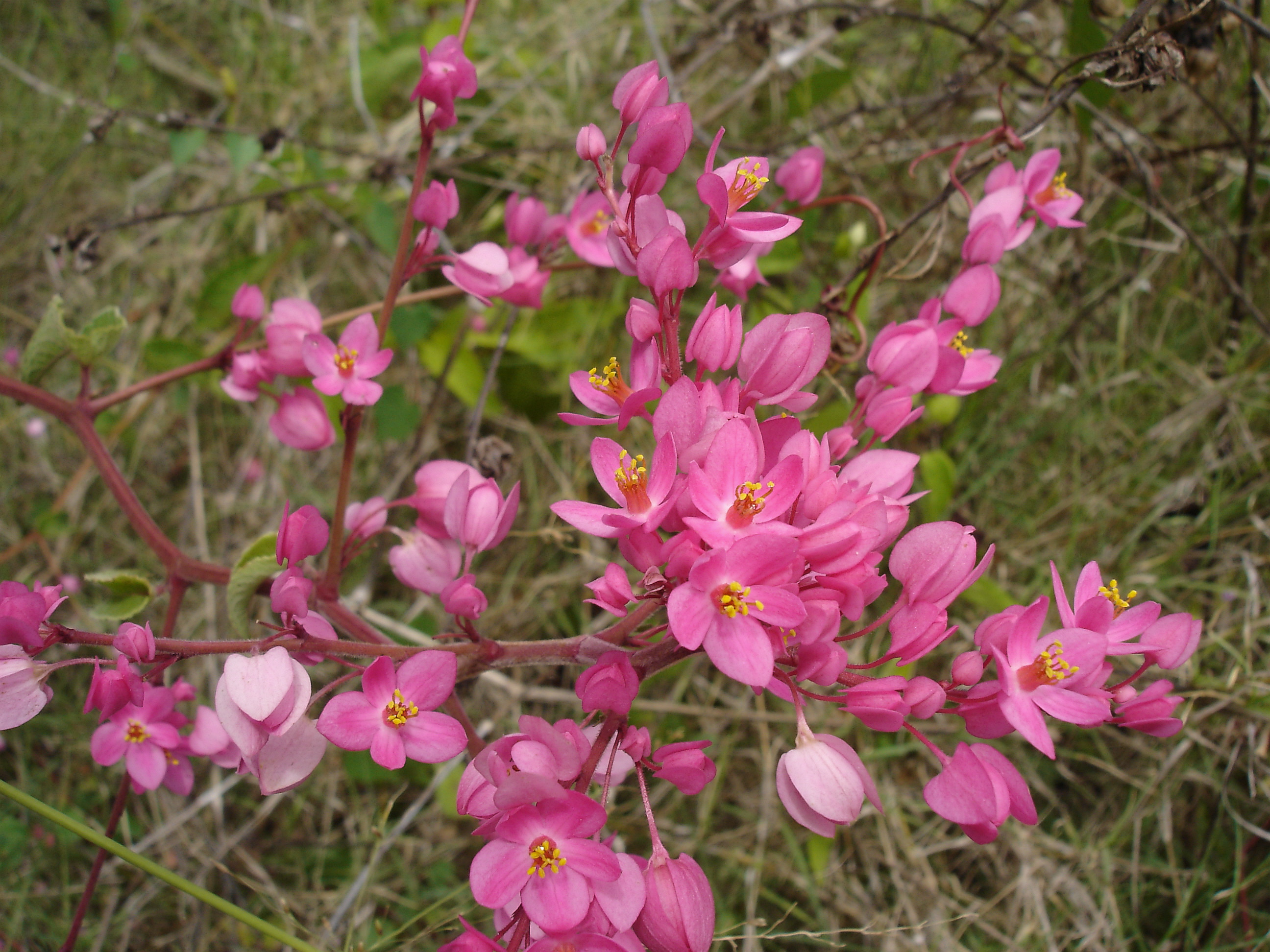
Antigonon is a small genus of flowering vines in the buckwheat family, Polygonaceae, placed in the order Caryophyllales. It was formally described by the botanist Stephan Endlicher in 1837. The genus contains approximately three species, all native to the Americas, ranging from Mexico and Central America through parts of the Caribbean.
Plants in this genus are vigorous, tendril-climbing vines that grow from a stout tuberous root system, which allows them to survive drought and periodic die-back. The stems branch freely and produce coiled tendrils that allow the plant to scramble over supporting vegetation or structures. Leaves are alternately arranged and typically heart-shaped to ovate, with a somewhat rough or papery texture.
The flowers are produced in raceme-like clusters, often concentrated toward the stem tips and tendrils. Each flower is bell-shaped and composed of five tepals — the perianth parts are not differentiated into distinct petals and sepals — typically in shades of pink or rose-purple, though white- and yellow-flowered forms are known. The stamens are fused at their bases into a short tube. The most widely cultivated species, Antigonon leptopus (coral vine, chain-of-love, queen's wreath), is grown as an ornamental throughout tropical and subtropical regions worldwide for its profuse and long-lasting floral display.
Etymology
The genus name Antigonon was established by Stephan Endlicher in 1837 in his Genera Plantarum (Endl. Gen. 310). The precise Greek derivation of the name is not documented in the primary botanical literature.
Distribution
Antigonon comprises approximately three species native to the Americas, with the range centred in Mexico and Central America (including Guatemala). Antigonon leptopus has been widely introduced and naturalized across tropical and subtropical regions globally, where it is cultivated as an ornamental and has in some areas become invasive.
Ecology
The vines grow from tuberous roots, a trait that aids survival through dry seasons and provides resprouting capacity after disturbance or fire. Flowers attract a range of pollinators, and the genus is adapted to seasonally dry tropical habitats, thriving in disturbed areas, forest margins, and secondary growth.
Cultivation
Antigonon leptopus is the principal cultivated species, widely grown as an ornamental climber in tropical, subtropical, and warm-temperate gardens. It is valued for its profuse, long-lasting pink flowers and vigorous growth over fences, trellises, and arbours. White-flowered cultivars are also in cultivation. Plants can become weedy or invasive outside their native range and should be managed accordingly.










