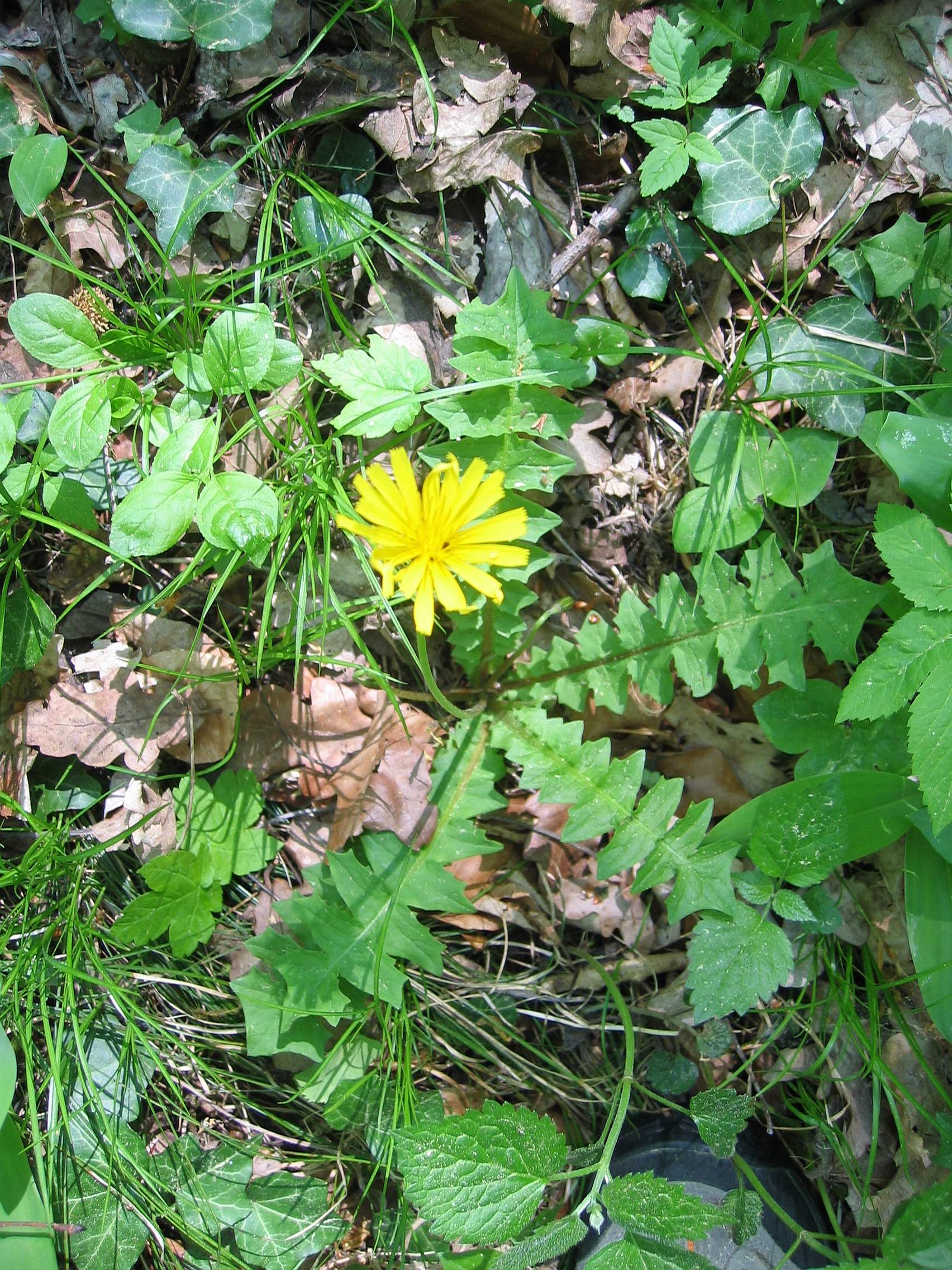
Aposeris is a monotypic genus of flowering plants in the daisy family, Asteraceae (order Asterales). Its sole species, Aposeris foetida, is a perennial hemicryptophyte growing 10–20 cm tall, entirely hairless. It produces several leafless, unbranched stems, each bearing a single yellow flower head. The leaves form a basal rosette and are pinnatisect, with 3- to 5-angled segments that narrow into a winged petiole. The involucre is about 1 cm long, with bracts arranged in two rows — the outer ones much reduced. The ligulate florets are yellow. The fruits (cypselae) are 4–5 mm long, shortly and densely hairy, and lack both a beak and a pappus. Flowering occurs from June to July.
The genus name has a complex nomenclatural history: coined by Necker in 1790 (a rejected publication), validated by Cassini in 1827, with the species recombination formally credited to Lessing.
Etymology
The name Aposeris was coined by the botanist Noël Martin Joseph de Necker in 1790, but all names published in that work were later declared rejected under the botanical code. The genus name was validated by Alexandre Henri Gabriel de Cassini in 1827. The sole species epithet foetida (meaning “fetid” or “stinking”) refers to the plant’s unpleasant scent. The formal recombination of the species name is credited to Christian Friedrich Lessing.
Distribution
Aposeris foetida is native to central and southeastern Europe, ranging from the northern and western Alps through the Alpine foreland to the southern slopes and into southeastern Europe. Its distribution is described as central- and southeastern-European (Mittel- und südosteuropäisch). In Switzerland, it occurs in fir-spruce forests and calcareous pastures at montane to subalpine elevations, occasionally reaching the alpine zone.
Ecology
Aposeris foetida is a perennial hemicryptophyte of montane to subalpine fir-spruce forests (phytosociological unit Abieti-Piceion) and calcareous pastures. It prefers neutral to basic, medium-moist, moderately nutrient-poor to medium-rich soils in lighted to partially shaded positions, with a sub-Atlantic to subcontinental climatic affinity. Ecological indicator values (Landolt et al. 2010): humidity 3+, light 3, reaction 4 (neutral to basic), temperature 2+ (lower subalpine/upper montane), nutrients 3, continentality 2 (sub-Atlantic).
Conservation
Aposeris foetida is assessed as Least Concern (LC) on the Swiss national and regional Red Lists. It has no national priority status, no international responsibility designation, and no legal protection under Swiss cantonal or federal law.
Taxonomy
The genus Aposeris (Asteraceae) is monotypic, containing only Aposeris foetida. The name was originally published by Necker (1790) but that work was subsequently rejected nomenclaturally. Cassini (1827) is recognized as the validating author of the genus name, and Lessing is credited with the formal species recombination. GBIF records no synonyms for this genus.










