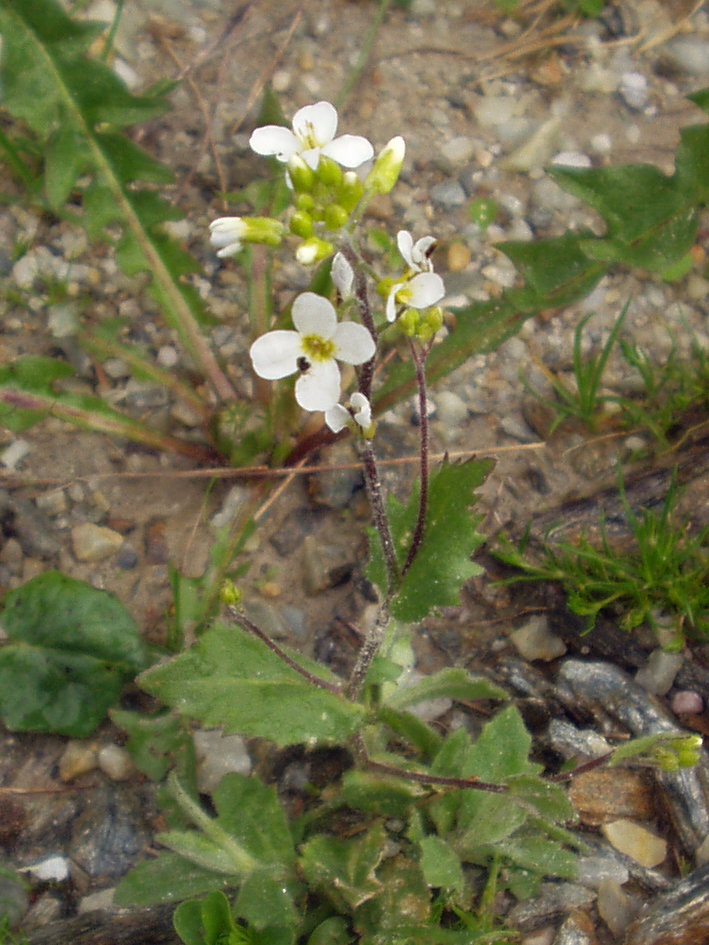
Arabis, commonly known as rockcress, is a genus of flowering plants in the mustard family (Brassicaceae), established by Linnaeus in 1753. The genus comprises annuals, biennials, and perennials ranging from 10 to 80 cm in height. Plants typically form basal rosettes alongside cauline leaves that are simple, entire to lobed or dentate, and 1–6 cm long. Stems may be erect, ascending, or decumbent, unbranched or branched distally, and are covered in variable pubescence consisting of stalked and stellate trichomes.
The small, four-petaled flowers are most often white but can range to pink or purple, with tetradynamous stamens. Fruits are narrow, linear siliques — usually sessile, smooth or slightly torulose, and flattened — containing uniseriate, flattened seeds that are often winged or margined and are not mucilaginous when wetted. The base chromosome number is x = 8.
The genus is distributed across the Northern Hemisphere and encompasses a wide ecological range, from lowland deserts to alpine rocky slopes and cliffs. Pollinators include members of Apieae and Lepidoptera. GBIF records 266 descendant taxa; other sources cite approximately 180 recognized species — a disparity reflecting differing circumscriptions and the recent major taxonomic revision of the group.
Following molecular phylogenetic work, the broadly defined Arabis was found to comprise two groups that are not each other's closest relatives. As a result, most New World species have been transferred to the segregate genus Boechera, while most Old World members are retained in Arabis sensu stricto.
Etymology
The genus name Arabis is of Latin origin, derived from Arabia — historically used to refer to plants associated with arid, rocky landscapes reminiscent of the Arabian Peninsula. The name reflects the genus's characteristic habitat on dry rocky slopes and cliff faces. The English pronunciation is /ˈærəbɪs/.
Distribution
Arabis is distributed across the Northern Hemisphere, spanning Europe, North Africa, and temperate Asia to Japan, with additional representation in North America before the segregation of Boechera. The genus inhabits a wide range of elevations and substrates, from lowland deserts and dry grasslands to subalpine and alpine rocky slopes, cliff faces, and scree. In Switzerland and central Europe, several Arabis species occur in mountain and subalpine zones, while in the American Southwest the genus is recorded across Arizona, New Mexico, and the Colorado Plateau.
Ecology
Arabis plants occupy rocky, cliff-side, and dry habitats, and are well adapted to poor, well-drained soils across a broad altitudinal gradient. The genus tolerates both sunny and semi-shaded positions. Pollinators include members of Apieae (umbellifers) and Lepidoptera (butterflies and moths). Several species have adapted to colonize walls, banks, hedgerows, and waste places, and a number are considered weeds in disturbed or non-native ranges.
Cultivation
Some Arabis species, most notably Arabis alpina and Arabis caucasica, are cultivated as ornamental plants, particularly valued as low-growing ground covers and rock-garden subjects. They suit well-drained, sunny to partly shaded positions and tolerate dry, poor soils. Many other members of the genus are regarded as weeds and are not cultivated intentionally. Arabis is best suited to specialized garden settings — rock gardens, wall crevices, and alpine troughs — rather than general landscape use.
Propagation
Arabis can be propagated by seed sown in spring directly into well-drained soil. Vegetative propagation via division of established clumps is also practiced for ornamental perennial forms. The plants are generally easy to establish in appropriate rocky or sandy substrates.
Taxonomy
Arabis L. was formally established by Carl Linnaeus in Species Plantarum (1753, p. 664) within the family Brassicaceae (mustard family), order Brassicales. The GBIF accepted name is Arabis L. (ID 5374837). Historical synonyms include Abasicarpon, Abazicarpus, Arabidium, Arabisa, and Cardaminopsis.
Molecular phylogenetic analyses demonstrated that the traditionally broad circumscription of Arabis was polyphyletic — the Old World and New World lineages are not each other's closest relatives. This prompted a major rearrangement: most New World species (formerly North American "Arabis") were transferred to the reinstated genus Boechera, while Old World species are retained in Arabis sensu stricto. The base chromosome number is x = 8, and the silique has complete, membranous, translucent, veinless septa — a key diagnostic character.










