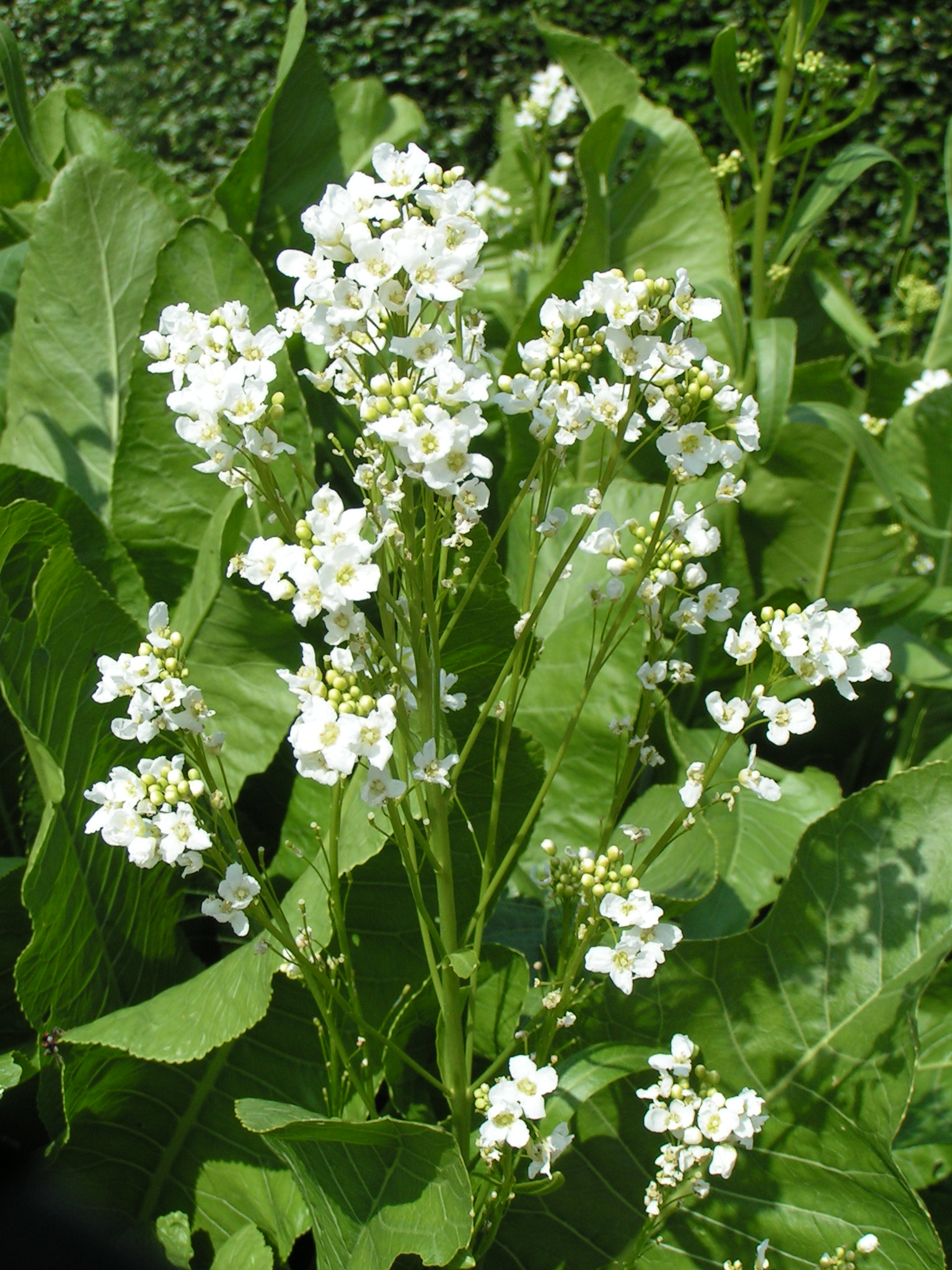
Armoracia is a small genus of perennial flowering plants in the family Brassicaceae (the mustard family), within the order Brassicales. It is native to the Palaearctic — southeastern Europe and western Asia — though its most famous member has been spread worldwide through cultivation. Plants of the World Online recognizes three species: Armoracia rusticana, A. macrocarpa, and A. sisymbrioides; many further names have been described historically but subsequently synonymized.
The genus is best known for Armoracia rusticana, horseradish, which serves as the type species. Horseradish is a robust perennial growing up to 1.5 metres tall, with large, bright green, hairless, unlobed leaves that can reach 1 metre in length. The white four-petalled flowers are scented and borne in dense panicles. The plant is cultivated primarily for its thick, white, tapered taproot. A characteristic biochemical reaction occurs when the root is cut or grated: enzymes break down the glucosinolate sinigrin to release allyl isothiocyanate (mustard oil), producing the sharp, pungent aroma and heat that horseradish is known for. Exposure to air or heat dissipates this pungency and darkens the flesh.
Armoracia has been cultivated since antiquity. The genus was formally named by Heinrich Bernhard Ruppius in his Flora Jenensis (1745), though Linnaeus later classified the horseradish as Cochlearia armoracia. The roots and leaves have long served both culinary and medicinal purposes across Europe and Asia.
Etymology
The genus name Armoracia was first formally applied by Heinrich Bernhard Ruppius in his Flora Jenensis (1745); Linnaeus subsequently used Cochlearia armoracia for the same plant. The name is possibly derived from "Amoracia," the term used by Pliny the Elder in his Natural History to describe a plant recommended for its medicinal qualities. The common name "horseradish" — attested in English from the 1590s — combines "horse" (used figuratively to mean large, strong, or coarse) and "radish."
Distribution
Armoracia is native to the Palaearctic, with its origin centered in southeastern Europe and western Asia. Through centuries of cultivation, Armoracia rusticana has become naturalized across temperate regions worldwide, including North America (where it was introduced during European colonization) and much of Europe.
History
Horseradish has been cultivated since antiquity. Dioscorides listed it under the names Persicon sinapi and Sinapi persicum; Pliny the Elder referred to it as "Amoracia" and recommended it for medicinal use; Cato discussed it in his agricultural treatises. A mural in Ostia Antica depicts the plant. During the Middle Ages, both roots and leaves were used in traditional medicine across Europe. By the 16th and 17th centuries, herbalists including Pietro Andrea Mattioli and John Gerard documented it, and Gerard recorded its use as a sauce with fish in Germany. It was introduced to North America during European colonization, with both George Washington and Thomas Jefferson recording it in garden accounts.
Cultivation
Horseradish (A. rusticana) is perennial in hardiness zones 2–9 and may be grown as an annual elsewhere. The root is harvested in autumn after the first frost kills the leaves; offshoots are replanted to produce the following year's crop. Plants spread via underground shoots and can become invasive if left undisturbed; older roots left in the ground become woody and lose culinary value, though they can be dug and divided to start new plants.
Cultural Uses
Armoracia rusticana (horseradish) has been used as a condiment with meats and fish in Germany, Scandinavia, and Britain for centuries, and is today used worldwide as a spice and condiment. Both roots and leaves served as traditional medicine during the Middle Ages. Native Americans used horseradish to stimulate the glands, to combat scurvy, and as a diaphoretic treatment for the common cold.










