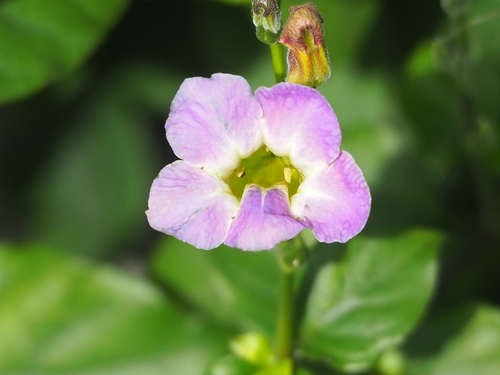
Asystasia is a genus of flowering plants in the family Acanthaceae, order Lamiales, described by the Dutch botanist Carl Ludwig Blume in 1826. The genus comprises approximately 59 accepted species distributed across the tropics of Africa, Asia, Australia, and New Guinea.
Plants in the genus are typically perennial herbs or subshrubs with weak, trailing or sprawling stems. The best-known member, Asystasia gangetica (Coromandel), is a rapidly spreading perennial herb whose stems can reach over 1 metre in length, sprawling along the ground or scrambling over surrounding vegetation up to 3 metres tall. Like other members of Acanthaceae, flowers are tubular and typically two-lipped (bilabiate), with bees serving as primary pollinators.
Several species, particularly A. gangetica, are notable as aggressive weeds in plantation agriculture and disturbed habitats throughout the tropics, having naturalized far beyond their native range in tropical Africa and South and Southeast Asia. In oil palm plantations the species can come to dominate the ground layer rapidly if left unchecked. Despite its weedy character, A. gangetica is also valued as a food plant — its leaves and young shoots are eaten as a cooked vegetable across West Africa and Southeast Asia — and as a traditional medicinal herb used widely across its range. The genus is also cultivated as an ornamental ground cover in tropical and subtropical gardens.
Etymology
The genus name Asystasia is derived from Greek, meaning "inconsistency" or "instability," a reference to the variable or inconstant character of the flowers across the group. It was formally described by Carl Ludwig Blume in 1826 in his Bijdragen tot de flora van Nederlandsch Indië.
Distribution
Asystasia is native to the tropics of Africa, South and Southeast Asia (from India through Indonesia and the Philippines), Australia, and New Guinea. Asystasia gangetica, the most widespread species, has naturalized throughout the Pacific and other tropical regions well beyond its native range, particularly in disturbed habitats, roadsides, and riverbanks.
Ecology
Species of Asystasia favour humid tropical conditions, growing on roadsides, riverbanks, and disturbed ground in both semi-waterlogged and well-drained cultivated areas. Asystasia gangetica thrives where mean annual rainfall is 1,200–2,100 mm and may not persist without irrigation during dry seasons longer than four months. Bees are the primary pollinators. The genus has significant invasive weed potential in plantations and agricultural land throughout the humid tropics.
Cultivation
Asystasia gangetica and related species grow readily in humid tropical and subtropical climates. They are tolerant of cutting and can be maintained as ground cover or even mown as part of a low-traffic lawn. Plants grow best where rainfall is ample year-round; supplemental irrigation is needed where dry seasons exceed four months.
Cultural Uses
Several Asystasia species, especially A. gangetica, have long been used as food and medicine across Africa and Asia. Leaves and young shoots are eaten cooked as a pot herb — often mixed with beans, groundnut, or sesame paste — and are sold in local markets during the rainy season in parts of West Africa. In traditional medicine the plant is used across its range, and in Southeast Asia it is sold in Chinese medicine shops as 'kaw kua chai'. Phytochemical studies have identified alkaloids, tannins, steroidal saponins, flavonoids, and triterpenoids in the plant. The genus is also widely grown as an ornamental ground cover in tropical gardens.










