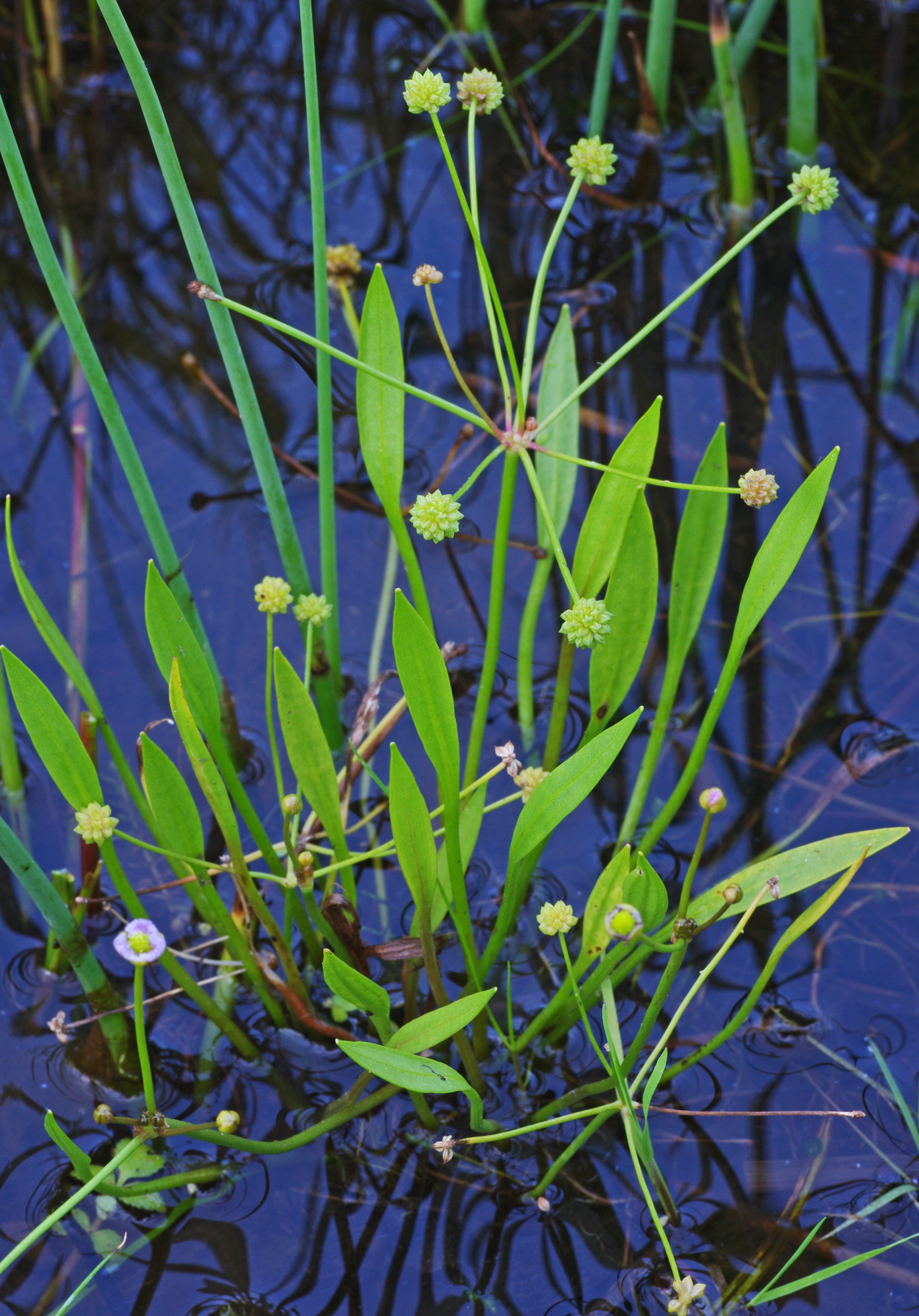
Baldellia is a small genus of aquatic monocots in the family Alismataceae (order Alismatales), commonly called lesser water-plantains. It contains three species distributed across much of Europe and the Mediterranean region, ranging from Ireland and the Canary Islands in the west to Turkey and Estonia in the east. The genus is very closely related to Echinodorus, another member of the water-plantain family.
Plants are aquatic or semi-aquatic, variable in form depending on ecological conditions. Leaves are aerial, elliptical to lanceolate or linear-lanceolate. Flowers are hermaphrodite, arranged in one to three whorls in umbels or racemes, or borne on long peduncles in the leaf axils. Each flower has six stamens and numerous carpels spirally arranged in a globose head; carpels are free and each contains a single ovule with apical styles. The small fruitlets are achenial and longitudinally five-ribbed, terminating in a short apical beak. Chromosome number is 2n=16.
The three recognised species are Baldellia ranunculoides, the most widespread, extending from the Azores and Ireland through to Turkey and Estonia; Baldellia repens, found in the Canary Islands, Iberian Peninsula, North Africa, and parts of western Europe; and Baldellia alpestris, restricted to northwestern Spain and northern Portugal.
Etymology
The genus name Baldellia honors Bartolommeo Bartolini-Baldelli, an Italian nobleman. No further derivation details are recorded in the primary sources.
Distribution
Baldellia species occur across much of Europe and the Mediterranean, from Ireland and the Canary Islands in the west to Turkey and Estonia in the east. Individual species have more restricted ranges: B. ranunculoides is the most widespread, B. repens is concentrated in the western Mediterranean and Macaronesia, and B. alpestris is confined to the northwestern Iberian Peninsula.
Ecology
Plants grow in aquatic or semi-aquatic habitats and are notably variable in morphological form depending on local ecological conditions (water depth, flow, substrate). The genus belongs to the water-plantain family (Alismataceae), a group typically associated with shallow freshwater margins, marshes, and slow-moving watercourses.










