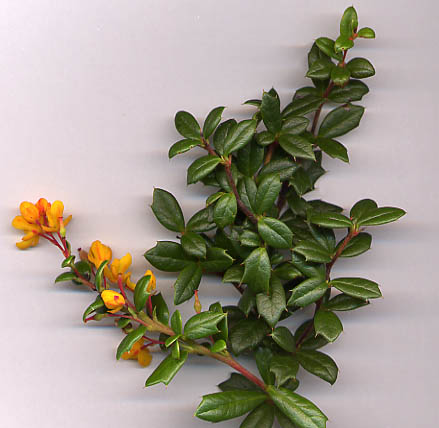
Berberis, commonly known as barberry, is a large genus of evergreen and deciduous shrubs in the family Berberidaceae. Estimates of the number of species vary by source, from roughly 500 to more than 600 currently accepted names, with the GBIF backbone listing 769 descendant taxa for the genus.
The plants are woody shrubs ranging from low-growing forms about 10 centimetres tall to robust shrubs reaching 4 to 5 metres. A defining feature of the genus is the presence of sharp spines: stems carry stiff, often three-pronged thorns that are modified leaves, while the true foliage clusters at short shoots above them. Leaves are commonly 1 to 10 centimetres long, sometimes spiny-toothed at the margins, and the foliage of many species is glossy and leathery, taking on rich red, orange, or purple tones in autumn.
Flowering is conspicuous and reliable. Small yellow to orange flowers, sometimes fragrant, appear in spring in pendulous racemes or occasionally singly. These give way to small berries 5 to 15 millimetres long that ripen red, purple, or dark blue, often dusted with a pale waxy bloom and persisting into winter. The berries of many species are edible and rich in vitamin C, with a distinctly acidic, lemony flavour.
The genus has long been valued for its hardy, adaptable nature in cultivation, but it carries a few important caveats. Several Berberis species act as alternate hosts for wheat stem rust (Puccinia graminis), and historic outbreaks of this disease led to legal restrictions on selling certain species in parts of the United States and Canada. More recently, Japanese barberry (Berberis thunbergii) has become an aggressive invader of woodlands across much of the eastern United States. Berberis was formally described by Linnaeus in Species Plantarum (1753), with Berberis vulgaris as the type species; modern molecular work supports keeping Mahonia as a separate, closely related genus.
Distribution
Berberis is broadly distributed across the temperate and subtropical regions of the world, with the conspicuous exception of Australia. The greatest species diversity occurs in South America and Asia, but native species also occur in Europe, Africa, and North America, including a substantial radiation in the mountains of the American Southwest. In Switzerland, three species are documented in the wild: Berberis vulgaris (native), B. thunbergii, and B. julianae. Many of the South American and Asian species are mountain plants of cool, humid uplands, while others extend into drier, continental habitats.
Ecology
The most significant ecological role of Berberis is as an alternate host for the wheat stem rust fungus, Puccinia graminis. The rust completes part of its life cycle on barberry leaves before reinfecting cereal crops, and outbreaks linked to barberry hedgerows have caused severe historical losses. Because of this, the sale and planting of certain species has been legally restricted in the United States and Canada. Berberis fruits are taken by birds, which act as the main dispersal agents and help account for the rapid spread of cultivated species into surrounding habitats.
Cultivation
Berberis is a popular landscape genus prized for its tough constitution, dense spiny growth, fragrant spring flowers, and ornamental fruit. It is used for borders, hedges, screens, groundcovers, accent plantings, and security barriers, and integrates well into Asian, cottage, rock, drought-tolerant, winter, and shade gardens. Plants grow at a medium rate, tolerate clay, loam, or sandy soils on the acid-to-neutral side of pH 8, and do best with good drainage. They flower and fruit most reliably in full sun but accept partial shade, and they tolerate heavy clay and thin, dry sites once established. Many species reach a fruiting maturity within three to five years. Common cultivation problems include leaf spots, rusts, aphids, scale, whiteflies, and chlorosis on alkaline soils; ingestion of foliage or large quantities of fruit is mildly toxic and may cause gastrointestinal upset. Hybridization between species is frequent in gardens, which can complicate identification of cultivated specimens.
Conservation
At the genus level Berberis is not of broad conservation concern, but it is a notable source of invasive plants. Berberis thunbergii (Japanese barberry) is considered invasive in 32 US states, where it forms dense thickets that displace native vegetation, resist browsing by deer, and have been linked to elevated populations of ticks that vector Lyme disease. The combination of suckering growth, prolific bird-dispersed fruit, and tolerance of disturbed habitat means several other introduced Berberis species have also become locally problematic.
Cultural Uses
Berberis fruits have a long history of culinary use. The dried berries of Berberis vulgaris (zereshk) are a staple of Iranian cuisine, where they are used to flavour rice and stews, and the fresh fruit of many species is made into jellies, preserves, syrups, and wine. The bright yellow inner wood and root bark contain berberine, an isoquinoline alkaloid that has been used historically as a yellow dye for wool and leather and that gives Berberis its long-standing place in traditional medicine. Berberine itself has well-documented antibacterial activity and has been applied to enteric infections such as bacillary dysentery; additional pharmacological effects, including reported antitumour activity, have been investigated in the laboratory.
Taxonomy Notes
Berberis was established by Carl Linnaeus in Species Plantarum (1753), with Berberis vulgaris designated as the type species, and is the type genus of the family Berberidaceae in the order Ranunculales. The genus has long been entangled with Mahonia, a group of compound-leaved species sometimes treated within Berberis and sometimes as a separate genus; molecular phylogenetic work cited in modern treatments supports keeping Mahonia as a distinct but closely related genus, although regional floras (for example in the American Southwest) still vary in their treatment. GBIF currently recognises 769 descendant taxa within Berberis, while horticultural and floristic sources commonly cite figures of around 500 to 600 accepted species.
Propagation
Fresh seed is the most reliable means of raising species from wild origin. It germinates best when sown as soon as it is ripe in autumn, kept in a cold frame over winter to satisfy its dormancy requirement. Selected forms and named cultivars are usually multiplied vegetatively from cuttings of half-ripe wood taken in July or August and rooted in a closed frame, or by simple layering of low branches.

