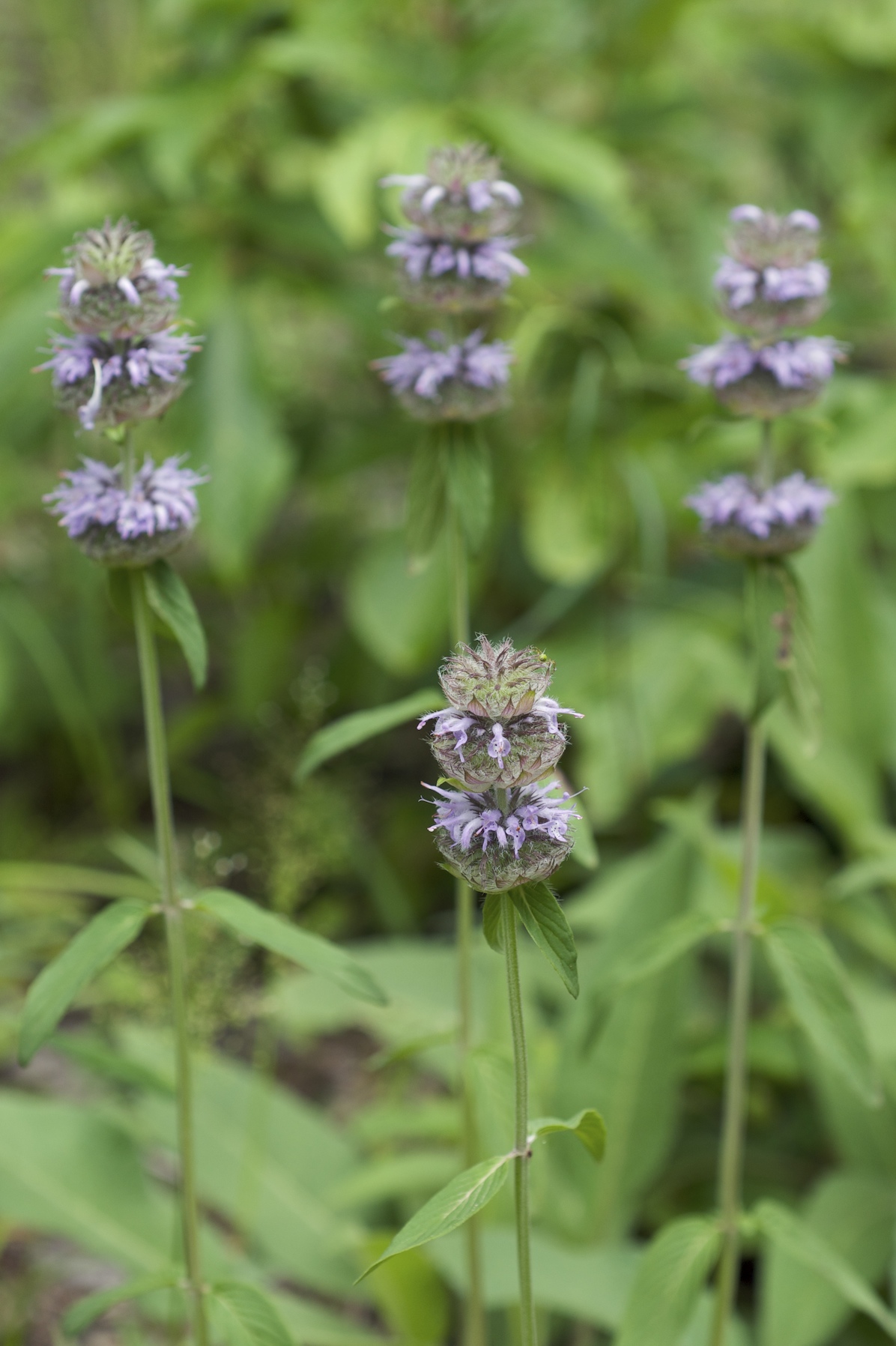
Blephilia is a small genus of four species of herbaceous perennial flowering plants in the family Lamiaceae (order Lamiales), commonly known as pagoda plants or wood mints. All species are native to eastern North America, where they typically grow in open areas, glades, and mesic forests.
Plants in the genus are strictly perennial and spread both by seed and through stem division. The flowers are small, white to purple-lavender, and arranged in inflorescences that cluster in the upper leaf axils, often forming several distinct circular tiers along the stem — an arrangement that gives rise to the common name "pagoda-plant." Leaves are generally lanceolate to ovate and vary in shades of green; depending on the species they are either petiolate or subsessile. Like many members of the subtribe Menthinae within the mint family, all parts of Blephilia are highly aromatic when crushed, with scents reminiscent of menthol and spearmint.
The genus comprises four described species: Blephilia ciliata (downy pagoda-plant), widespread from Texas and Florida north to Quebec and Ontario; Blephilia hirsuta (hairy pagoda-plant), with a similar broad range from Texas and Georgia to Quebec and Ontario; Blephilia subnuda (Cumberland pagoda-plant), a narrow endemic of northeastern Alabama and southern Tennessee; and Blephilia woffordii (Wofford's pagoda-plant), endemic to central Tennessee. All species are considered threatened or endangered in at least some parts of their range.
Etymology
The common names "pagoda plant" and "wood mint" refer to the plant's tiered, whorled flower arrangement and its membership in the mint family (Lamiaceae), respectively. The genus name Blephilia is derived from the Greek word for eyelash, likely alluding to the fringed bracts or ciliate leaf margins seen in some species.
Distribution
Blephilia is native to eastern North America. The two widespread species, B. ciliata and B. hirsuta, range from Texas, Florida, and Georgia north to Quebec and Ontario. The remaining two species, B. subnuda and B. woffordii, are narrow endemics restricted to northeastern Alabama/southern Tennessee and central Tennessee, respectively.
Ecology
Blephilia species grow predominantly in open areas, glades, and mesic (moderately moist) forests of eastern North America. Their aromatic foliage, characteristic of subtribe Menthinae, may deter some herbivores.
Conservation
All four species of Blephilia are considered threatened or endangered in at least some U.S. states. The two endemic species — B. subnuda (Cumberland pagoda-plant) and B. woffordii (Wofford's pagoda-plant) — have particularly restricted ranges in Alabama and Tennessee, making them especially vulnerable to habitat loss.

