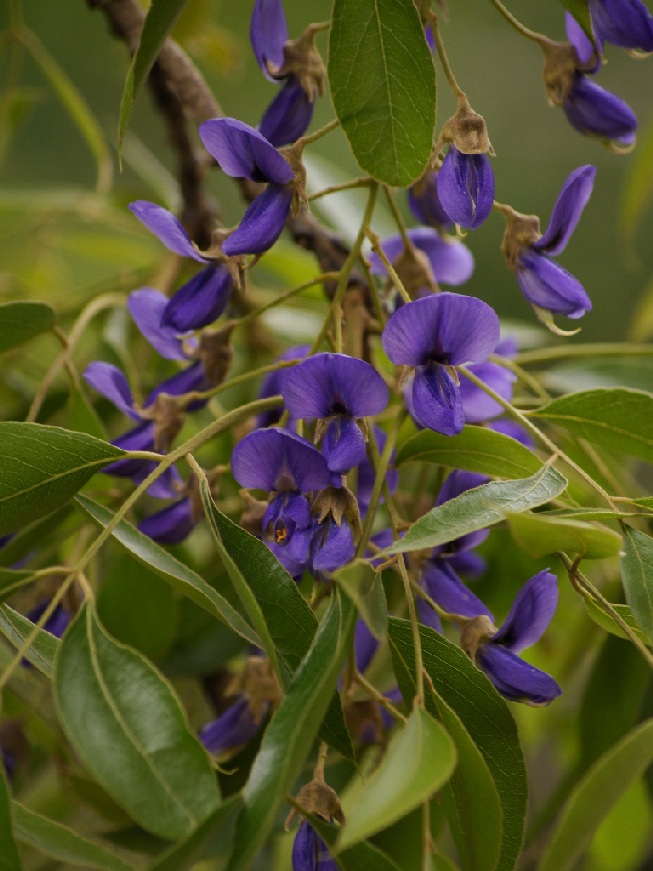
Bolusanthus is a monotypic genus of flowering plants in the family Fabaceae (legume family), placed in the subfamily Faboideae and order Fabales. It contains a single species, Bolusanthus speciosus, commonly known as the tree wisteria — a name that reflects the striking resemblance of its blossoms to those of the Northern Hemisphere wisteria vines.
The tree is small and deciduous, typically reaching up to 7 metres in height. Its bark is black and deeply fissured, and the branches are characteristically drooping, giving the crown a graceful, weeping appearance. The most notable ornamental feature is the profusion of lilac-blue flowers that appear between September and October, before the new leaves emerge, covering the bare branches in colour. After flowering, the tree produces grey seed pods, each containing three to eight smooth seeds that range in colour from bright yellow to brown.
The wood of Bolusanthus speciosus is notably hard, heavy, and yellow in colour. It has traditional utility value, having been used for axe-handles, wagon spokes, and fencing poles. The tree is also widely planted in gardens and parks throughout southern and eastern Africa for the beauty of its flowers.
The genus was first described formally by the German botanist Hermann Harms in 1906, based on prior work by Harry Bolus. The genus name commemorates Bolus himself — a South African botanist, botanical artist, businessman, and philanthropist who lived from 1834 to 1911 and made significant contributions to the documentation of southern African flora.
Etymology
The genus name Bolusanthus honours Harry Bolus (1834–1911), a South African botanist, botanical artist, businessman, and philanthropist who made important contributions to the study of southern African flora. The genus was formally described by the German botanist Hermann Harms in 1906.
Distribution
Bolusanthus speciosus is native to a broad arc of southern and eastern Africa, including KwaZulu-Natal and the Northern Provinces of South Africa, Eswatini, Botswana, Malawi, Mozambique, Zambia, and Zimbabwe. It grows at low to medium elevations in woodland and wooded grassland habitats.
Taxonomy Notes
Bolusanthus is a monotypic genus — it contains only one accepted species, Bolusanthus speciosus — within the subfamily Faboideae of the family Fabaceae. The genus was first published by Hermann Harms in Repertorium Specierum Novarum Regni Vegetabilis 2: 15 (1906), based on a combination from Bolus.










