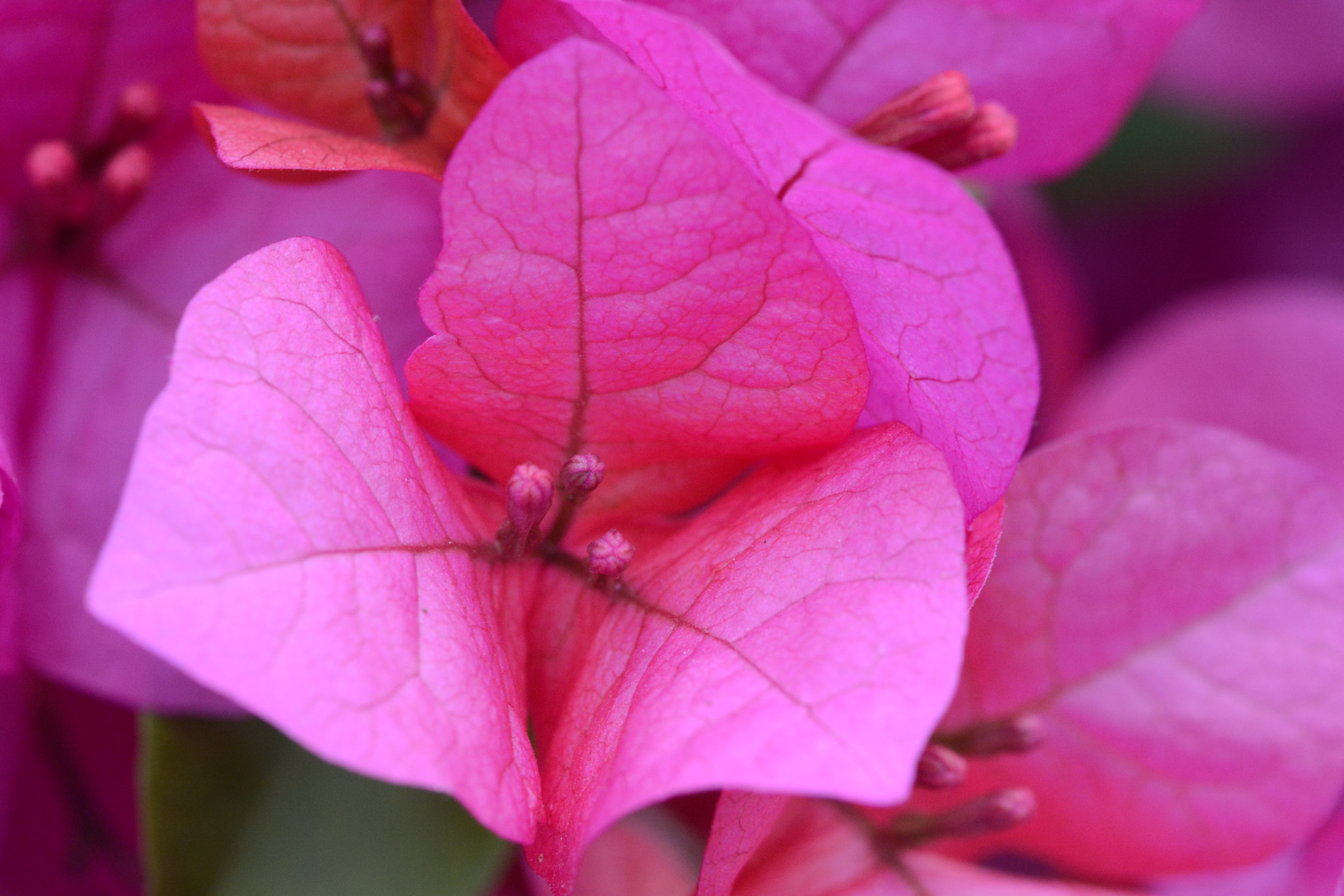
Bougainvillea (Bougainvillea Comm. ex Juss.) is a genus of thorny ornamental vines, bushes, and trees in the family Nyctaginaceae, order Caryophyllales. The genus comprises between 4 and 22 species (around 16 accepted by most checklists), native to the tropical forests of South America — principally Brazil, Bolivia, Paraguay, Peru, Uruguay, and Argentina.
The plants are perhaps best known for their spectacular floral display, though the showy structures are not petals but bracts — large, papery, sepal-like modified leaves surrounding three small, simple, waxy white flowers. These bracts appear in vivid shades of pink, magenta, purple, red, orange, white, and yellow. Stems are armed with stout spiky thorns, and plants grow 1–12 metres tall by scrambling over other plants. Leaves are alternate, simple, ovate-acuminate, 4–13 cm long. In regions with year-round rainfall the plants are evergreen; where a dry season occurs they are deciduous. The fruit is a narrow five-lobed achene.
The genus was first described by the French botanist Philibert Commerçon, who accompanied Louis Antoine de Bougainville on his circumnavigation of the Earth, and formally published by Antoine Laurent de Jussieu in 1789. Today there are over 300 cultivars and hybrids, most derived from interbreeding among just three South American species. Bougainvillea × buttiana, a natural hybrid of B. glabra and B. peruviana, is the parent of numerous garden-worthy cultivars widely grown in warm-climate horticulture worldwide.
Etymology
The genus is named after the French explorer and naval admiral Louis Antoine de Bougainville (1729–1811). The plant was first described by botanist Philibert Commerçon during Bougainville's voyage of circumnavigation, and formally published as Buginvillæa by Antoine Laurent de Jussieu in 1789. The spelling was standardised as Bougainvillea in the Index Kewensis during the 1930s.
Distribution
Bougainvillea is native to the tropical forests of South America, with its natural range spanning Brazil, Bolivia, Paraguay, Peru, Uruguay, and Argentina. Through cultivation it has become naturalised and widely grown across warm-temperate and tropical regions worldwide, including the Mediterranean Basin, South Asia, California, Florida, East Africa, the Canary Islands, Australia, and the Philippines.
Cultivation
Bougainvillea thrives in full sun with well-drained, moderately dry soil and is hardy in USDA Zones 9b–10; it is frost-sensitive but can be grown as a container or hanging-basket plant in cooler climates. Once established, plants are notably drought-tolerant and salt-tolerant, making them popular for coastal landscapes. In equatorial regions they bloom year-round; elsewhere bloom cycles typically last four to six weeks. Plants can be trained along fences and walls, shaped into standards, grown as hedges, or kept small by bonsai techniques. Propagation is straightforward via tip cuttings. Over 300 named cultivars exist, including double-flowered and variegated forms, most derived from crosses among B. glabra, B. spectabilis, and B. peruviana.
History
Bougainvillea entered European science in 1789 when Antoine Laurent de Jussieu published Philibert Commerçon's field descriptions from Bougainville's circumnavigation. In the early 19th century, B. spectabilis and B. glabra were introduced to European nurseries and distributed by Kew Gardens to British colonies worldwide. A crimson specimen found in Cartagena, Colombia, was initially described as a distinct species (B. buttiana) but later identified as a natural hybrid. By the 1930s, when three species were grown together across East Africa, India, the Canary Islands, Australia, and the Americas, spontaneous hybrid crosses became common, generating the diverse cultivar pool seen today. B. spectabilis and B. glabra were not formally classified as distinct species until the mid-1980s.
Taxonomy Notes
Bougainvillea is placed in the tribe Bougainvilleeae of the family Nyctaginaceae (order Caryophyllales), alongside two other genera; its sister tribe is Pisonieae. The genus was formally established as Bougainvillea Comm. ex Juss. (1789, Gen. Pl. 91), a conserved name (Nom. Cons.). Species counts vary widely in the literature (4–22), with the Catalogue of Life recognising 16 accepted species. Many cultivated plants are multi-generation hybrids, making species-level identification difficult; spontaneous bud-sports and natural mutations have further multiplied cultivar names, sometimes with multiple names applied to a single cultivar.










