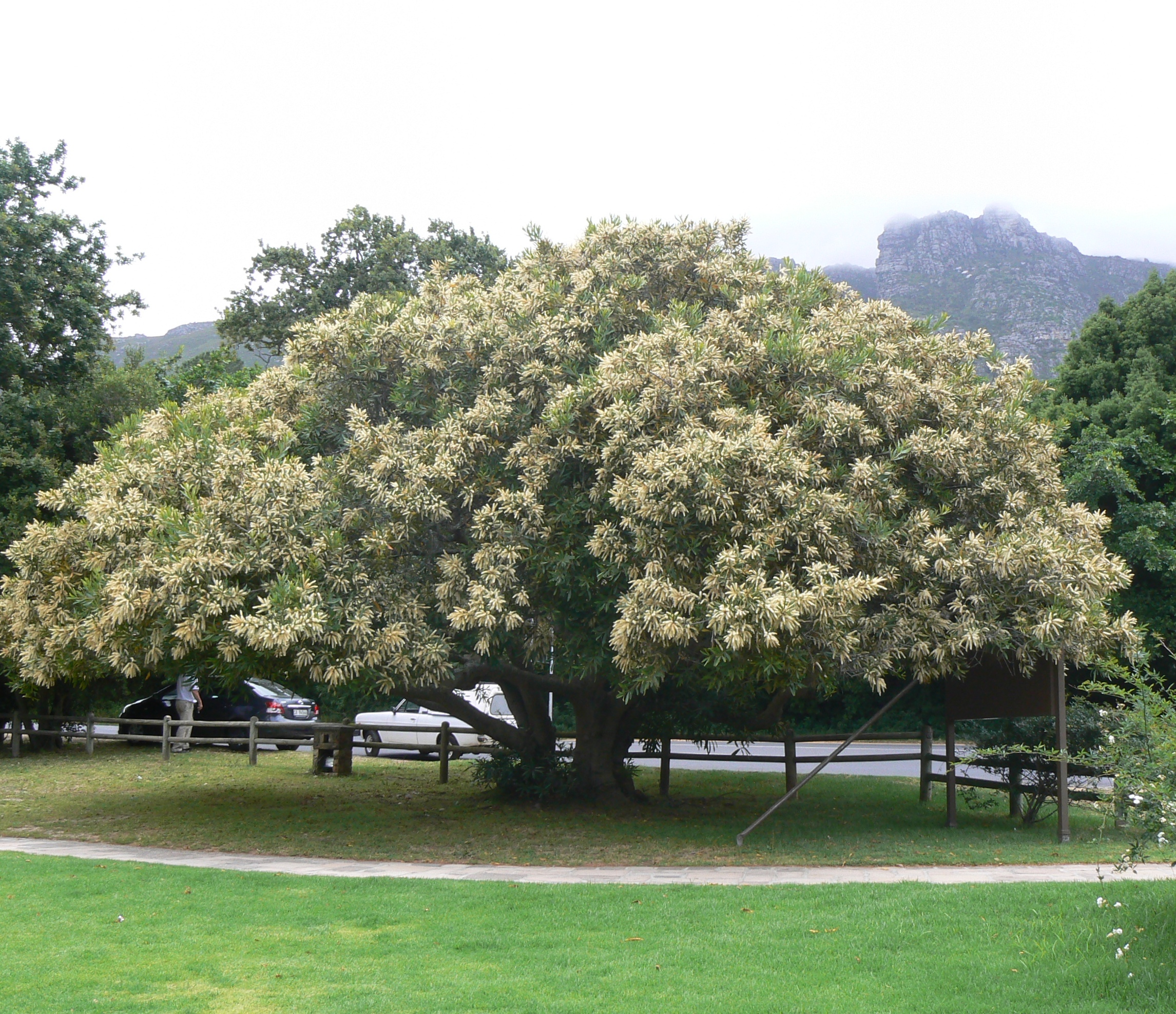
Brabejum is a monotypic genus in the family Proteaceae (order Proteales), containing a single species: Brabejum stellatifolium, commonly known as wild almond or bitter almond (Afrikaans: ghoeboontjie). It is a large bushy evergreen tree that branches widely at ground level and produces numerous erect vigorous stems. Its narrow, bluntly toothed leaves grow up to 15 cm long and are arranged in distinctive star-shaped whorls of six — an unusual phyllotaxis that makes it one of the most reliably identifiable trees in the Cape. In summer, densely crowded white flowers appear on spikes that arise from rusty buds at the leaf axils. By autumn the plant bears almond-shaped fruits up to 5 cm long, magenta to reddish brown in colour.
Brabejum is of exceptional biogeographical significance: it is Africa's only representative of the subfamily Grevilleoideae within the enormous Protea family. Its nearest relative within the family is not any African protea, but the macadamia tree of Australia and New Caledonia — reflecting the genus's status as a Gondwanan relict, isolated on the African fragment as the ancient supercontinent broke apart hundreds of millions of years ago.
The tree is confined to the fynbos biome of South Africa's Western Cape, where it grows along stream banks, in sheltered gorges, and on lower mountain slopes. It is often a component of Afro-montane forests. Despite its restricted range, the species is not currently listed as threatened.
Brabejum stellatifolium holds a notable place in Cape Town's heritage: Jan van Riebeeck's settlers used it to form the first formal boundary of the Cape Colony — the Van Riebeeck's Hedge — parts of which can still be seen at Kirstenbosch. The bitter nut, inedible raw, was historically boiled, roasted, and ground by both settlers and Khoi people to produce a coffee-like drink.
Etymology
Stellatifolium means "star-leaved" or "stellate-leaved", describing the distinctive star-shaped whorls in which the leaves are arranged. The common name "wild almond" reflects the superficial resemblance of the fruits to almonds, not any botanical relationship; the Khoi name ghoeboontjie similarly refers to the fruit kernels and their use as a traditional coffee substitute. The origin of the genus name Brabejum is uncertain.
Distribution
Brabejum stellatifolium is restricted to the fynbos biome of the Western Cape province of South Africa, where it grows along stream banks, in sheltered gorges, and on the lower slopes of mountains. It is abundant on the eastern slopes of Table Mountain, though historically numbers were reduced in that area to make way for commercial pine plantations. The species is not currently listed as threatened despite its limited range.
Ecology
Brabejum is a Gondwanan relict: within the Proteaceae its nearest relative is the macadamia (Macadamia spp.) of Australia and New Caledonia, and its more distant relatives exist only in Australasia and South America. It is the sole African survivor of its subfamily Grevilleoideae, separated from its relatives by plate tectonics over hundreds of millions of years. In its native habitat it is a component of Afro-montane forests within the fynbos biome, favouring moist, sheltered sites near streams.
Cultural Uses
The bitter nut of Brabejum stellatifolium was used by both Khoi people and early Dutch settlers at the Cape as a coffee substitute: the kernels were boiled, roasted, and ground to produce a hot drink. The Khoi name ghoeboontjie directly references this use. The tree also carries historical significance as the material used to construct Van Riebeeck's Hedge in the 17th century — the first formal boundary of the Dutch Cape Colony — remnants of which survive at the Kirstenbosch National Botanical Garden.










