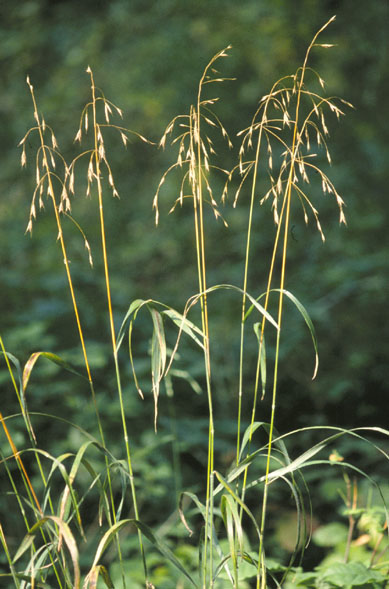
Bromus is a large genus of cool-season grasses in the family Poaceae, placed in its own tribe Bromeae within the subfamily Pooideae. Commonly known as bromes or brome grasses, the genus is widely cited as containing roughly 160 to 170 species, though regional treatments such as SEINet's southwestern North American flora count closer to one hundred — a reflection of how much the species concept and the sectional classification have shifted as monographs and molecular work accumulate. Five sections are recognized in North American treatments: Bromus, Genea, Ceratochloa, Neobromus, and Bromopsis. The genus was established by Linnaeus in 1753 and remains the only genus in its tribe.
Members of the genus are perennial, annual, or biennial grasses, usually tufted (cespitose) and sometimes rhizomatous. Culms range from very short — about five centimetres — to nearly two metres tall, depending on species and habitat. The inflorescence is a panicle that may be erect or distinctly nodding, and either open and airy or compact and dense. Spikelets are comparatively large for grasses, five to seventy millimetres long and bearing three to thirty florets, and the lemmas typically carry an awn. Field identification leans on a combination of characters: the leaf sheaths are closed (connate) for most of their length, the lemma awns are usually inserted just below the tip rather than terminally, and the ovary bears small hairy appendages — a combination of features unusual enough to anchor the genus among the temperate grasses.
Bromus occurs across temperate regions of every populated continent, with native or naturalized representatives across Africa, the Americas, Australia, and Eurasia. The genus is large enough that any given region usually holds a substantial subset: Switzerland alone records 38 species and subspecies, and southwestern North America hosts dozens, including widely encountered species such as Bromus sterilis, B. catharticus (rescue grass), B. diandrus (ripgut brome), B. inermis (smooth brome, used as forage), and B. tectorum (cheatgrass), the last of which has become one of the most ecologically consequential invasive grasses in western North America.
Etymology
The genus name Bromus comes from the Latin bromos, itself borrowed from Ancient Greek brómos, an old word for oats. In classical usage the term was applied to true oats (species now placed in Avena, such as Avena sativa and A. barbata), so Linnaeus's choice carried the long-standing association with cereal grasses rather than naming a novel concept.
Distribution
Bromus is distributed across the temperate zones of every continent except Antarctica, with native or naturalized representatives in Africa, the Americas, Australia, and Eurasia. The genus is well represented in regional floras: Info Flora records 38 species and subspecies for Switzerland alone, and the SEINet treatment lists more than fifty entries from the southwestern United States, including B. arizonicus, B. carinatus, B. catharticus, B. diandrus, and B. tectorum. Several species, most prominently B. tectorum, have spread far outside their native ranges and are now established across much of Europe, southern Russia, Japan, South Africa, Australia, New Zealand, Iceland, Greenland, North America, and western Central Asia.
Ecology
Brome grasses are foodplants for caterpillars of various Lepidoptera, including the chequered skipper. In disturbed-ground ecology the genus is best known for the behaviour of Bromus tectorum (cheatgrass): the species establishes quickly on disturbed sites and then expands outward through rapid growth and prolific seed production, building continuous fine-fuel cover that increases fire frequency and reshapes the systems it invades — most strikingly the sagebrush steppe of the western United States.
Conservation
Conservation concerns for Bromus fall on both sides of the ledger. Several species are themselves invasive: B. tectorum has spread across most of Europe, southern Russia, Japan, South Africa, Australia, New Zealand, Iceland, Greenland, North America, and western Central Asia, and its dominance in sagebrush steppe — combined with the resulting increase in fire frequency — was specifically cited by the U.S. Fish and Wildlife Service when considering greater sage-grouse protection. At the same time some native bromes are rare enough to receive conservation attention in their home flora; Info Flora flags Bromus grossus DC. among the rarer species in the Swiss flora. The ISSG Global Invasive Species Database does not currently maintain a record at the genus level for Bromus.
Cultural uses
A few Bromus species have served as human food or drink. Bromus mango was historically cultivated as a grain by indigenous peoples in Chile and Argentina, and the Tarahumara of northern Mexico have used Bromus grain in fermented beverages. B. inermis (smooth brome) has a broader and more contemporary economic role as a sown forage grass.
Taxonomy notes
Bromus was established by Linnaeus in Species Plantarum (1753, p. 77) and is the sole genus in tribe Bromeae of subfamily Pooideae, family Poaceae. Estimates of species number depend on the source: Wikipedia cites approximately 160–170 species, while the SEINet treatment uses a more conservative figure of roughly 100, and GBIF's backbone lists 310 descendant taxa once subspecies and synonyms are included. North American treatments split the genus into five sections — Bromus, Genea, Ceratochloa, Neobromus, and Bromopsis.










