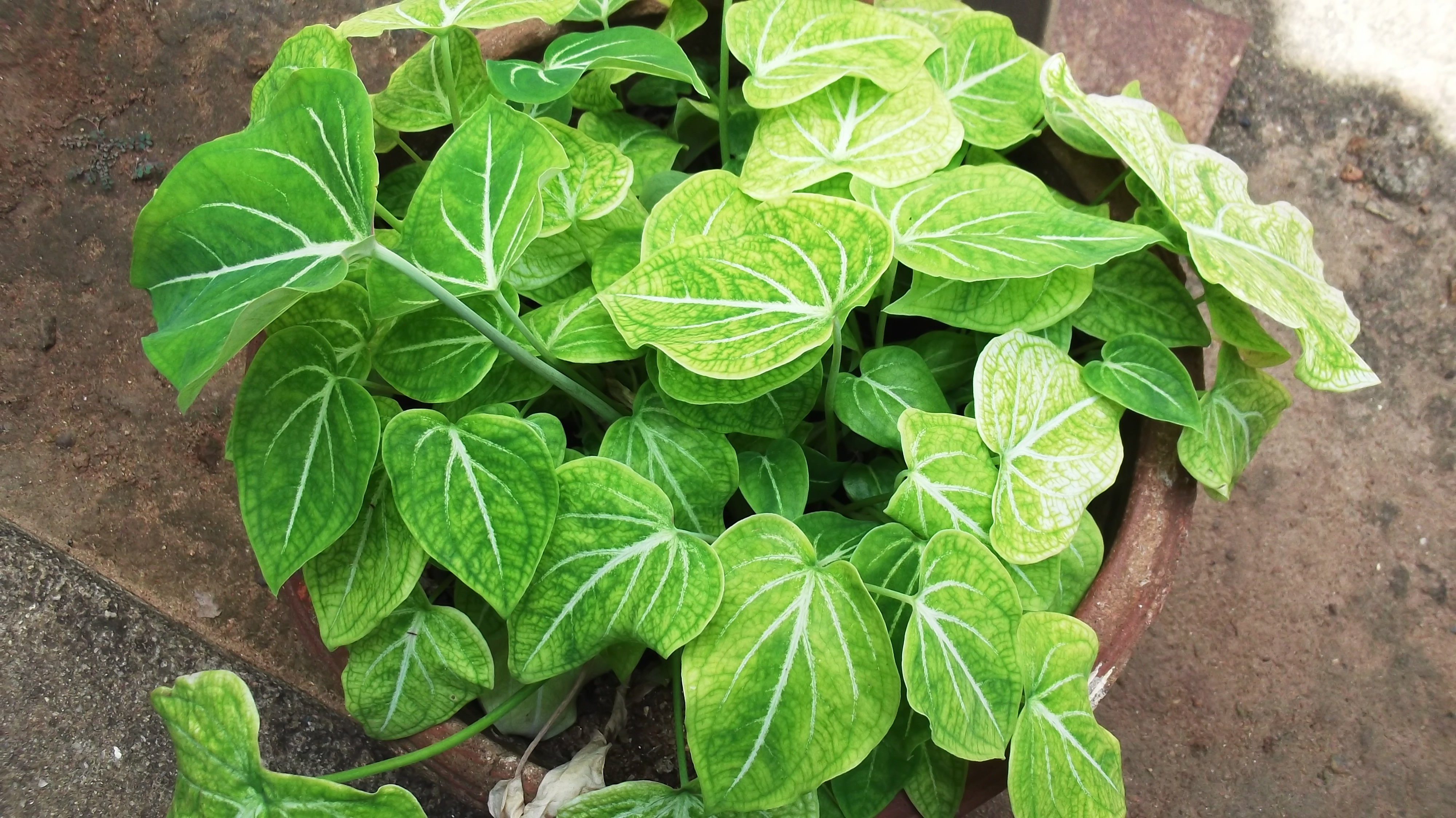
Caladium is a genus of tropical flowering plants in the family Araceae, order Alismatales, comprising around 19 accepted species native to South America and Central America. Commonly called elephant ear (a name shared with the related genera Alocasia, Colocasia, and Xanthosoma), heart of Jesus, and angel wings, caladiums are best known for their spectacular foliage: large, arrowhead- or heart-shaped leaves marked with bold patterns in combinations of white, pink, red, and green.
Wild species grow in open forest clearings and along riverbanks from Costa Rica south to northern Argentina, reaching 40–90 cm in height with leaves 15–45 cm across. The plants grow from tubers and become dormant during the dry season. The genus has naturalized far beyond its South American homeland, establishing populations in India, Bangladesh, western and central Africa, and on islands across the Indian, Pacific, and Caribbean basins.
In cultivation, caladiums are among the most popular ornamental foliage plants in the world. More than 1,000 named cultivars have been developed, the vast majority derived from Caladium bicolor. Cultivated forms are broadly grouped into “fancy-leaved” types — with rounder, more heart-shaped leaves — and “lance-leaved” types. Nearly all commercial tuber production is concentrated around Lake Placid, Florida, USA. Caladiums are hardy only to USDA zone 10; in cooler climates they are grown as seasonal “bulbs” or as houseplants.
All parts of the plant are toxic and should not be ingested; contact may also irritate sensitive skin.
Etymology
The name Caladium derives from the Malay word keladi, which is used to refer to several genera within the family Araceae, including Alocasia, Caladium, and Dieffenbachia, though it may specifically denote the genus Colocasia.
Distribution
Caladium is native to South America and Central America, ranging from Costa Rica south to northern Argentina, with the greatest diversity in the Amazon basin. The genus has become naturalized in India, Bangladesh, western and central Africa, and on numerous tropical islands in the Indian, Pacific, and Caribbean Oceans.
Cultivation
Caladiums are grown from tubers and thrive in warm, humid conditions, preferring partial to full shade, though sun-tolerant cultivars are now available. During the growing season they require moderate, consistent moisture (damp but not waterlogged). In temperate regions, tubers must be lifted before the first frost, dried, and stored over winter at 13–16 °C in moderately dry conditions. The two main cultivar groups are “fancy-leaved” (broad, heart-shaped) and “lance-leaved” (narrower). Most commercial tuber production worldwide originates from the Lake Placid, Florida area of the United States. Caladiums can be propagated by dividing the tubers.
Propagation
Caladiums are propagated primarily by dividing their tubers, typically in spring before planting. Tubers should be stored over winter at 13–16 °C, kept moderately dry, and planted out once temperatures have reliably risen. Division of larger tubers allows each section with at least one growth eye to produce a new plant.










