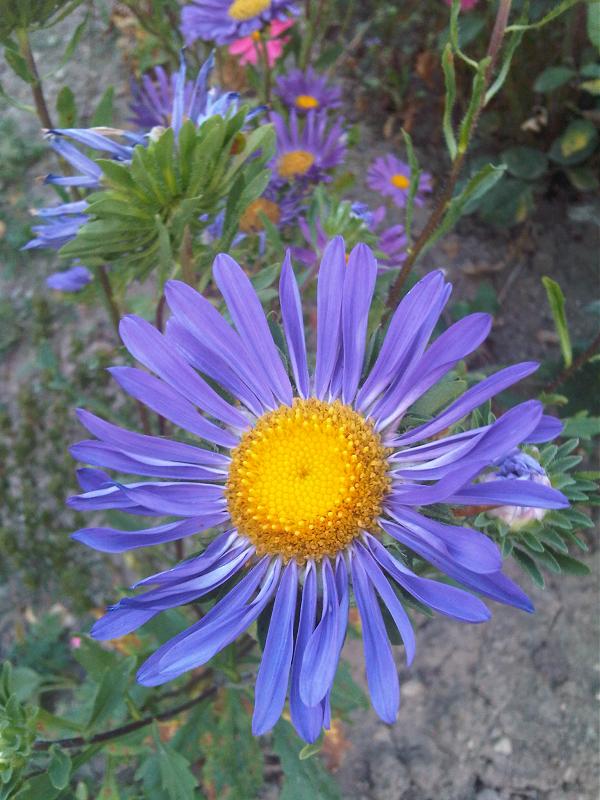
Callistephus is a monotypic genus of flowering plants in the daisy family, Asteraceae (order Asterales), containing a single species, Callistephus chinensis — widely known as the China aster or annual aster. The genus was described by the French botanist Alexandre Henri Gabriel de Cassini in 1825. It is native to China and Korea but has been taken into cultivation so extensively that it is now grown as an ornamental worldwide, prized both for cottage-garden borders and as a cut flower.
Callistephus chinensis is an annual or biennial herb with a single, mostly unbranched, erect stem reaching 20–100 cm tall. Its alternate leaves vary in shape and size along the stem: the basal leaves typically wither before flowering, mid-stem leaves are borne on winged petioles with serrated margins, and the uppermost leaves can be smooth-edged. Each stem bears a large, solitary flower head (occasionally several, on branches), surrounded by layered, leaflike phyllaries — the outer ones reaching up to 3 cm, the inner sometimes tinged purple. The head carries one or two rings of ray florets, purple in the wild type, encircling numerous small yellow disc florets at the center. Flowering runs from August to October in the Northern Hemisphere. The fruit is a rough, glandular, purple-mottled cypsela that grays with age, topped by a pappus of one outer ring of reddish scales and two inner rings of white bristles.
Centuries of cultivation and breeding — documented in China for roughly 2,000 years and in Europe since at least 1728 — have produced cultivars spanning red, pink, blue, purple, and white, in single and double-flowered forms of varying heights. As a garden plant it favors fresh, nutrient-rich, humus-rich soil and warm, humid conditions, and it has naturalized well beyond its native range, including in Indochina, Europe, North America, Australia, and New Zealand, often along the edges of deciduous forests at elevations from roughly 300 to 2,700 m. Like many long-cultivated ornamentals it has accumulated some susceptibility to pests and disease, notably fusarium wilt and insects such as leafhoppers, aphids, and blister beetles, though resistance varies by cultivar.
Distribution
Native to China and Korea, Callistephus chinensis has naturalized well beyond its origin — in Indochina, Europe, North America, Australia, and New Zealand — typically on the edges of deciduous forests at elevations of roughly 300–2,700 m.
Cultivation
Bred extensively for the ornamental trade, the China aster comes in cultivars spanning red, pink, blue, purple, and white, in single- and double-flowered forms of varying height; the wild type is purple. It thrives in fresh, nutrient-rich, humus-rich soil under warm, humid conditions, but is susceptible to fusarium wilt and to pests including leafhoppers, aphids, blister beetles, the tarnished plant bug, and mites, with resistance varying by cultivar.
History
Callistephus chinensis has been cultivated in China for roughly 2,000 years, and has been grown in Europe since at least 1728, giving rise through long selective breeding to its many modern color and form variants.










