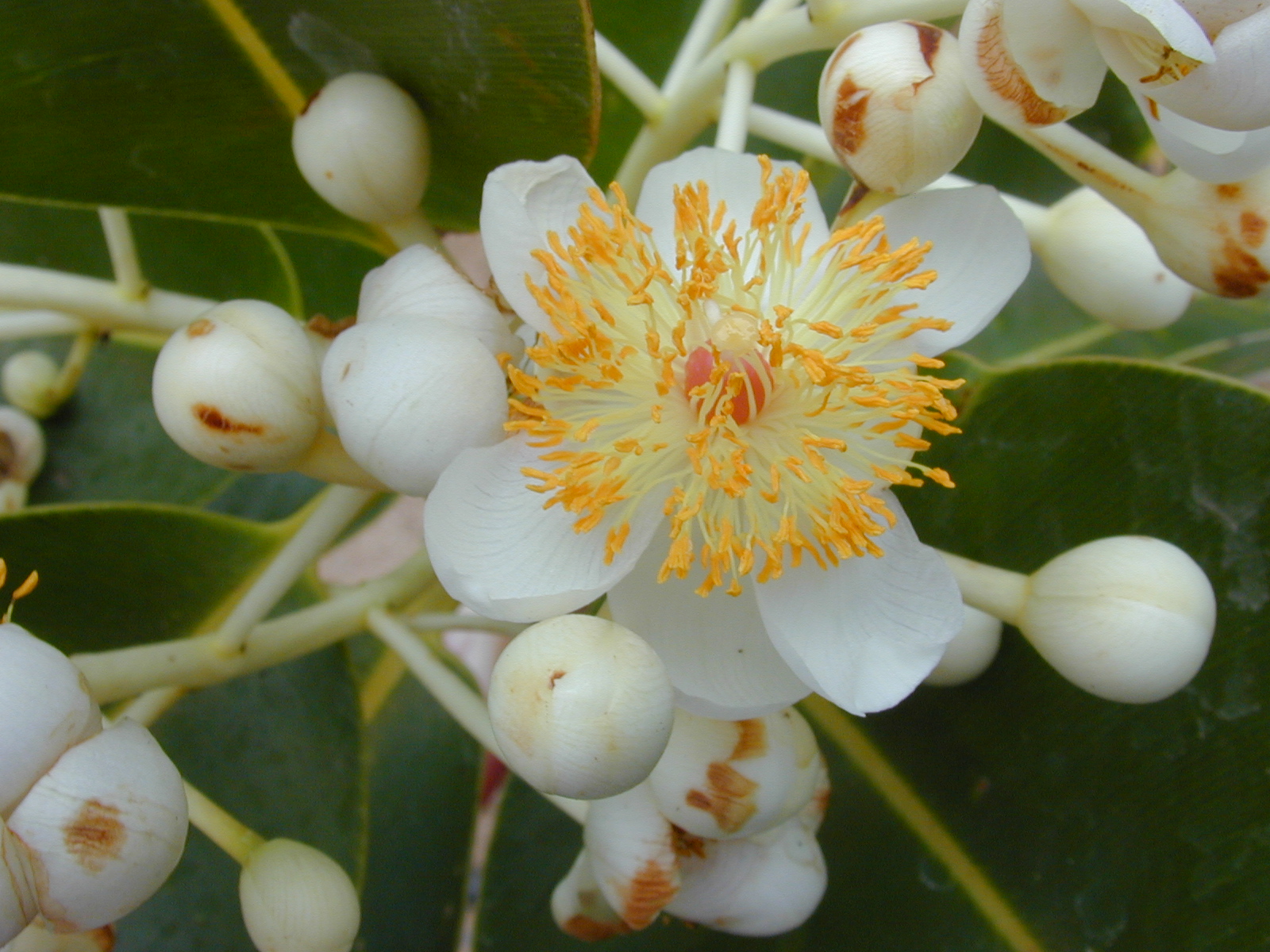
Calophyllum is a genus of approximately 200 species of tropical flowering trees and shrubs in the family Calophyllaceae, placed within the order Malpighiales. The genus is distributed mainly across tropical Asia, with additional species occurring in Africa, the Americas, Australasia, and the Pacific Islands.
Plants in this genus are trees or shrubs that produce a colorless, white, or yellow latex. The leaves are oppositely arranged with leathery blades and a distinctive venation pattern: narrow parallel veins alternate with resin canals, giving the foliage a characteristic and attractive appearance. Flowers are borne in cymes or thyrses arising from leaf axils or branch tips; the sepals and petals are often similar in appearance and arranged in whorls, with numerous stamens. The fruit is a drupe with thin flesh surrounding a large seed.
Many Calophyllum species are commercially valuable hardwoods, capable of reaching 30 meters in height. The outer sapwood ranges from yellowish to orange with a pink tinge, while the inner heartwood is light reddish to red-brown. The wood has a distinctive streaked or zig-zag grain and is notable for its high chatoyance (a silky sheen). It is used in boat-building, flooring, furniture, and plywood, and is marketed under the trade name bitangor.
The genus also has a rich phytochemical profile. Secondary metabolites including coumarins, xanthones, flavonoids, and triterpenes have been isolated from various species; many have demonstrated cytotoxic, anti-HIV, antimicrobial, and anti-inflammatory activity in laboratory studies. Plants are used in traditional medicine across their range to treat conditions including peptic ulcers, infections, and pain.
Among the most notable members is Calophyllum inophyllum (mastwood or alexandrian laurel), the source of tamanu oil — a greenish, nutty-scented oil used in cosmetics, traditional topical medicine, and historically as lamp oil and waterproofing. This species was of particular cultural and economic importance to Austronesian peoples, who relied on it for building large outrigger vessels during their expansion across Oceania and Madagascar, making it comparably significant to European oaks in maritime history.
Etymology
The genus name Calophyllum derives from the ancient Greek words kalos (beautiful) and phyllon (leaf), a reference to the genus's distinctively attractive, leathery foliage with its characteristic parallel venation.
Distribution
Calophyllum is predominantly a tropical Asian genus, with the greatest species richness in Southeast Asia and Malesia. The genus extends to sub-Saharan Africa, the Americas, Australasia, and the Pacific Islands, reflecting a broad pantropical range among its roughly 200 accepted species.
Ecology
Calophyllum species occupy a range of tropical habitats, from coastal sandy beaches — where C. inophyllum grows as a windbreak and erosion-control tree — to inland tropical forests. The genus is particularly associated with island and coastal environments across its Austronesian distribution range, and many species are found in lowland to montane rainforests across Malesia and the Pacific.
Cultural Uses
Calophyllum has deep cultural significance across its range. Austronesian peoples of Malaysia and Wallacea depended on species of this genus — particularly mastwood (C. inophyllum) — for building large outrigger ships, making Calophyllum the tropical analogue of oak in European maritime cultures. Tamanu oil, pressed from the nuts of C. inophyllum, has been used for centuries as a massage oil, topical remedy, lamp fuel, and waterproofing agent, and remains commercially produced for the cosmetics industry. Traditional medicine across tropical Asia and the Pacific employs various species to treat ulcers, tumors, pain, and infection.
History
The role of Calophyllum in Austronesian expansion is well documented: members of the genus native to Malaysia and Wallacea were carried by Austronesian voyagers as they migrated through Oceania and to Madagascar, ensuring a supply of shipbuilding timber in newly settled islands. C. inophyllum (mastwood) was the primary species used, valued for its straight-grained, durable wood suited to hulls and masts of large outrigger vessels.

