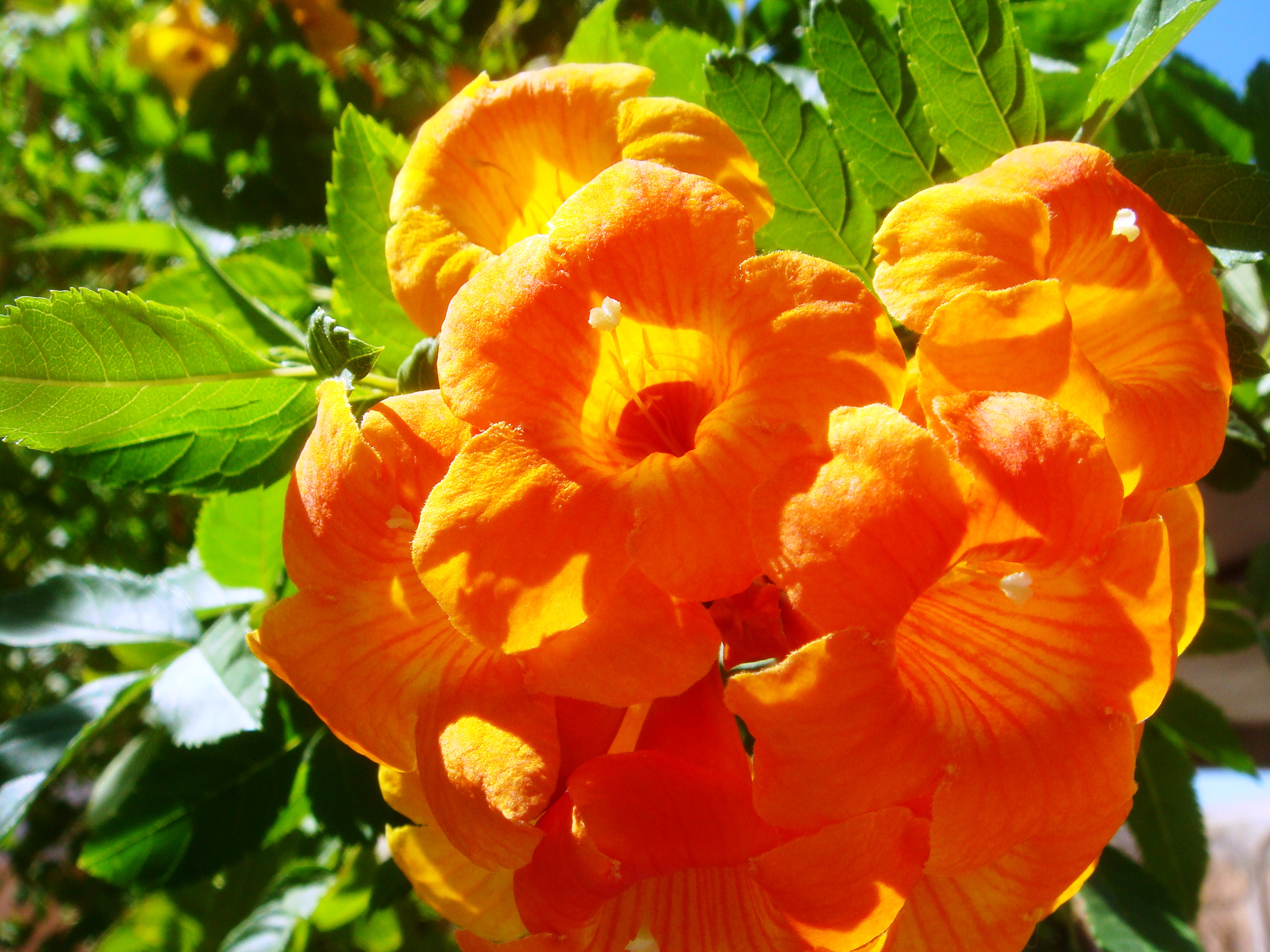
Campsis, commonly known as trumpet creeper or trumpet vine, is a small genus of two species of flowering plants in the family Bignoniaceae, within the order Lamiales. The genus comprises vigorous deciduous perennial climbers native to woodland habitats: Campsis grandiflora (Chinese trumpet vine) from East Asia, and Campsis radicans (American trumpet vine) from the southeastern United States.
Both species are strong-growing woody vines that attach themselves to surfaces by means of aerial roots, enabling them to scale walls, fences, and trees without additional support. They are best known for their spectacular, large, funnel- or trumpet-shaped flowers, borne in clusters during summer. Flower color typically ranges from orange to red, making these plants conspicuous in bloom.
A widely grown hybrid, Campsis × tagliabuana (commonly sold as 'Madame Galen'), arose in the mid-19th century as a cross between the two species and inherits characteristics of both parents — intermediate flower size and good cold-hardiness relative to C. grandiflora.
Plants in this genus are reasonably hardy and perform best in full sun with the support of a wall or sturdy structure. Because of their vigor, they can spread aggressively and are considered invasive in parts of North America beyond their native range.
Etymology
The genus name Campsis derives from the Greek kampsis (κάμψις), meaning "bending" or "curvature", an allusion to the curved stamens found inside the flowers. The common names "trumpet creeper" and "trumpet vine" refer to the large, flared, tubular flower shape characteristic of the genus.
Distribution
Campsis has a disjunct native range spanning two continents: C. grandiflora is native to East Asia (China, Korea, Japan), while C. radicans is native to the woodlands of the southeastern United States. The hybrid C. × tagliabuana is of garden origin. Both species are widely cultivated beyond their native ranges and C. radicans in particular has naturalized in parts of Europe and temperate North America.
Cultivation
Both species thrive in full sun and are tolerant of a wide range of soils once established. They require a sturdy support structure — wall, fence, or pergola — as they grow vigorously and can become heavy. Regular pruning in late winter or early spring controls size and encourages flowering on new wood. Campsis radicans is hardier (to approximately USDA zone 4–5) than C. grandiflora (zone 7–8); the hybrid C. × tagliabuana is intermediate. The plants can spread by suckering and self-seeding and should be sited with care to prevent unwanted spread.










