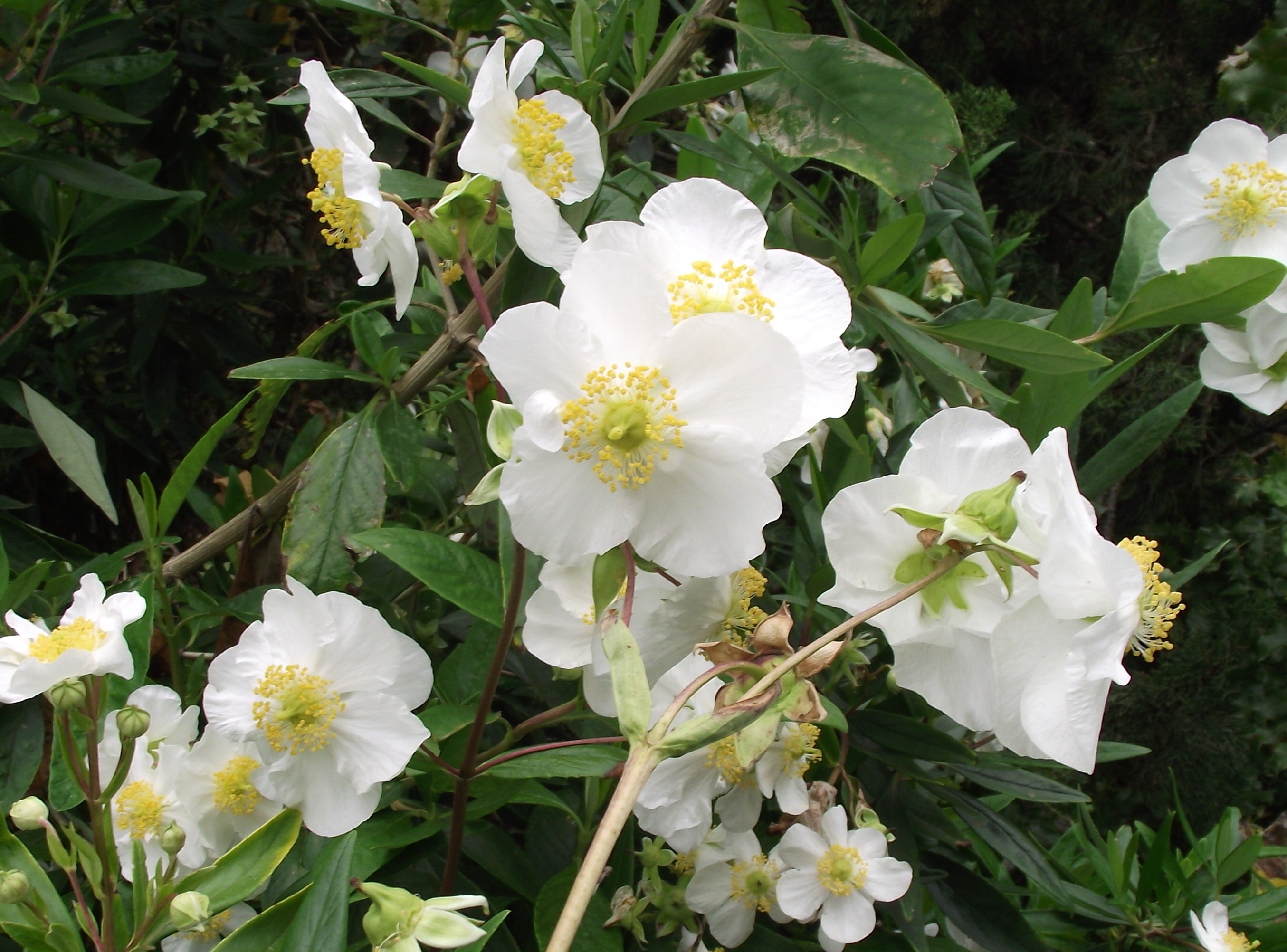
Carpenteria (tree anemone or bush anemone) is a monotypic genus of flowering plants in the hydrangea family Hydrangeaceae, order Cornales. It is closely related to Philadelphus and represented by a single species, Carpenteria californica. The genus was published by John Torrey in 1854.
The sole species is an evergreen shrub growing 1–3 m tall with flaky bark on older stems. The leaves are opposite, lanceolate, 4–10 cm long and 1–2.5 cm broad, glossy green above with a blue-green to whitish downy underside. The sweetly-scented flowers are 3–7 cm across, with five to eight pure white petals surrounding a cluster of yellow stamens, blooming from late spring to midsummer. The fruit is a leathery capsule 6–12 mm in diameter containing numerous seeds.
It is a rare California endemic, restricted to only seven sites in Fresno and Madera Counties in the Sierra Nevada foothills, where it grows in chaparral and oak woodlands at 340–1,340 m elevation. The species is well adapted to wildfire, regenerating from stump sprouts, though natural seedlings are rare. Despite its limited wild range, it has been widely cultivated as an ornamental since 1875 and is now far more common in gardens than in its native habitat. Several cultivars have been developed, with 'Elizabeth' and 'Bodnant' earning the Royal Horticultural Society's Award of Garden Merit.
Etymology
The genus Carpenteria was named by John Torrey in 1854 in honor of Dr. William Marbury Carpenter, a noted botanist from Louisiana.
Distribution
Carpenteria californica is endemic to the Sierra Nevada foothills of California, known from only seven sites in Fresno and Madera Counties between the San Joaquin River and Kings River. It grows at elevations of 340–1,340 m. The species is now far more common in cultivation throughout subtropical and temperate regions of the northern hemisphere than in its restricted natural range.
Ecology
The bush anemone inhabits chaparral and oak woodland communities in the Sierra Nevada foothills. It is well adapted to wildfire, regenerating from stump sprouts after burning; however, natural seedling recruitment is rare. This fire-adapted reproductive strategy, combined with its extremely limited distribution across just seven known sites, contributes to the species' rarity in the wild.
Cultivation
Carpenteria californica has been cultivated as an ornamental shrub since 1875, valued for its lush evergreen foliage, large sweetly-scented white flowers, and drought tolerance. It is hardy to −10 °C (14 °F) in sheltered, full-sun locations and is used in traditional and wildlife gardens. It first flowered in England for Gertrude Jekyll at Godalming in 1885. Named cultivars include 'Bodnant' (cold-tolerant to −15 °C), 'Elizabeth' (compact habit with masses of smaller white flowers), and 'Ladham\'s' (large flowers). The cultivars 'Elizabeth' and 'Bodnant' have received the Royal Horticultural Society's Award of Garden Merit.
Conservation
Carpenteria californica is a rare species, endemic to only seven sites in the wild within Fresno and Madera Counties, California. Natural seedling recruitment is uncommon, and the species relies on vegetative regeneration from stump sprouts after fire. While it has no global IUCN listing, its extremely restricted native range and small number of populations make it a species of conservation concern in its natural habitat. It has been successfully introduced to cultivation, where it is now much more widespread than in the wild.
History
John Torrey first described the genus Carpenteria in 1854, naming it after Louisiana botanist Dr. William Marbury Carpenter. The species entered cultivation in 1875, and it first flowered in England for the renowned plantswoman Gertrude Jekyll at Godalming in 1885. Since then, it has become a well-established ornamental shrub, far more abundant in gardens worldwide than in its restricted native range.
Taxonomy
Carpenteria is a monotypic genus in the family Hydrangeaceae, order Cornales. It is most closely related to the genus Philadelphus (mock oranges). The genus and its sole species, C. californica, were described by John Torrey in 1854 (Pl. Frém. Exped. 12, T. 7). No subspecies or varieties are recognized.










