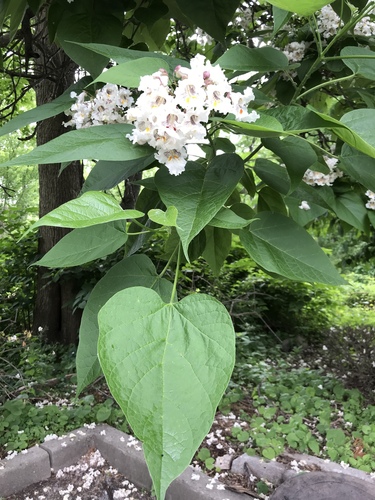
Catalpa is a genus of flowering deciduous trees in the family Bignoniaceae, order Lamiales, comprising around 8–11 accepted species native to warm temperate and subtropical regions of North America, the Caribbean, and East Asia.
Trees in this genus typically grow 12–18 metres (40–60 ft) tall, with branches spreading to a canopy diameter of 6–12 metres (20–40 ft). They are notably fast-growing; a 10-year-old sapling may already stand around 6 metres tall. The foliage is a key identifying feature: large, heart-shaped leaves that are sometimes three-lobed, giving Catalpa a bold, tropical appearance that can cause confusion with unrelated species such as Paulownia tomentosa and the tung tree (Vernicia fordii).
In summer, Catalpa species produce broad, showy panicles of flowers generally white to pale yellow in colour. These are followed in late summer or autumn by long, slender silique fruit pods, 20–50 centimetres (8–20 in) in length, filled with small flat seeds each bearing two thin wings for wind dispersal. The distinctive hanging pods give rise to the popular common names “cigar tree” and “Indian bean tree.”
The two North American species — Catalpa bignonioides (southern catalpa) and Catalpa speciosa (northern catalpa) — are the most widely cultivated members of the genus, planted broadly as ornamental street and park trees beyond their native ranges. Catalpa ovata from China, bearing pale yellow flowers, is likewise grown ornamentally in temperate gardens worldwide. Where C. bignonioides and C. ovata co-occur in cultivation, they hybridise to produce Catalpa × erubescens, itself a popular ornamental.
Though Catalpa wood is relatively soft, it is valued for woodturning and furniture when well seasoned, prized for its stability and attractive grain. The genus name derives from the Muscogee word “kutuhlpa,” meaning “winged head,” first recorded in English by naturalist Mark Catesby between 1729 and 1732.
Etymology
The genus name Catalpa derives from the Muscogee (Creek) word “kutuhlpa,” meaning “winged head,” a reference to the winged seeds. The name was first used in print by naturalist Mark Catesby between 1729 and 1732 (spelled “Catalpa” and “Catalpah”), and Carl Linnaeus published the species as Bignonia catalpa in 1753. Giovanni Antonio Scopoli formally established the genus Catalpa in 1777. The common names “cigar tree” and “Indian bean tree” refer to the genus’s long, bean-like seed pods.
Distribution
Catalpa is native to warm temperate and subtropical regions of North America, the Caribbean, and East Asia. North American species (C. bignonioides and C. speciosa) have natural ranges in the eastern and central United States, while C. ovata, C. bungei, and C. fargesii are native to China. Caribbean species (including C. longissima, C. brevipes, and C. macrocarpa) occur in Cuba and surrounding islands. Both major North American species have been extensively planted as ornamentals far outside their native ranges across temperate regions worldwide.
Cultivation
Catalpa trees are widely planted as ornamental shade trees in parks, gardens, and along streets throughout the temperate world. They are fast-growing — reaching about 6 metres in 10 years — and begin flowering approximately 3 years after planting, producing fruit after about 5 years. The large canopy and dense foliage provide excellent wind and rain shelter. The long seed pods that drop in late summer can be considered a nuisance in cultivated settings. The wood, though soft, is valued for furniture and woodturning when well seasoned due to its stability and attractive appearance.










