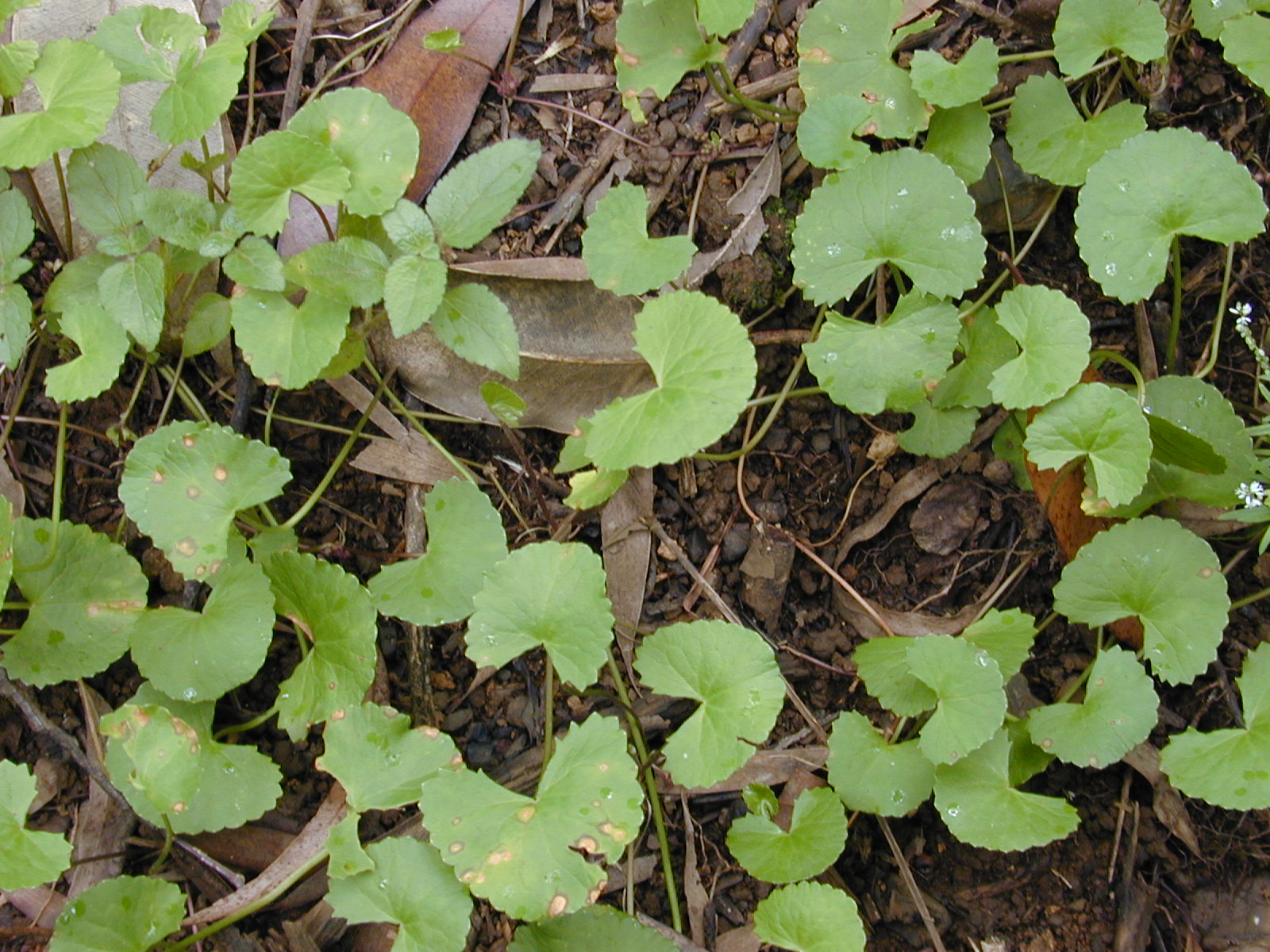
Centella is a genus of approximately 53 species of herbaceous flowering plants in the family Apiaceae (carrot family), order Apiales, placed within the subfamily Mackinlayoideae. The genus was historically assigned to Araliaceae, but molecular studies support its placement in Apiaceae.
Plants in the genus are typically low-growing perennials with slender creeping stolons that connect individual plants to one another. Leaves are long-stalked, rounded to kidney-shaped, with palmately netted venation and a smooth texture. Small umbels of white or crimson flowers are borne close to the soil surface, and the fruit are characteristically densely reticulate — a feature that distinguishes Centella from the closely related genus Hydrocotyle.
The genus is distributed across tropical and subtropical regions of Africa, Asia, Australia, and the islands of the western Pacific. Most species are concentrated in southern Africa, with the pantropical Centella asiatica being by far the best-known member. C. asiatica grows in swampy, wetland, and riparian habitats across the Indian subcontinent, Southeast Asia, parts of Australia, and the southeastern United States, and has been introduced widely enough to be considered invasive on several Pacific islands.
Centella asiatica is used as a culinary vegetable and occupies a prominent place in traditional medicine systems across Asia, where it has long been used in connection with skin conditions and wound healing. The species contains pentacyclic triterpenoids including asiatic acid and madecassic acid, along with their glycoside derivatives asiaticoside and madecassoside.
Distribution
The genus occurs across tropical and subtropical Africa, Asia, Australia, and the western Pacific. The majority of species are native to southern Africa. Centella asiatica has the widest range, extending from the Indian subcontinent and Sri Lanka through Southeast Asia to Australia and the southeastern United States; it has been introduced to numerous Pacific islands, where it is regarded as invasive in Hawaii, French Polynesia, the Solomon Islands, and other archipelagos.
Ecology
Centella species typically grow in moist, swampy, or wetland habitats in temperate and tropical regions. Because many species are semi-aquatic, they are particularly sensitive to water-borne chemical and biological pollutants. Centella asiatica can tolerate drier conditions (including sandy loam soils) when irrigated regularly. Where introduced outside its native range — especially on Pacific islands — C. asiatica is rated high risk as an invasive species and has been implicated in the decline of native sedge species in Hawaii.
Cultural Uses
Centella asiatica (gotu kola) is consumed as a leafy vegetable across parts of South and Southeast Asia and is a prominent herb in Ayurvedic, traditional Chinese, and Sri Lankan medicine, where it has historically been applied to skin conditions, wounds, and various other complaints. The plant contains a suite of bioactive pentacyclic triterpenoids — asiatic acid, madecassic acid, asiaticoside, and madecassoside — though formal clinical evidence for therapeutic efficacy is limited. Topical use can cause contact dermatitis in some individuals.
Taxonomy Notes
Centella has been the subject of changing family-level placement: it was traditionally assigned to Araliaceae, but molecular phylogenetic studies have firmly placed it within Apiaceae, in the subfamily Mackinlayoideae. GBIF accepts the genus in Apiaceae, order Apiales.










