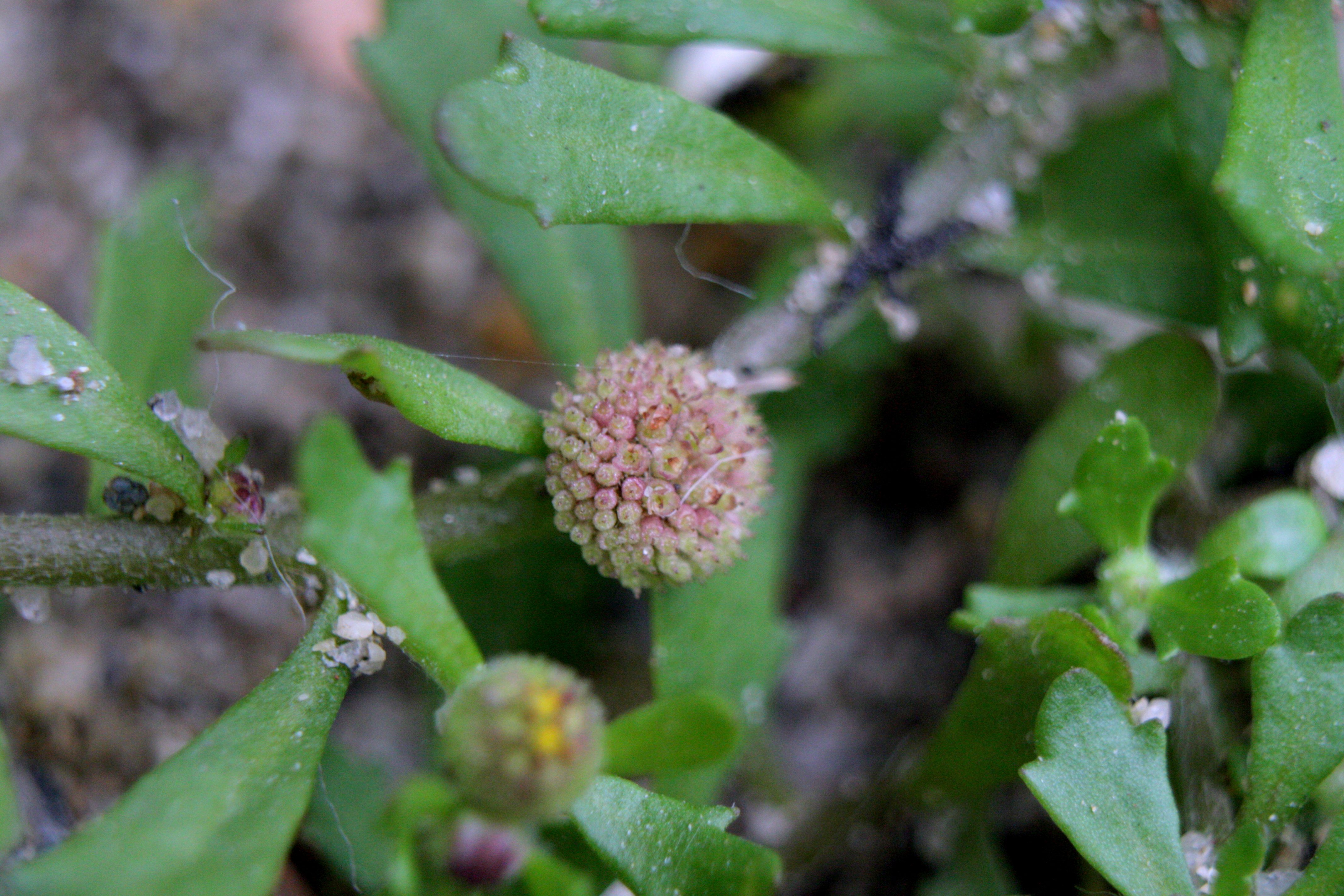
Centipeda is a genus of flowering plants in the daisy family, Asteraceae (order Asterales), comprising about 12 species native primarily to Australia and New Zealand, with the range extending into Asia and across the Pacific to southern South America. Australia alone hosts approximately 11 species across all States.
Members of the genus are annual or perennial herbs that are glandular and aromatic. The leaves are cauline, alternate, typically toothed along the margins, and sessile (lacking a petiole). The flower heads (capitula) are small, lateral or arranged in terminal racemes, nearly sessile, and solitary. The involucral bracts are arranged in two series and are herbaceous with scarious (papery) margins; the receptacle is convex, pitted, and naked. The outer florets are tubular, female, and multiseriate, with minute conical corollas. The inner florets are campanulate (bell-shaped), bisexual, fertile, and four-toothed. The anthers are blunt at the base with ovate apical appendages. The fruit is an achene (cypsela), clavate to cylindrical in shape, with 3–5 blunt, pubescent ribs and no pappus.
The type species, Centipeda minima (spreading sneezeweed), is the most widespread member of the genus and is the subject of pharmacological research for its anti-inflammatory properties. Other notable species include Centipeda cunninghamii (old man weed), used in traditional Aboriginal medicine and shown to possess antioxidant and anti-inflammatory compounds, and Centipeda thespidioides (desert sneezeweed). The genus was described by João de Loureiro in his Flora Cochinchinensis (1790) and revised taxonomically by N.G. Walsh in 2001.
A 2012 molecular phylogeny by Nylinder et al. resolved Centipeda racemosa (snuffweed) as sister to the remaining species — it is also the only consistently perennial member. Several species pairs and groupings were identified based on both molecular and morphological characters, including the slowly maturing capitula shared by C. thespidioides, C. cunninghamii, C. crateriformis, and the morphologically divergent New Zealand endemic C. aotearoana.
Distribution
Centipeda has a primarily Australasian distribution, with approximately 11 of the roughly 12 recognized species occurring in Australia across all States. The genus extends from Australia and New Zealand northward into Asia and eastward across the Pacific to southern South America. The most widespread species is Centipeda minima (spreading sneezeweed), which ranges from Australia through Southeast Asia.
Cultural Uses
Several Centipeda species have documented medicinal properties. Volatile oils from Centipeda minima have demonstrated anti-inflammatory activity by inhibiting inflammatory cytokines in animal models, and the species has been used to ease allergic rhinitis by reducing eosinophil infiltration and mast cell proliferation. Centipeda cunninghamii (old man weed) is used in traditional Aboriginal Australian medicine, and chemical analysis has confirmed that its extracts contain novel compounds with anti-inflammatory and antioxidant properties.
Taxonomy Notes
The genus Centipeda was described by João de Loureiro in Flora Cochinchinensis (1790) and belongs to the family Asteraceae, order Asterales. A comprehensive taxonomic revision was published by N.G. Walsh in 2001 (Muelleria Vol 15: 33–64), with the NSW Flora Online treatment authored by E.A. Brown and updated in 2016.
A 2012 molecular phylogeny by Nylinder et al. based on nucleotide sequence data resolved the species-level relationships within the genus. Centipeda racemosa (snuffweed) was found to be sister to all other species and is the only consistently perennial member. Two well-supported species pairs were identified: C. pleiocephala + C. nidiformis, and C. borealis + C. minima. Another clade comprising C. thespidioides, C. cunninghamii, C. crateriformis, and the morphologically aberrant New Zealand endemic C. aotearoana is united by the shared character of capitula that mature more slowly relative to the subtending shoot. C. elatinoides occupies a weakly supported intermediate position and is difficult to place based on morphology alone.










