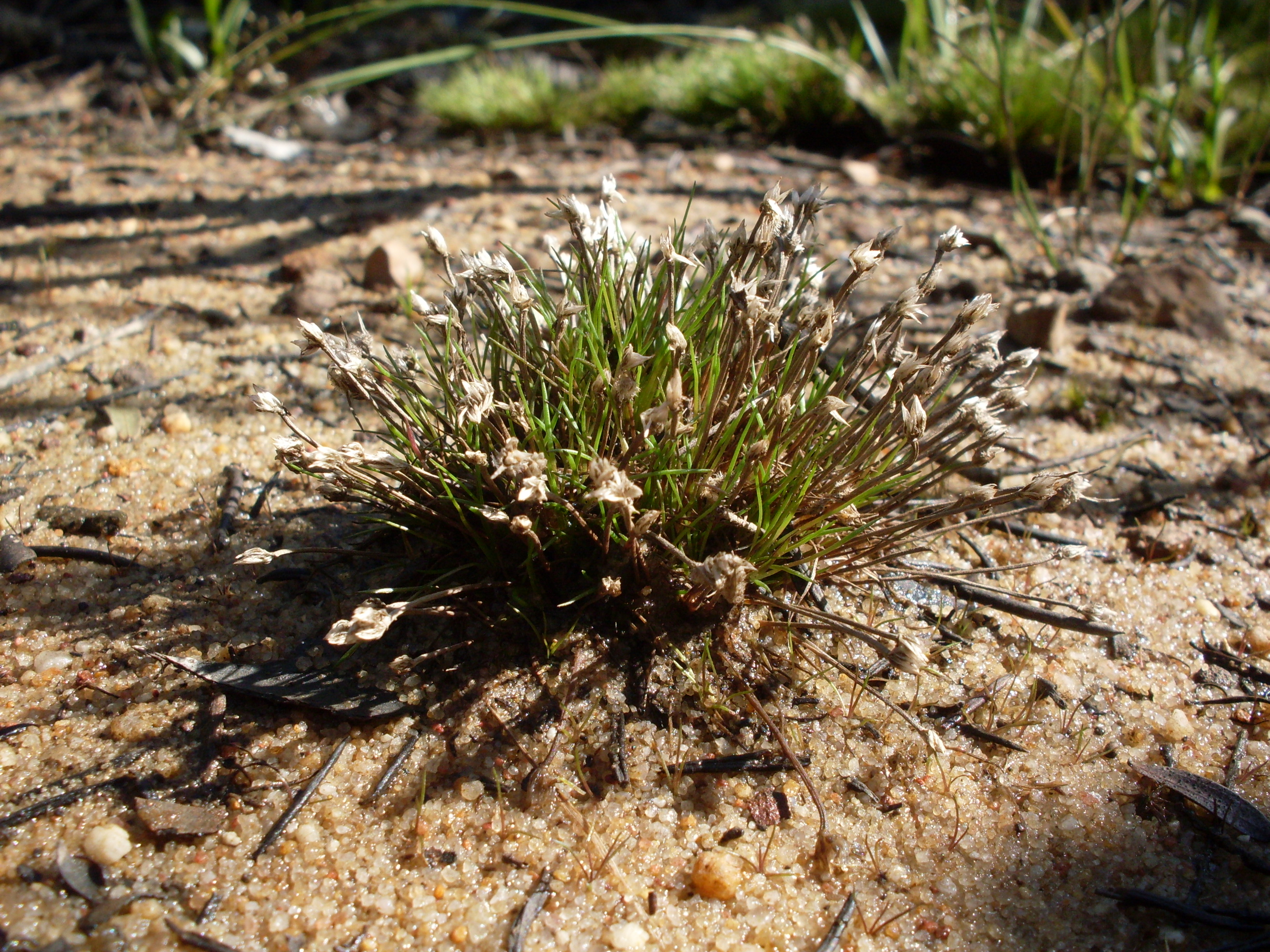
Centrolepis is a genus of small, tufted herbaceous plants in the family Restionaceae (order Poales), sometimes placed in the formerly recognised family Centrolepidaceae. Commonly known as "thorn grass scales", the genus comprises about 25 species native to Australia, New Zealand, New Guinea, and south-east Asia as far north as Hainan Dao. Species are either annual or cushion-forming perennials with linear, narrow leaves arising from the base; the innermost leaves are typically reduced to a short, membranous, glabrous sheath.
The inflorescence is highly distinctive: a terminal cymose head enclosed by a pair of unequal, glume-like primary bracts with dilated sheathing bases, each enclosing one to numerous pseudanthia. Each pseudanthium consists of 1–30 partially fused female flowers arranged in one or two superimposed rows, with styles usually fused at the base, and typically a single male flower at the base. Secondary bracts (2–3 per pseudanthium or absent) are hyaline or scarious and veinless. Flowers are tiny and wind-pollinated. The infructescence is compound, dry, and membranous, with each follicle containing a single ovoid to fusiform seed that dehisces by an outer slit.
Centrolepis species are found in damp, open habitats — clay, sand, or silty soils near lake and pond margins, often in gumland scrub or seasonally wet depressions. In New Zealand, Centrolepis strigosa is classified as Threatened – Nationally Endangered. The Australian contingent is strongly endemic, with 19 of Australia's 20 species found nowhere else.
Etymology
The name Centrolepis derives from the Greek words kentron (spur, point) and lepis (scale), meaning "pointed scale" — a reference to the pointed, glume-like bracts that enclose the condensed flower heads.
Distribution
Centrolepis is native to Australia, New Zealand, New Guinea, and south-east Asia (as far north as Hainan Dao, including Thailand, Vietnam, Cambodia, Laos, Borneo, Philippines, Sulawesi, and Sumatra). Australia is the centre of diversity with 20 species, 19 of which are endemic, occurring across all states. Two species extend to New Zealand (C. strigosa and C. glabra), with C. strigosa also recorded from Australia.
Ecology
Centrolepis species inhabit coastal to lowland environments, typically growing in open, damp places on clay, sand, or silty substrates. They are often found near lake and pond margins, on open sand pans within gumland scrub, or in seasonally wet depressions. Centrolepis strigosa is a seasonal annual adapted to these ephemerally wet habitats, with seeds dispersed by wind.
Conservation
In New Zealand, Centrolepis strigosa is classified as Threatened – Nationally Endangered under the NZTCS (2023), with qualifiers indicating it is sparse, data-poor, range-restricted, and secure overseas. Previous assessments include Nationally Critical (2012) and Naturally Uncommon (2009). It is described as a naturally uncommon, biologically sparse seasonal annual. No conservation assessments are currently cited for other species in the genus.
Taxonomy Notes
Centrolepis was historically placed in its own family, Centrolepidaceae, under the APG III system. Phylogenetic work by Briggs et al. (2014) demonstrated that Centrolepidaceae is embedded within Restionaceae, and APG IV (2016) subsequently adopted an enlarged circumscription of Restionaceae that includes the former Centrolepidaceae. This classification is now followed by major regional floras including NZPCN and PlantNET.
Propagation
Propagation of Centrolepis is considered difficult, and plants should not be removed from the wild. No established horticultural propagation protocols are documented.










