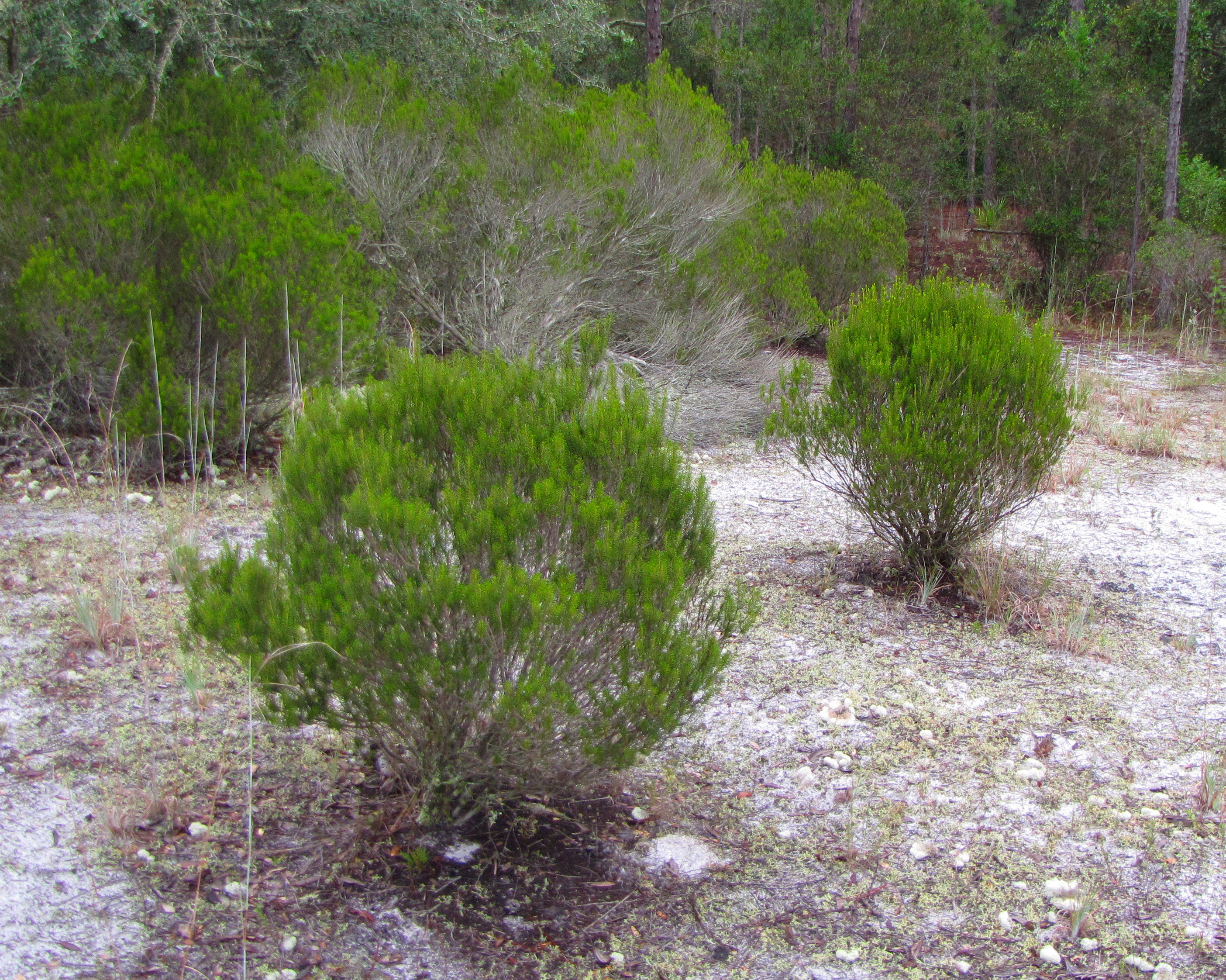
Ceratiola is a monotypic genus of flowering plants in the heath family (Ericaceae, order Ericales), containing a single species: Ceratiola ericoides, commonly known as Florida rosemary or sand heath. This evergreen shrub is endemic to the southeastern United States, where it grows in dry, sandy scrub habitats on the Atlantic Coastal Plain from South Carolina through Florida to Mississippi.
The plant forms a rounded, densely branched shrub reaching up to 1.8 metres in height. Its dark green, needle-like leaves are 8\u201312 mm long and about 1 mm wide, bearing a fragrance reminiscent of culinary rosemary \u2014 hence the common name. The flowers are small and range from yellow to brown. The fruit is a green or yellow juicy drupe about 3 mm in diameter, containing two seeds.
Ceratiola was historically placed in the family Empetraceae, but molecular phylogenetic work since 2002 has reclassified it within the tribe Empetreae of the subfamily Ericoideae in the Ericaceae. The genus is an important component of Florida scrub ecosystems, where it grows alongside sand pine and evergreen scrub oaks. Its seeds are dispersed by birds such as the Florida scrub jay and eastern towhee, while ants and rodents act as seed predators. The species is fire-adapted, with populations regenerating from a soil seed bank between fire events that typically occur at 15\u2013100 year intervals.
Distribution
Ceratiola ericoides is endemic to the Atlantic Coastal Plain of the southeastern United States, occurring in subtropical scrub and dry sandy habitats from Georgia and South Carolina southward throughout Florida, and westward into coastal counties of Alabama and Mississippi. It is a characteristic component of Florida scrub communities, commonly co-occurring with sand pine (Pinus clausa) and evergreen scrub oaks (Quercus spp.).
Ecology
The fruit and seeds of Ceratiola ericoides are consumed by a variety of wildlife. The Florida harvester ant (Pogonomyrmex badius) and oldfield mouse (Peromyscus polionotus) act as seed predators, destroying the seeds they consume. In contrast, birds \u2014 particularly the Florida scrub jay (Aphelocoma coerulescens) and eastern towhee (Pipilo erythrophthalmus) \u2014 swallow the fruits whole and pass viable seeds through their digestive tracts, serving as dispersal agents. Seeds in the soil lose viability in under 10 years.
Florida rosemary is fire-adapted: scrub communities burn at intervals of 15 to 100 years, killing all above-ground plants. Regeneration depends entirely on the soil seed bank. If a site burns again within 10 years, the seed bank is depleted and rosemary cannot re-establish. Observations of declining seed production after about 35 years suggest that natural fire return intervals in these habitats rarely exceed 40 years.
Taxonomy
Ceratiola was historically classified within the family Empetraceae (the crowberry family). Following molecular phylogenetic studies published around 2002, Empetraceae was reclassified as the tribe Empetreae within the subfamily Ericoideae of the family Ericaceae (the heath family). Ceratiola ericoides remains the sole species in the genus Ceratiola, which is now firmly placed within Ericaceae, order Ericales.










