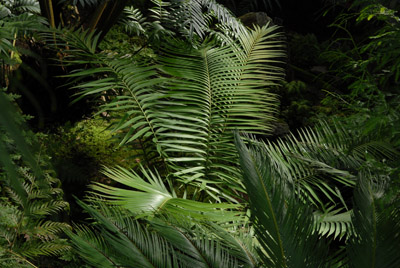
Ceratozamia is a genus of cycads in the family Zamiaceae, order Cycadales — a lineage of ancient seed plants that have persisted largely unchanged since the Mesozoic. The genus is entirely New World in origin, comprising 27 known living species and one or two fossil species, with the great majority endemic to mountainous regions of Mexico and a handful of species extending south into Guatemala, Honduras, and Belize.
Plants in this genus are dioecious, meaning male and female reproductive structures occur on separate individuals. The stem is globose or cylindrical, rarely branched, and may be partially or wholly underground or emergent above the soil surface. Several species produce basal offsets or suckers. The leaves are pinnately compound, straight, and spirally arranged; the petioles and leaf rachis often bear spines, though some species have few or none. Leaflets are simple, entire, and articulate at the base, with parallel lateral veins and no distinct midrib. Male cones are cylindrical, upright, hairy, and stalked; female cones are stalked or sessile, erect, and finely hairy. Seeds are oblong to elliptical with a fleshy, whitish outer coat.
The genus name is derived from the Greek word ceras (κέρας), meaning "horn," a reference to the paired, spreading, horn-like projections on both the male and female sporophylls that distinguish Ceratozamia from other cycad genera.
Most species inhabit sheltered slopes in moist montane forests at elevations of roughly 800 to 1,000 metres, in habitats ranging from tropical rainforest to pine-oak forest with seasonal dry periods. Leaflet morphology correlates with moisture regime: broad, thin leaflets characterise species of permanently wet forests, while narrow, thick leaflets occur in species from seasonally dry climates.
Ceratozamia is of significant conservation concern. Almost all described species appear on the IUCN Red List as vulnerable, endangered, or critically endangered, and the entire genus is listed under CITES Appendix I and EU Annex A, prohibiting commercial international trade. Illegal poaching remains a serious ongoing threat.
Etymology
The name Ceratozamia derives from the Greek ceras (κέρας), meaning "horn," combined with Zamia (the related cycad genus). The reference is to the paired, spreading, horn-like projections borne on the sporophylls of both male and female cones — a feature unique to this genus within the family Zamiaceae.
Distribution
The genus is centred on mountainous Mexico, where most of its 27 living species are endemic. A small number of species extend into the mountains of Guatemala, Honduras, and Belize. Species typically grow at elevations of 800–1,000 m on sheltered slopes in moist forests, ranging from permanently wet tropical rainforest to pine-oak forest with alternating wet and dry seasons.
Ecology
Ceratozamia species occupy a narrow ecological range of montane forest habitats in Mesoamerica. A notable correlation exists between leaflet morphology and moisture availability: species inhabiting perennially wet forests tend to have broad, thin leaflets, while those in seasonally dry pine-oak forests have narrow, thick leaflets. Several species produce basal suckers, which can aid vegetative spread in forest understory conditions.
Conservation
Almost all described species of Ceratozamia are listed as vulnerable, endangered, or critically endangered on the IUCN Red List, reflecting their extremely limited geographic ranges and small population sizes. The entire genus is placed under CITES Appendix I and EU Annex A, which prohibit commercial international trade except for non-commercial purposes such as scientific research. Illegal collection from wild populations remains a major and ongoing threat to species survival.
Cultivation
Ceratozamia species are cultivated as ornamental cycads by specialist collectors worldwide, valued for their architectural foliage and rarity. Because all species are CITES Appendix I listed, legally traded specimens must be accompanied by documentation confirming nursery propagation or pre-convention origin. In cultivation, most species prefer well-drained substrates, partial to dappled shade, and protection from frost, broadly reflecting their montane forest origins.










