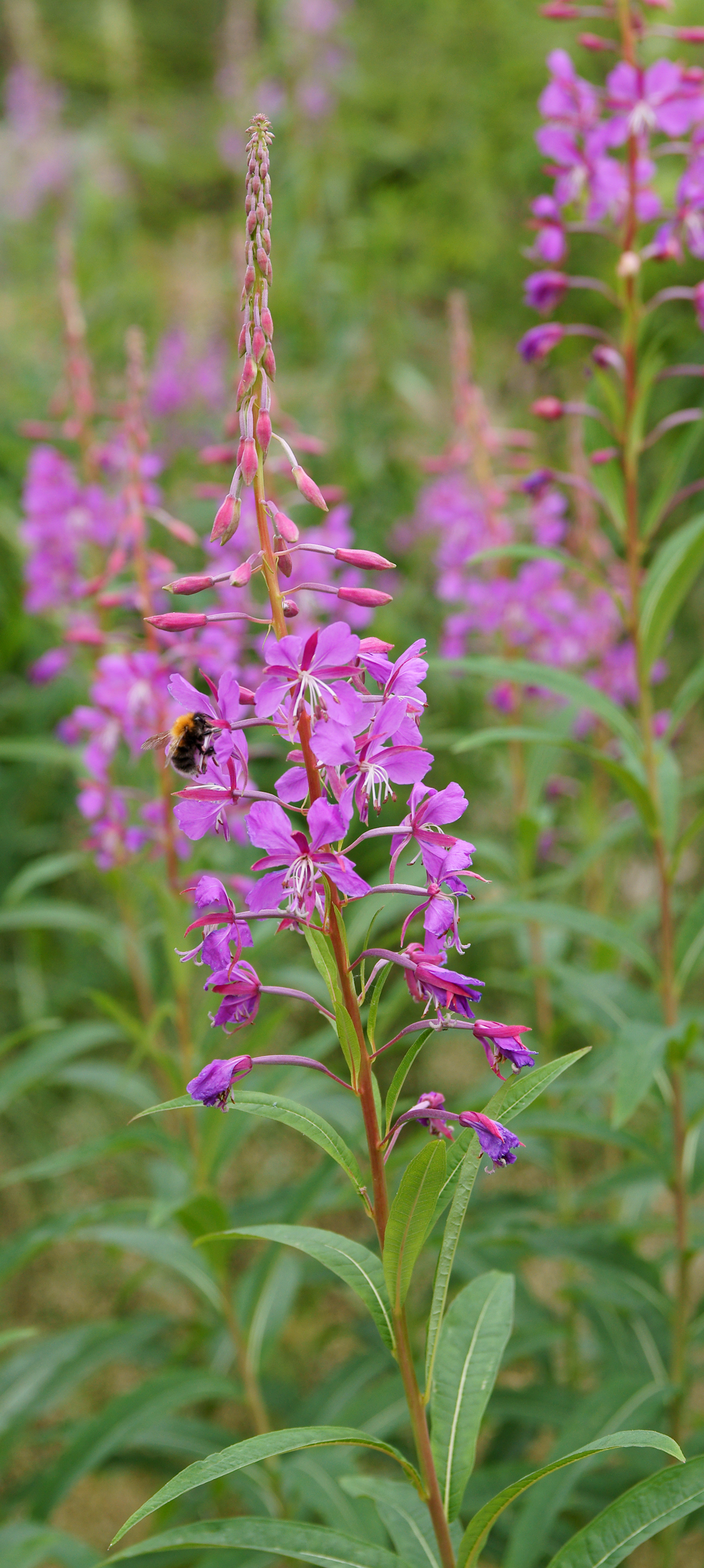
Chamaenerion is a genus of upright herbaceous perennials in the family Onagraceae (the evening-primrose or willowherb family), order Myrtales. It contains roughly eight species, all native to the northern hemisphere, and has sometimes been treated as part of the broader genus Epilobium — a placement that remains contested, with some authorities preferring the name Chamerion for the segregate genus.
Plants grow from a woody base or from rhizomes and bear simple, spirally arranged, usually narrow leaves. The inflorescence is a raceme of showy four-petalled flowers, typically rose-purple to pink, rarely white. A key diagnostic character separating Chamaenerion from Epilobium is that the petals are free at the base rather than united into a floral tube. The lower pair of petals is narrower than the upper pair, rendering the flower slightly zygomorphic (bilaterally asymmetric). There are eight roughly equal stamens and a long, four-lobed style. The fruit is a slender four-chambered capsule that splits open at maturity to release numerous seeds, each bearing a tuft of white silky hairs that aids wind dispersal.
The best-known member is Chamaenerion angustifolium, widely called fireweed in North America and rosebay willowherb in Britain. It is notable for its ability to colonise disturbed ground — especially burnt-over areas — rapidly and en masse, its dense pink spires a familiar sight in the aftermath of forest fires or on railway embankments. Most other species occupy montane or subalpine habitats: C. latifolium (dwarf fireweed) grows in gravelly riverbeds and rocky ground across Eurasia and North America, while C. dodonaei and C. fleischeri are cultivated as alpine-garden ornamentals. The genus as a whole is distributed across the northern hemisphere, with the greatest species diversity in Eurasia; unusually for Onagraceae, which is predominantly a western-hemisphere family, two Chamaenerion species reach North America.
Distribution
Chamaenerion is native to the northern hemisphere. Six of the eight species are restricted to Eurasia; only C. angustifolium and C. latifolium extend into North America. This makes the genus unusual within Onagraceae, a family whose diversity is centred on the western hemisphere. Most species inhabit high-elevation moist and rocky terrain, with C. angustifolium as the outlier — it thrives in disturbed lowland habitats across its wide circumpolar range.
Ecology
Chamaenerion species, particularly C. angustifolium, are important larval food plants for several Lepidoptera. Recorded moths include the double-striped pug (Gymnoscelis rufifasciata), the gothic (Naenia typica), the Hebrew character (Orthosia gothica), Langton's forester moth (Alypia langtoni), the setaceous Hebrew character (Xestia c-nigrum), and both the elephant hawk-moth (Deilephila elpenor) and small elephant hawk-moth (D. porcellus). The genus's capacity to colonise fire-disturbed ground quickly also makes it an early successional keystone in boreal and montane ecosystems.
Cultivation
The white-flowered cultivar of C. angustifolium is recommended as a border perennial where its spreading habit can be managed; plants can reach 2 m in height. C. dodonaei and C. fleischeri are suited to alpine gardens, where they form compact clumps of 20–30 cm.
Taxonomy Notes
The taxonomy of Chamaenerion is unsettled. The genus is sometimes subsumed into the broader Epilobium and, when treated separately, the valid name is disputed between Chamaenerion and Chamerion. Molecular and morphological work points to it as a natural (monophyletic) group distinguished from Epilobium chiefly by its free (not fused) petals and zygomorphic flowers. Eight species in two sections — sect. Chamaenerion and sect. Rosmarinifolium — are generally recognised.










