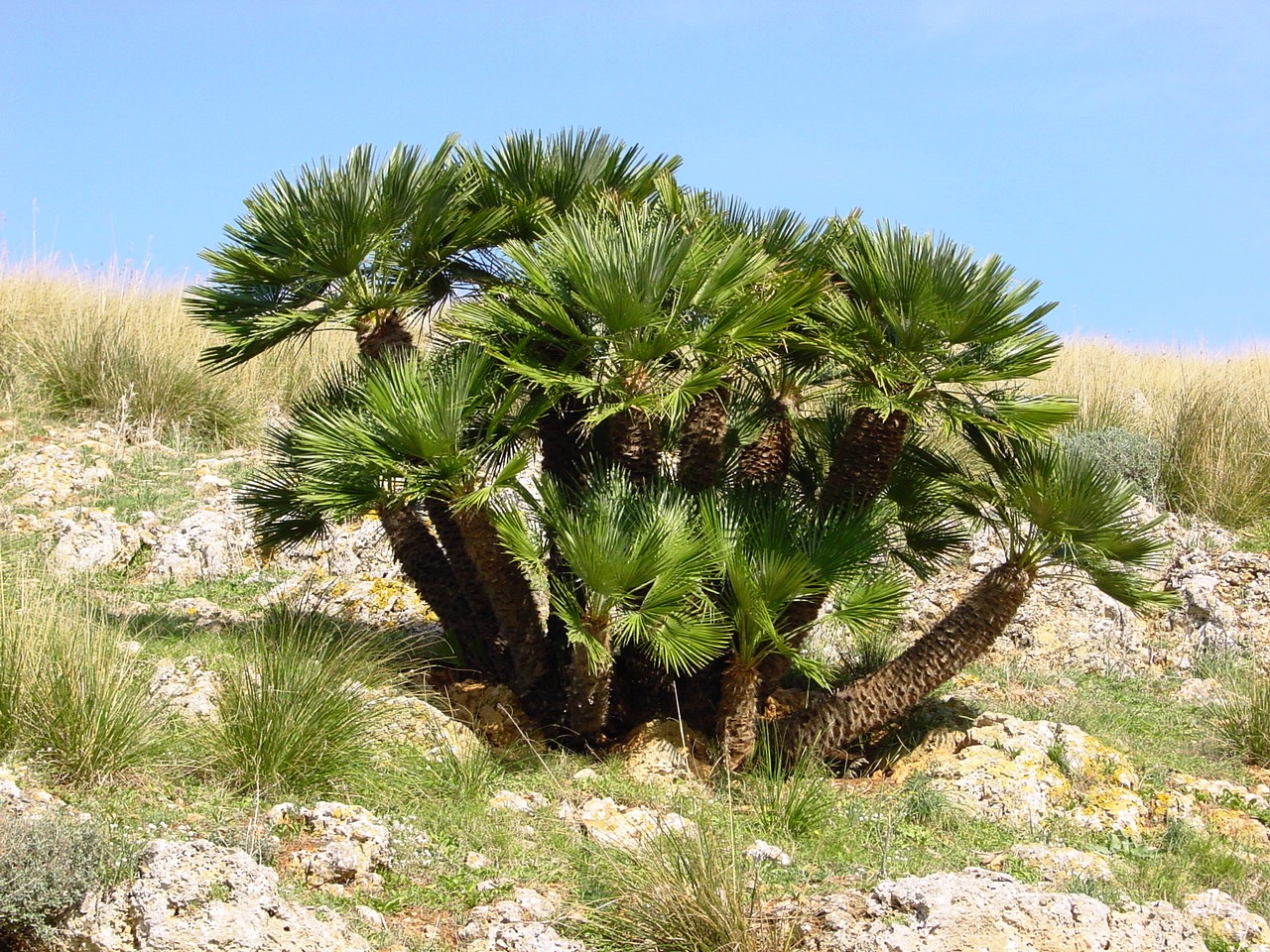
Chamaerops is a monotypic genus of shrub-like clumping palms in the family Arecaceae (order Arecales), native to the western Mediterranean basin. Its sole species, Chamaerops humilis (European fan palm or Mediterranean dwarf palm), is one of only two palms native to continental Europe and one of the most cold-hardy palms in cultivation.
The palm grows as a cluster of stems from a single underground rhizome, reaching 2–5 m tall with trunk diameters of 20–25 cm. It is a fan palm (tribe Corypheae) bearing palmate, sclerophyllous leaves up to 1.5 m long, each divided into 10–20 rigid leaflets. Petioles are armed with sharp, needle-like spines. Plants are usually dioecious, with dense short inflorescences at stem tops. Female flowers are tri-ovulate; fruits ripen from bright green to dull yellow or brown in autumn, each containing a small seed (0.6–0.8 g) with a woody endocarp.
Two varieties are recognized: C. h. var. argentea (glaucous-leaved, from the Atlas Mountains of NW Africa) and the green-leaved C. h. var. humilis (SW Europe). Compact thornless cultivars such as 'Vulcano' are popular in cultivation. The genus is closely related to Trachycarpus but distinguished by its clumping suckering habit, spiny petioles, and minor floral differences.
Exceptionally drought-tolerant and hardy to −12 °C (with the Atlas blue form possibly hardier to −24 °C), Chamaerops is widely cultivated across temperate regions worldwide — from the UK and Pacific Northwest to Australia and New Zealand — and holds the RHS Award of Garden Merit.
Etymology
The genus name Chamaerops derives from Greek χαμαί (chamai, "on the ground, dwarf") and ῥώψ (rhops, "bush, shrub"), referring to the low, shrubby, clumping growth habit. The specific epithet humilis is Latin for "lowly" or "humble," likewise alluding to its dwarf stature compared to taller palms.
Distribution
Chamaerops is native to the western Mediterranean basin: the southern coasts of Spain, Portugal, France, and Monaco; central and southern Italy; and the islands of Malta, Sicily, Sardinia, Corsica, and the Balearic Islands. In North Africa it occurs in Morocco, Algeria, and Tunisia. It is one of only two palm genera native to continental Europe, with the northernmost wild individual at Genoa, Italy (44°N). In cultivation it grows well in southern England, the US West and East Coasts, the southwestern US, New Zealand, and parts of Australia.
Ecology
Chamaerops humilis is a fire-adapted species that survives frequent burning by re-sprouting from underground rhizomes, making it ecologically important for erosion control and desertification prevention. It flowers in spring (April–May) and is pollinated exclusively by the weevil Derelomus chamaeropsis in a nursery pollination mutualism — the weevils complete their life cycle only in male inflorescences, while eggs laid in female inflorescences die once seeds develop. Unusually, pollinator-attracting scent is released by leaves, not flowers. Ripe fruit pulp smells of rancid butter, attracting nocturnal carnivorous mammals (badgers, foxes) for seed dispersal. The pulp both inhibits premature germination and deters invertebrate seed predators, creating a trade-off between dispersal success and seed predation risk. The fungus Coniothyrium palmarum has been recorded on dead petioles in Italy.
Cultivation
Highly valued in gardens and landscaping for its drought tolerance, cold hardiness (to −12 °C, potentially −24 °C for the Atlas blue form), and architectural form. It prefers hot summers and is very slow-growing. Established specimens need little care. Widely cultivated across Mediterranean Europe, the southern UK, the US West and East Coasts, the drier southwestern US, New Zealand, and parts of Australia. It has received the Royal Horticultural Society's Award of Garden Merit.
Conservation
Natural populations face mounting pressure from urbanization and habitat loss across the Mediterranean basin. In its northernmost range, the introduced South American moth Paysandisia archon is a serious threat. Introduced ornamental palm species have brought non-native seed predators (Coccotrypes dactyliperda, Dactylotrypes longicollis) that attack both exotic and native palms. Increasing regulations aim to protect wild stands and their associated Mediterranean endemics.
Cultural Uses
Traditionally, mature leaves are used for brooms and for weaving mats and carrier baskets; young unopened leaves are softened with sulfur for fine fiber work. The husk (called "higa" in southern Spain) is edible when young. The bitter, tannin-rich fruit is not eaten but has been used in traditional medicine as an astringent. The palm is also valued as a charismatic element of the classic Mediterranean "garrigue" and "macchia" landscapes.
Taxonomy Notes
Chamaerops is closely related to Trachycarpus but is distinguished by its clumping, suckering habit, spiny petioles (spineless in Trachycarpus), and minor floral differences. The genus is monotypic; the only universally accepted species is C. humilis. Two varieties are recognized — C. h. var. argentea (syn. cerifera, with glaucous leaves, from NW Africa's Atlas Mountains) and C. h. var. humilis (green-leaved, from SW Europe). At least three horticultural cultivars exist: 'Nana', 'Vulcano' (compact, thornless), and 'Stella'. Several other taxa of unresolved status and numerous synonymized species are listed under C. humilis.










