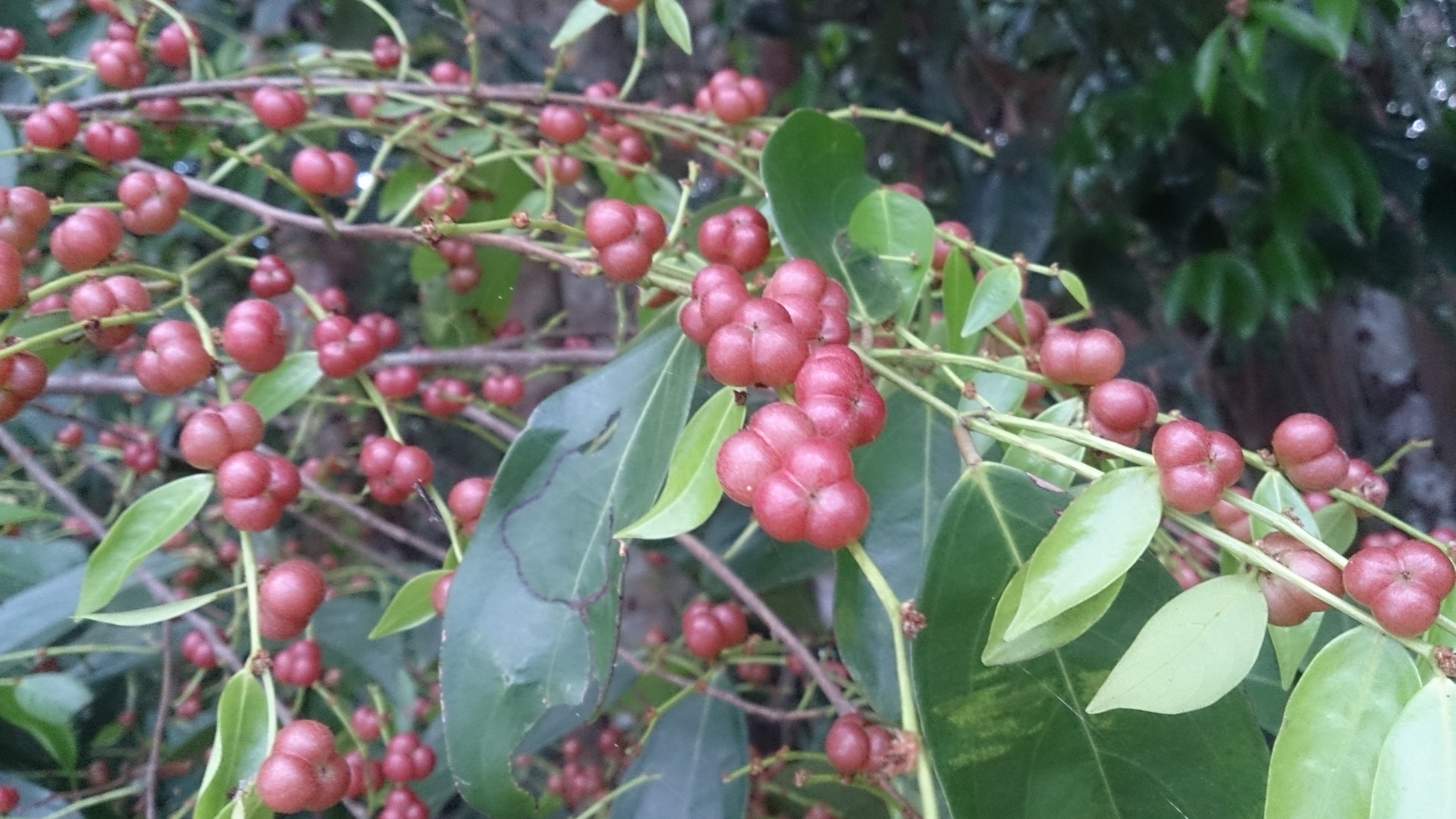
Champereia is a monotypic genus of shrubs or trees in the family Opiliaceae (order Santalales), described in 1844 (some sources cite 1843) by the British botanist William Griffith in the Calcutta Journal of Natural History. The sole species, Champereia manillana (Blume) Merrill, is known by the common name false olive and the Chinese name 台湾山柚 (tai wan shan you). Plants are polygamous, reaching 2–10 m in height with glabrous branchlets and pale bark. Leaves are simple, ovate to lanceolate or oblong, 5–13 cm long, glabrous, and leathery to papery in texture. Inflorescences are axillary panicles 4–20 cm long, borne at defoliated nodes or directly on the trunk, with minute bracts. Flowers are 4- or 5-merous and unisexual or bisexual: bisexual flowers have reflexed tepals, an annular disk, and a semi-sunken ovary with a sessile stigma; female flowers have erect tepals, rudimentary stamens, and a lobed disk. The fruit is an ellipsoid drupe 1–2.5 cm long, orange-red to red when ripe, with fleshy mesocarp, woody endocarp, and an embryo bearing three cotyledons. Two varieties are recognised: var. manillana (shorter panicles, smaller drupes) and var. longistaminea (larger panicles, larger drupes). The genus was at one time treated under the synonym Yunnanopilia.
Distribution
Champereia is a monotypic genus with a single species (C. manillana) distributed across tropical and subtropical Asia. Its range extends from southern China (Guangxi, Yunnan) and Taiwan through mainland Southeast Asia (Myanmar, Thailand, Vietnam, Malaysia), the Andaman and Nicobar Islands of India, Indonesia, the Philippines, New Guinea, and Christmas Island. The variety var. longistaminea is restricted to Yunnan and Guangxi, while var. manillana occupies the remainder of the range.
Ecology
Champereia manillana grows in a variety of lowland to montane habitats including forests, thickets, hillsides, valleys, slopes, and coastal areas, from sea level up to 1300 m elevation. It is a tree of 2–10 m with flowering from February to June and fruiting from February to July.
Conservation
Champereia manillana is assessed as Least Concern (LC) on the IUCN Red List, evaluated in 2019 by Botanic Gardens Conservation International (BGCI) and the IUCN SSC Global Tree Specialist Group. The species has a wide distribution and no major threats are currently identified.
Taxonomy
The genus Champereia was established by William Griffith in 1844 (sometimes cited as 1843) in the Calcutta Journal of Natural History (vol. 4, p. 237). It belongs to the small pantropical family Opiliaceae within the order Santalales. The genus has at times been synonymised under Yunnanopilia (C. Y. Wu & D. Z. Li). The sole accepted species, C. manillana, was originally described from material in the Philippines; its basionym traces to Blume and was transferred to Champereia by Elmer Drew Merrill in 1912 (Philippine Journal of Science, C. 7: 233). The genus is polygamous and distinctive within Opiliaceae for its three-cotyledon embryo and paniculate inflorescences borne on older wood.










