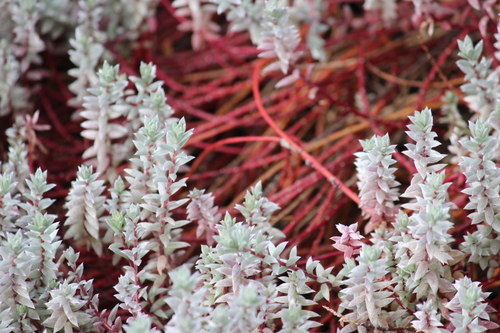
Chenolea is a small genus of flowering plants in the family Amaranthaceae (sometimes placed in Chenopodiaceae under traditional classification systems). It belongs to the order Caryophyllales, within the eudicot clade of angiosperms. The genus was described by Carl Peter Thunberg and contains two accepted species: Chenolea diffusa and Chenolea convallis. Both are native to Southern Africa. The plants are commonly known as Soutbosse in Afrikaans. iNaturalist records over 1,400 observations of Chenolea, indicating it is a relatively well-documented genus within its native range.
Distribution
Chenolea is native to Southern Africa. The two recognized species, Chenolea diffusa and Chenolea convallis, are both restricted to this region.
Taxonomy Notes
The family placement of Chenolea differs between classification systems. Wikipedia (following the APG IV system) places it in Amaranthaceae, while GBIF retains it in Chenopodiaceae. This is a well-known classification discrepancy: the APG system subsumes Chenopodiaceae within an expanded Amaranthaceae, whereas traditional systems treat them as separate families. The genus was described by Carl Peter Thunberg (Thunb.) and contains two accepted species.










