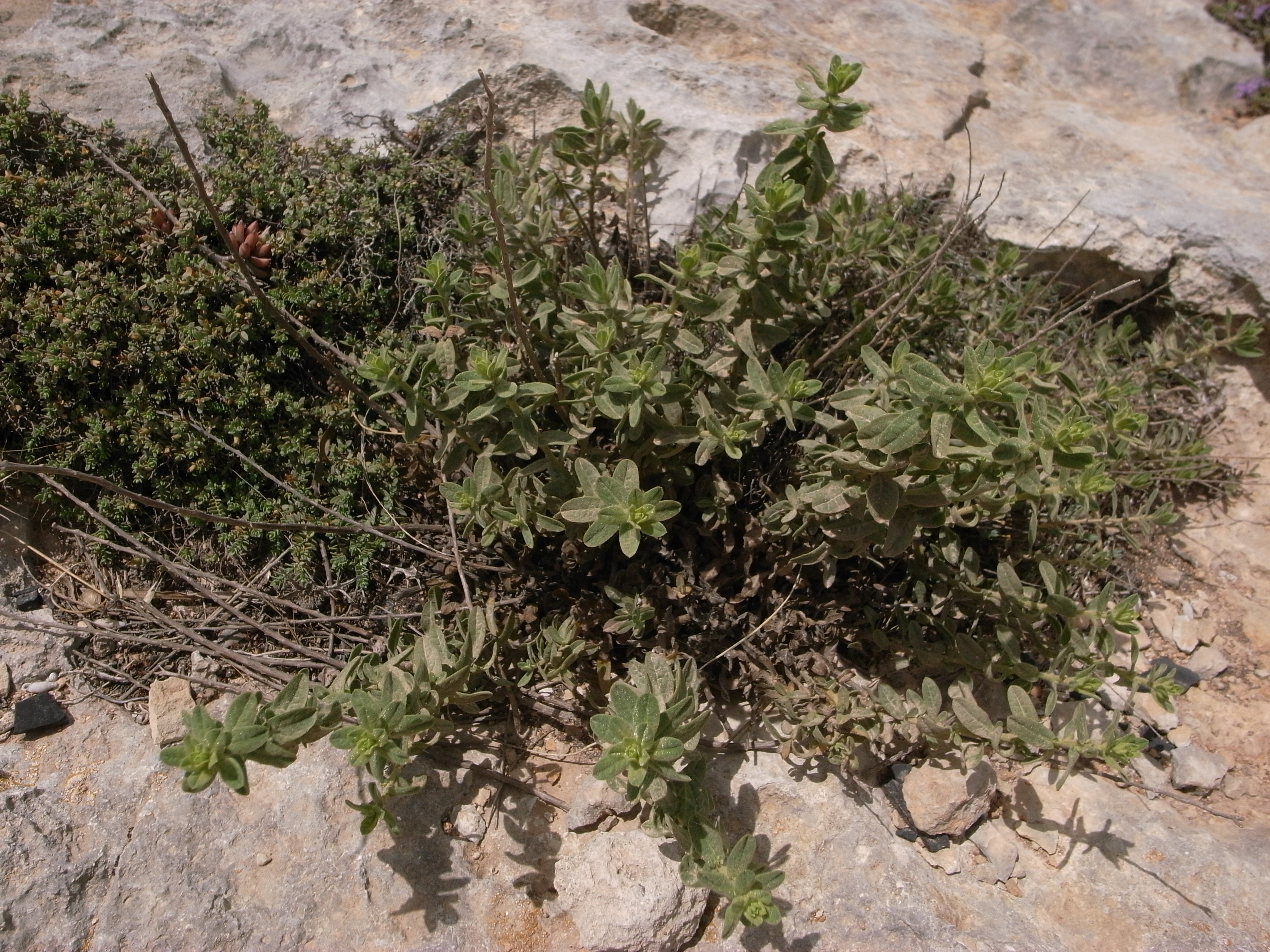
Chiliadenus is a genus of flowering plants in the family Asteraceae (order Asterales), placed in subfamily Asteroideae, tribe Inuleae, and subtribe Inulinae. The genus was described by Alexandre Henri Gabriel de Cassini in 1825, with Chiliadenus glutinosus (L.) Fourr. as its type species (originally published as Chiliadenus camphoratus Cass.). It comprises approximately 10 accepted species distributed across the Mediterranean basin.
Members of Chiliadenus are subshrubs or perennial herbs with a rhizomatous rootstock. Stems are erect or ascending, reaching up to 50 cm, and are typically branched in the upper portion. The vegetative parts are characteristically glandular and pubescent, with abundant multicellular hairs giving the plants a sticky texture. Leaves are alternate, sessile, oblong-lanceolate (5–30 × 1–3.7 mm), with entire, serrate, or dentate margins, and are puberulent-glandular on both surfaces.
The inflorescences are discoid, homogamous capitula (flower heads), either solitary or arranged in corymbose clusters. Ray florets are absent; the disc florets are tubular, yellow, with 4–5 short lobes. The involucre is cylindrical to cup-shaped with imbricate bracts, and the receptacle is naked (without paleae). Flowers measure 5.5–7.5 mm. The androecium consists of 5 stamens with connate, shortly spurred anthers. The fruit is an ellipsoid achene (2.5–3.5 mm) with 5 vascular bundles, topped by a pappus of capillary bristles (5.5–7.5 mm). The chromosome number is 2n=16. Flowering occurs from July to October. Pollination is entomogamous (primarily by butterflies), and seed dispersal occurs via ants (myrmecochory), animal attachment (zoochory), and wind (anemochory).
Notable species include C. glutinosus (the type, widespread in the western Mediterranean), C. bocconei (endemic to Malta), C. lopadusanus (endemic to Sicily), and C. montanus (ranging from Egypt to Saudi Arabia).
Etymology
The genus name Chiliadenus was established by the French botanist Alexandre Henri Gabriel de Cassini (1781–1832), who published it in 1825 in the Dictionnaire des Sciences Naturelles (ed. 2, vol. 34, p. 34). The name likely combines the Greek words chilioi (χίλιοι, “thousand”) and adēn (ἀδήν, “gland”), alluding to the abundant glandular hairs covering the leaves and stems — a feature noted in all regional flora descriptions. The type species was originally described as Chiliadenus camphoratus Cass., later recognised as a synonym of Chiliadenus glutinosus (L.) Fourr.
Distribution
Chiliadenus is a strictly Mediterranean genus. Species occur across the western and eastern basins: in Europe from Spain (including the Balearic Islands), Gibraltar, Andorra, southern France, Malta, and Sicily; in North Africa from Morocco, Algeria, Libya, and Egypt; and in the Middle East from Israel/Palestine, Jordan, Syria, Lebanon, and Saudi Arabia. C. glutinosus, the only species currently tracked in this database, is found in central, eastern, and southern Spain, the Balearic Islands, southern France, and northern Morocco, where it grows on calcareous rocks.
Ecology
Chiliadenus species typically inhabit calcareous rocky substrates in Mediterranean climates. C. glutinosus grows on limestone rocks (roquedos calcáreos) in the Subbética mountain range of southern Spain, flowering from July through October. The glandular, aromatic foliage — a defining feature of the genus — likely serves as a deterrent against herbivory. Pollination is entomogamous, primarily by diurnal and nocturnal butterflies. Seed dispersal employs multiple strategies: ants (myrmecochory) for short distances, animal fur attachment (zoochory), and wind-borne transport via the capillary pappus (anemochory).
Taxonomy
The genus was described by Cassini in 1825 (Dict. Sci. Nat., ed. 2, 34: 34) and placed in tribe Inuleae, subtribe Inulinae within Asteraceae subfamily Asteroideae. The type species, originally Chiliadenus camphoratus Cass., is now treated as a synonym of Chiliadenus glutinosus (L.) Fourr. GBIF recognises the genus with 11 descendant taxa. Several species were transferred to Chiliadenus from related genera (notably Jasonia) by the botanist Salvatore Brullo, who revised the genus in the late 20th century. The genus is closely allied to Inula and Dittrichia within the Inuleae tribe.










